


Interview: 'There's A Blurring Of That Fourth Wall': Actor Jamael Westman On TABLE 17
'Let's see what happens when two exes meet. Is it a joy, a disaster, or a little bit of both?'
After sold-out runs in New York and Los Angeles, Table 17 is making its UK debut at the Kiln Theatre. Written by Douglas Lyons and directed by Zhailon Levingston, the comedy follows exes Jada (Marisha Wallace) and Dallas (Jamael Westman) as they have dinner together, trying to figure out what went wrong in their relationship.
Recently, we had the chance to speak with Jamael Westman, who plays Dallas in Table 17. We discussed what it was like to prepare for the three-hander, the community that has been built around the Kiln Theatre and even the conversations he hopes that audiences have after seeing the play.
What made you want to be a part of Table 17?
The script! That's for any actor introduced to a piece. You could see the thing and be like, “Wow, that's an incredible show! I'd love to be in that.” I never saw it, but I read the script and I thought, “Yeah, this is right up my street.” The writing was so sharp and witty. And I connected with the journey of the characters, and with relationships - the ups and downs, the mistakes made, the forgiveness, the reconciliation, the messiness. Certainly in my younger years, for sure! And not only my own life, but my friends, family, things I see on TV. Relationships are difficult! Navigating each other's own vulnerabilities, aspects of themselves and ourselves that we don't feel comfortable with, being able to reveal those things to each other . . . The bravery of being honest.
So for those who might be unfamiliar with the play, can you tell us a bit about it and the character you play, Dallas?
Table 17 is the meeting of two exes over a dinner. Is it a mistake, or is it a great choice to reinvestigate, reappraise their relationship, why they became exes? Is there anything there? Also, this is table 17 in a restaurant bar called Bianca's, and the host of this place is River [Michael Rishawn], who is almost minding this relationship, or just constantly checking in as the evening progresses. They're like an angel of wisdom, sharpness and wit, just reading them for filth in different moments! That's Table 17. Let's see what happens when two exes meet. Is it a joy, a disaster, or a little bit of both?
The two exes are called Jada and Dallas. I play Dallas, and Dallas is the one that decided to reconnect with Jada to see if she wanted to meet up after the dust has settled - just to check in with someone who he shared a significant part of his life with. Which I don't think is unreasonable! Obviously things can end acrimoniously, but you'd always hope that you can have some semblance of a relationship with people who had such a significant role in your life.
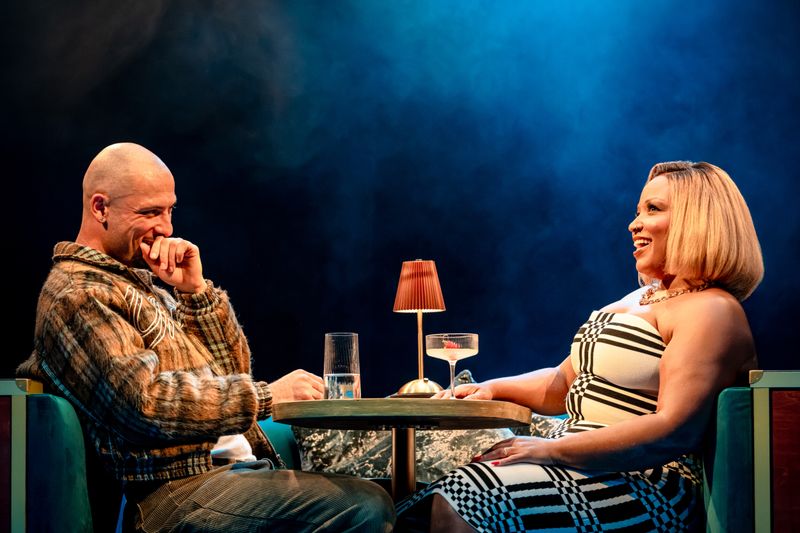
Photo credit: Steve Gregson
What is it like performing in a more intimate show like this versus something bigger like Hamilton [Westman starred as Alexander Hamilton in the original West End production]?
It's more exposing! With Hamilton - and I felt that from the get go in the early rehearsals - despite being a title character, I was sharing this experience. There was a company, and we all shared that. I always lent into the family that we had and the company that we were. Never felt the responsibility really lay on me, despite obvious appearances, which was wonderful. It gave me freedom to play, to discover and to give my all.
That being said, in Table 17, there's three of us, so immediately, it's just us three! And that has its own kind of giddiness that comes with it. But standing beside Marisha and Michael - very warm, very open, very generous - makes it so much easier to give your all.
Even when they're booing Dallas, I'm like, “It's a good time. Give me the boos! Feels good. I'm going to hit you with this monologue, and you might change your mind.” That has continuously been really special about this show - the audience and how they get to be a part of it and shape our experience. No show is ever the same, no matter what show you're doing. But it's never been more apparent and more palpable than doing this show.
What is it like performing at the Kiln Theatre, in a more intimate venue?
Vibes on vibes on vibes! Kiln Theatre community really knows how to bring the energy - they're giving levels! I got a lot of love for that. The area, it's like a second home whilst you're on a job. Anytime you spend time in a theatre, you're spending time with that community as well. And they bring in energy! People from all around London, whoever makes the journey, they're giving it. The Kiln's beautiful.
Speaking to Amit [Sharma], the artistic director, there's a desire to have that connection with the community. The desire of the show to connect with the community is reflected back by the community's desire to connect with us. So we're like having to lift heavy weights and get this audience to engage.
It's so perfect for the show, in the way that we stage the show as well. We're sometimes in the auditorium alongside that audience, but also, the tables are right up close. There's a blurring of that fourth wall - not only with the language, but with the way it's set and the way that the space is. We're all in it. We're all at the table, which is really special and an unforgettable experience.
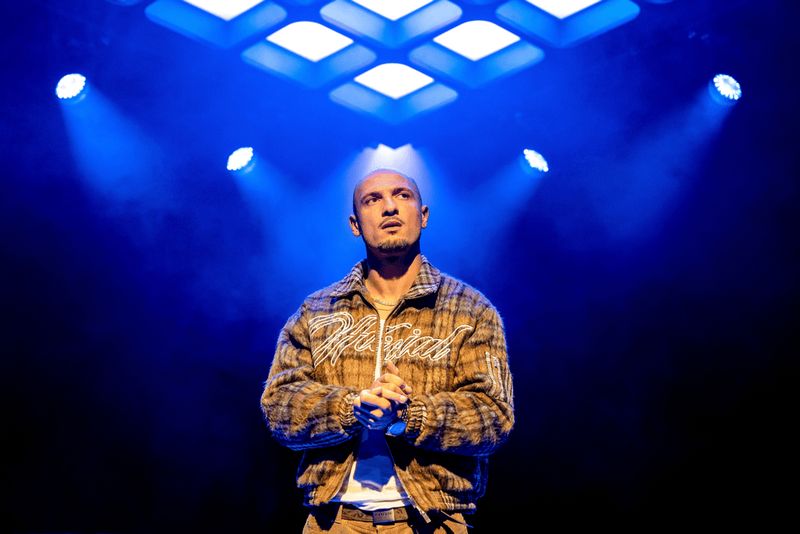
Photo credit: Steve Gregson
What do you hope audiences take away from Table 17?
Joy and laughter, for sure. The premise of any comedy is you want to be able to laugh. Comedy is a great means of opening up conversations about things that, for many in the moment and for years following, can be really hard to navigate - love, relationships, forgiveness, pain, hurt, betrayal, kindness, openness . . . All the things that come with love, and what love demands. The show really does investigate that and open up that conversation in all its brilliant ways, in messy ways. Jada and Dallas are not perfect, but as River says at the end, it's about the effort. And both of them make an effort to look each other in the eyes and see what's there, what was there, what happened, how they faced it, how they felt about it. Everyone deserves that with people they love, and also with themselves. It can just be looking in the mirror and asking yourself, “Am I loving myself enough? Am I being honest with myself?” I've made mistakes that have undermined myself, and I'll be honest about that. It doesn't necessarily have to be about someone you've loved. It's about your own love for yourself. So opening up those conversations.
Also, we all know a Jada and a Dallas, whether it's ourselves or someone else. People are in messy situations. We've all got our own lives and things that we’ve got to deal with. Even thinking about parents, sometimes our parents are the Jada and Dallas. There's whole generations and communities who are navigating love and relationships. So I’d want audiences to continue asking questions. It's never set in love. It's always a journey of growth, questioning and learning. So hopefully, the show sits in that and offers a space and incitement for more of that in our journey of love at the fundamental core of it, which is arguably why we're all here in some capacity. So how can we carry on that legacy, that light that sparks in the room that we have for each other?
And, in the world, sometimes it is black and white, particularly this period of time about the oppressor and the oppressed. Sometimes it's clear in love or in relationships who the oppressed are. The show plays on that in a way, in terms of who does the wrong and how it happens. It offers up questions in terms of how we see ourselves in each other. How we seem doesn't necessarily establish who we are. Being a man can mean lots of things, being a woman can mean lots of things, in a heteronormative sense. It doesn't have to be like that in terms of how relationships play out. And I'd say that across the board, gender doesn't mean everything in terms of how one loves, how one is loved and receives love. It can set a certain precedent, but it doesn't have to be. And there's something great about that, as well. There's endless possibilities to how love can exist and how we can be somewhere in there.
How would you describe Table 17 in one word?
Hope. We need hope in this world now more than ever, because hope causes people to try to do good - that's certainly what this show tries to do as well. These characters lean into hope, even in the height of despair. There's a lot of despair in the world, and we need hope and action to challenge that. The show offers that.
Table 17 runs until 24 October at the Kiln Theatre

Sign up for all the news on the Fall season, discounts & more...
|
Powered by

|