

Review: 4.48 PSYCHOSIS, Royal Ballet & Opera
A decade after its debut, Phillip Venables' dark opera based on Sarah Kane's final play"comes home".
 The idea that “art is not a mirror but a hammer” has been attributed to Bertolt Brecht, deployed by Leon Trotsky and could serve as the epitaph for Sarah Kane’s repertoire, not least her final work.
The highly divisive playwright — demonised by the press, praised by peers like Harold Pinter and Caryl Churchill — never saw 4.48 Psychosis staged. Completed in the months before her suicide at the age of 28, it premiered at the Royal Court in 2000 before being turned by Philip Venables in 2016 into his first opera. As part of his PhD, the composer adapted Kane’s text and created a heart-pounding piece which, paired with Hannah Clark’s eye-catching design and Ted Huffman’s fluid direction, delivers an engagingly immersive experience.
Venables has described how reading the playtext inspired him after he realised that it was “a libretto just waiting to be set, full of music.” He’s not wrong. He has pruned the text but kept the play’s episodic, splintered nature. Its 24 sections tumble one after another, sometimes circling back on themselves, sometimes falling further into the depths of a clinically depressed mind.
Co-commissioned by the Royal Opera House and Guildhall School of Music & Drama, it has taken a full decade for 4.48 Psychosis to “come home” to Covent Garden having already been staged twice at the Lyric Hammersmith as well as in the US, Germany and France. Its arrival is a timely one: the play was revived last year by the Royal Court for its 25th anniversary and the opera opens the night after a similarly bleak effort at the Coliseum.
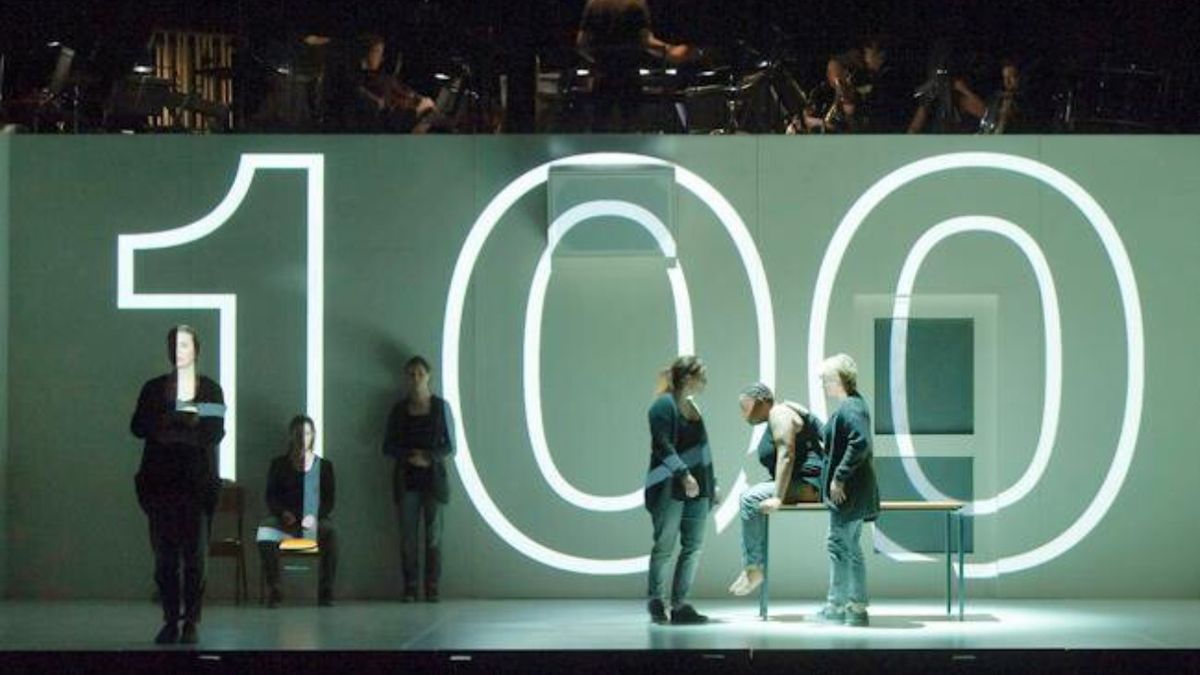
An initially sparse stage is populated by half a dozen chairs and a table. Around them are white painted walls marked by a clock (the title refers to the daily point where Kane felt that sanity was briefly within her reach) and a PA speaker from which muzak occasionally blurts. Everything changes when Pierre Martin’s sharp video work illuminates the set. Projected numbers count down rapidly and a raft of internal monologue, heated dialogue and a bold stream of medications appears from behind the six singers (Veena Akama-Makia, Sophia Burgos, Hannah Edmunds, Marta Fontanals-Simmons, Jacquelyn Stucker and Lauren Young).
The way that the dialogues between patient and doctor are punctuated is a true masterstroke from Venables. Kane tells us that “depression is anger” and he translates that straight into furious composition. Howls of frustration are given dramatic emphasis by the angry pounding of a drummer seated far right — usually with sticks, sometimes with fists — while the medic’s response is underscored by the beat of a hammer on a metal pole or a saw grinding through wood from far left. The anguish is fleshed out in a way beyond theatre, beyond any written words. While Kane was never shy of having her characters inflict extreme physical depravity on one another, here the violence is purely mental and self-inflicted.
Canadian conductor Naomi Woo directs the Chroma Ensemble situated atop the stage. Standing midway between the two percussionists who carry the dialogue, her measured waving of the arms comes across as that of a mediator looking to find middle ground between two fatigued combatants. This is a difficult score that asks for pinpoint precision to match the text being flashed up by Martin while delivering a complex arrangement intended to reflect the protagonist's highly mixed emotional landscape. Chroma rise to the challenge and more, delivering a convincingly dark tone throughout.
The biggest fault here (and it’s a minor one) is that the final act cleaves too closely to Kane’s real life. Whether 4.48 Psychosis was her idea of a suicide note will never be known, but having a singer climbing barefoot onto a table towards a noose (something not in the original text and which points to two aspects of how the playwright killed herself) seems a cruel step too far.
Trotsky tempered the famous quote by noting that even wielding a hammer is learned with the help of a mirror. Kane handles her hammer in typical fashion here but Venables’s ten-year-old opera remains a superbly polished mirror.
4.48 Psychosis continues until 25 October.
Photo credit: Stephen Cummiskey
Sign up for all the news on the Fall season, discounts & more...







Reader Reviews
To post a comment, you must register and login.