


Review: CONFETTI KIDS at The Chapel
Aurora Behlke’s New Play Examines the Effects of Nuclear Fallout
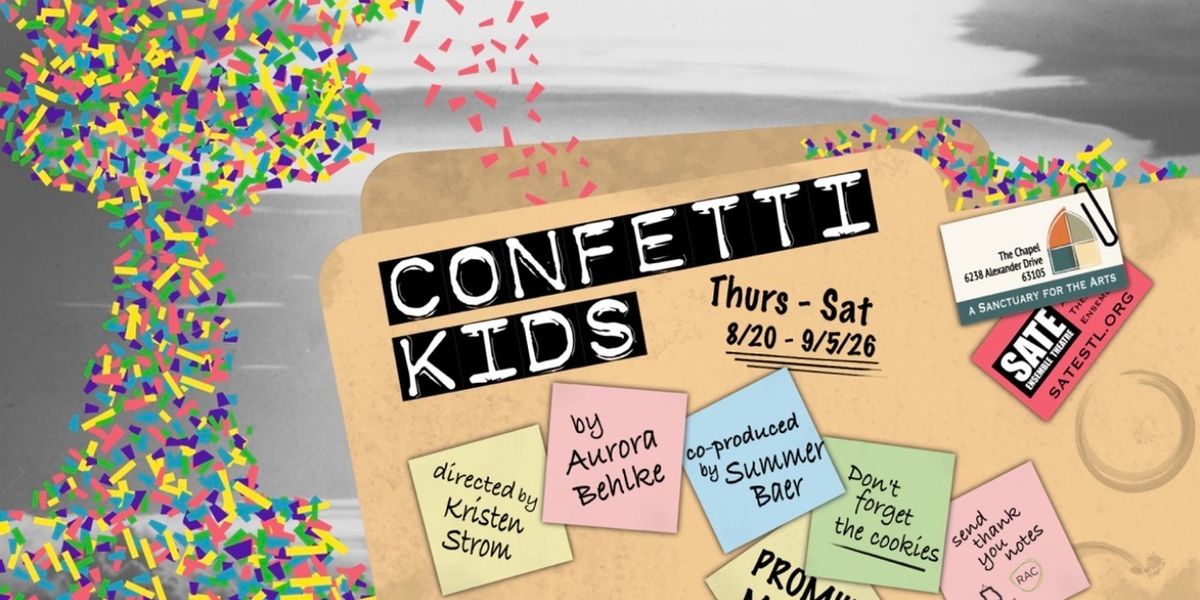
Just off Patterson Lane in Florissant, Missouri sits a storage building. The Hazelwood School District Logistics Center on Jana Lane sits next to Coldwater Creek, a tributary that was contaminated by a nuclear spill. The building, formerly known as Jana Elementary School, was repurposed by the district in 2022 following the discovery that then school grounds had also become contaminated.
Living near Coldwater Creek exposed residents of the St. Louis suburb to toxic levels of radiation. According to a 2025 article in the Journal of the American Medical Association (JAMA), living near the creek, or within its floodplain, more than doubled the risk of radiosensitive cancers for adults who were exposed as children to the radioactive waste.
Aurora Behlke’s new play, Confetti Kids, is a fictional account of a former Jana elementary student who is diagnosed with multiple myeloma. The protagonist’s cancer is presumed to have been caused by her exposure to radioactive byproducts when she was a student at the school.
Behlke’s historical discussion of nuclear development programs, her account of the creek’s contamination, her scripted monologue for her protagonist, and the relationship between the protagonist as her best friend are gripping. Her story is especially compelling for folks who grew up in North St. Louis County and have knowledge of the situation.
Her story falls short for those unfamiliar with the accident. There are scripted character issues with the protagonist’s daughter and her teacher, and the forced theatrical metaphor about nuclear fallout falls apart due to the implausibilities in Behlke’s narrative.
St. Louis Theater Circle Award winner Nicole Angeli stars as Dr. Rachel Graves a nuclear scientist and professor who developed cancer from her exposure to the creek or schoolyard’s toxins. Angeli paints Rachel as a patient firmly rooted in denial and wrestling through the early stages of psychological acceptance of her disease. The scientific scholar is also the mother of a high school senior. She refuses to tell her daughter about her illness despite the pleas of her best friend Daniel who is also her physician.
Daniel, played by Adam Flores, begs his friend to start treatment for her illness. His arguments are both clinically astute and emotionally grounded. Flores conveys Daniel’s distressing anguish that he cannot get through to his friend.
Rachel’s maternal instinct compels her to protect her teenage daughter Maya who is dealing with adolescent high school drama. The mother perceives Maya as a fragile girl. She doesn’t want to flip Maya’s apple cart while she is finishing her high school year.
Maya is a confident communicator. She has the composure, conviction, and maturity of woman decades older than a high school senior. It may have been a directorial decision or Tia René Williams’ characterization, but Maya’s gravitas lacks the insecurity one would expect from a high school senior. It is impossible to envision that Behlke’s teenage character is so fragile that her mother needs to shelter and buffer her. Williams is simply not believable as a teenager.
Vera, the high school teacher, is an overzealous, new in career, professional. The teacher, played with unrestrained enthusiasm by Hailey Medrano, is the catalyst that encourages Dr. Graves to share her academic knowledge and personal story at a PTA meeting that coincidentally happens to have been scheduled on Prom night.
It is unlikely that a new-in-career educator would be the administrative liaison for the school’s PTA, and that a meeting addressing a significant health crisis would be scheduled on a weekend evening that coincides with the senior prom.
Confetti Kids addresses a serious health crisis. The contaminated Coldwater Creek has been associated with increased cancer risks and premature mortality. Aurora Behlke’s script effectively examines the risks associated with nuclear research and the safe handling of nuclear waste. Behlke’s play would be more compelling if written as either a monologue or a two-hander between a patient and her doctor.
Angeli’s monologue examining the history of the nuclear development program, supported by Eric Satterfield’s video/projection designs, tells of the devastating effects on humanity. It is one of the most compelling parts of director Kristen Strom’s staging.
The playwrights' attempts at a theatrical metaphor linking nuclear fallout to confetti bloats the script and the connection to the high school dance feels contrived. However, the confetti comparison does give Strom, lighting designer Theresa Comstock, and props manager Cecile “Cece” Entz the opportunity to create some visually impressive imagery.
Confetti Kids, presented by SATE, continues at The Chapel through Saturday, September 5, 2026. Visit sate.org for more information.

Sign up for all the news on the Fall season, discounts & more...

|
Alex Edelman’s Just for Us New Jewish Theatre (NJT) (10/01-10/18) |

|
Come From Away Kirkwood Pac (9/18-10/18) |

|
Mamma Mia! The Fabulous Fox Theatre (3/30-4/04) |
|
|
Mamma Mia! Fox Theatre (3/30-4/04) |

|
Parsons Dance Touhill Performing Arts Center (4/10-4/10) |
|
Wicked Fox Theatre (5/12-5/30) |

|
Amadeus Gaslight (2/05-2/21) |

|
Rocky Horror Picture Show Original Cast Spooktacular Tour with Barry Bostwick, Nell Campbell, and Patricia Quinn The Fabulous Fox Theatre (10/06-10/06) |

|
Ballet Hispánico New York Touhill Performing Arts Center (11/14-11/14) |

|
The Color Purple (The Musical) The St. Louis Black Repertory Company (9/09-9/27) |

Reader Reviews
To post a comment, you must register and login.