
Review: BLOOD/SUCKER at 12th Ave Arts
What's scarier: a shape-shifting demon, or the American pubic school system?
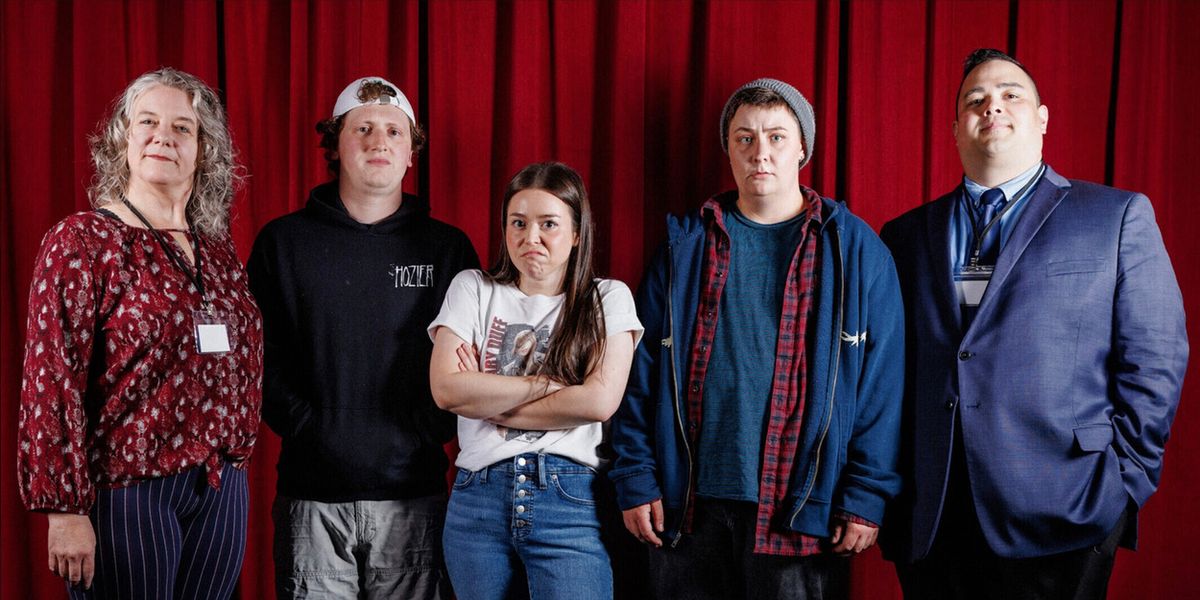
In Washington Ensemble Theatre’s Blood/Sucker, there’s something lurking in the shadows of the public high school, something that wants to suck the life out of all who roam the halls, teachers and students alike. Is it gun violence? Internet trolls? Bullying? Racism? Transphobia? Food insecurity? Academic inequity? Just being a person in America? Or perhaps, on top of all of that, something much spookier? Well, it's all of it.
It's 2021, and history teacher Ryan Galay is doing his best. He cares very deeply, and has the nerve to try and teach his students a perspective that isn’t exclusively Western. His class, Asian-American history, is in jeopardy, much to the chagrin of his students. It’s student Abby Davis’ favorite class, and it’s easy to see why. As a teacher, he’s present, progressive, caring, and empathetic. Abby doesn’t get a lot of consideration and care from her other teachers–none of them bothered to even ask if she had eaten today.
But sweet Mr. Galay receives backlash from the community about his syllabus, everyone in a froth about CRT. Specifically, Mr. Galay teaches about how the CIA used psychological warfare against Filipino resistance forces during the Hukbalahap Rebellion in the early 1950s by weaponizing their fears of the mythical aswangs (shape-shifting monsters). The principal, Ms. Hilary Johnson, wants to do the right thing, but struggles to negotiate the pressure from the parents with the value in the coursework. And the death threats aren’t helping. The aforementioned aswang does eventually make its presence known, and its arrival shifts the show from social-horror-by-implication into something with real stakes: bodies start turning up.
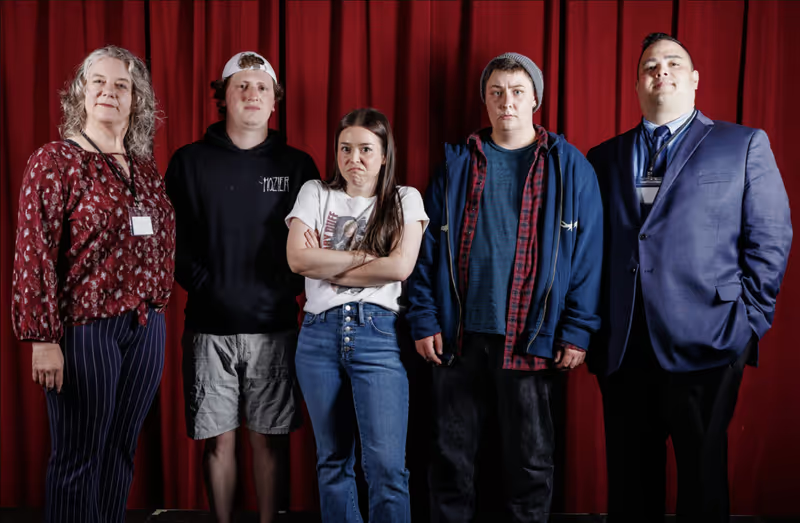
Monty Rozema, and Mario Orallo-Molinaro in Blood/Sucker.
Photo by Brett Love.
Written by Anamaria Guerzon and directed by Sophia Franzella, this horror dramedy about the post-COVID American school system includes fresh, high-craft elements that elevate the production. For one, most of the actors play two distinct characters: one student and one faculty member. And they do so with aplomb. This cast ensemble seamlessly pivots from one character to another. Rachel Guyer-Mafune’s Abby is high-octane and overwhelmed, while her Mrs. Langley, Ryan Galay’s only confidant in the teacher’s lounge, is organized and jaded. Montey Rozema plays Abby’s kind and eager friend Elias as well as Bob, a brooding and enigmatic custodian. William Eames plays two antagonistic, what’s-wrong-with-America characters: Martin, the teen hell bent on tormenting his peers, and the pushy gym teacher Mr. Piper whose vocabulary is riddled with microaggressions. And this isn’t to say that those who played one character weren’t impressive: Peggy Gannon’s Principal Johnson starts as painfully diplomatic, but shifts to contain multitudes. And Mario Orallo-Molinaro’s Ryan Galay is so big hearted and invested in his students that you wish you had him as a teacher in high school. With high-craft performances came touching, compelling relationships between characters (some, fittingly, unexpected), which are key in a show about the importance of compassion.
The other elevating factor in this production is the stagecraft. Layered over the accurate set design of the high school (by set designer Jeremy Hollis) are lush visual storytelling techniques, including old-school overhead transparencies, shadows, puppets (shoutout puppeteer Erin Owens), and projected laptop screens. It’s a textured, eerie world full of dimensions and colors. For a single-setting story, the environment feels far from static.
Though there are gory and creepy elements to the play, it’s not frightening, per se, which made the writing issues more apparent. It is noble and important to address the issues surfaced in this play, but when so many of them are addressed at once, the message gets muddled.
Take the syllabus conflict: the community’s pushback against critical race theory is a real, complex issue that could have anchored the entire play. But the show doesn’t stop there. There’s doxxing. Deadnaming. Death threats. Gun violence. Food insecurity. Bullying. Each issue is legible and well-observed on its own, but stacked together, they become a jumble and the show’s message gets murky. That said, it does create that haunted house feeling of a new horror around every corner. They’re just social horrors rather than ghouls and guys with chainsaws. However, if that’s the concept, that the American school system is a haunted house, then the show should be scarier.
Ultimately, Blood/Sucker is worth seeing. Its message is familiar — be kind to people, the systems we've built are failing everyone in them — but the horror framing is a fresh take on a familiar message.
Blood/Sucker performs at 12th Ave Arts through September 21, 2026. For tickets and information, visit https://washingtonensemble.org/blood-sucker/.
Prefer BroadwayWorld in Google Search?
Add us as a preferred source so our stories show up more often in Top Stories and Google’s AI answers — for you.
Sign up for all the news on the Fall season, discounts & more...

|
Eureka Day Leo K. Theater (9/24-11/15) |
|
Our Town & Sanctuary City State Theater (10/02-11/01) |

|
"Pig Farm" (a staged experience) Seattle Open Arts Space (10/09-10/10) |
|
This Is Halloween The Triple Door (10/15-10/31) |
|
Waitress Washington Center for the Performing Arts (6/23-6/24) |
|
The Velvet Tropicana Intiman Theatre (4/01-4/04) |
|
RAGTIME Village Theatre (9/15-10/18) |
|
Poe Unexpected: Edgar Allan Poe Improvised Unexpected Productions Improv (10/02-10/31) |
|
PYG or the mis-edumacation of Dorian Belle ArtsWest (6/10-7/03) |

|
Village Theatre Presents: My Funny Valentine Village Theatre (2/13-2/13) |

Reader Reviews
To post a comment, you must register and login.