


Review: BOEING BOEING at Turner Theater
Performances take place through April 4.
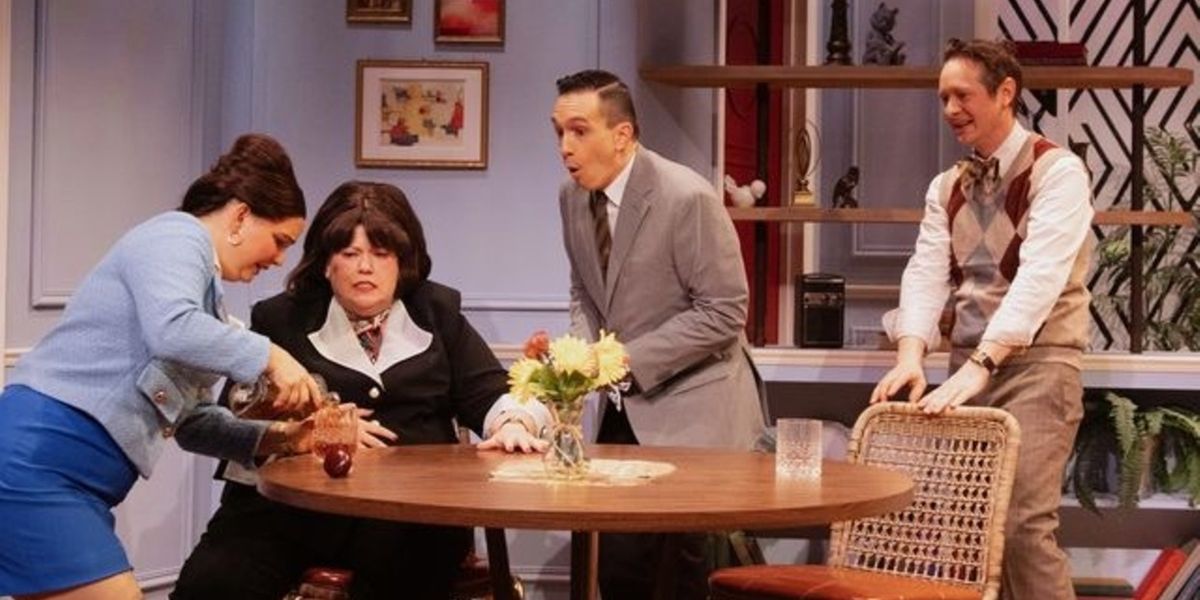
Before the play begins, a bit of context is warranted for those who may know this title only from its cinematic incarnation. Boeing Boeing is a farce written by French playwright Marc Camoletti, with an English-language adaptation translated by Beverley Cross. It was first staged in London at The Apollo Theatre in 1962, eventually running for seven years. It was so wildly popular that by 1991, the play was listed in the Guinness Book of World Records as the most-performed French play throughout the world.
The film Boeing Boeing became a 1965 American romantic comedy of misunderstandings and innuendos starring Tony Curtis and Jerry Lewis. It was a lively, if imperfect, translation of the stage material to screen. The story is a bedroom farce without the sex; a prolonged tease rooted in the comedic angst of deception. The film has its charms, but the stage is where this storyline truly takes flight via the physical intimacy of a live audience, slamming doors echoing through the house, and the performer's choreographed chaos constantly moving throughout the play, in one room and out another. Boeing Boeing was born for the theater, and it is down the theater runway we go.
The play is set in the 1960s and focuses on bachelor Bernard, who has a flat in Paris and three alluring airline stewardesses engaged to him, unaware of each other. Bernard’s life becomes even more complicated when his friend Robert comes to stay, as factors like unpredictable weather and the commissioning of a new state-of-the-art Boeing jet disrupt his carefully planned escapades. As fate would have it, all three fiancée stewardesses end up in the same city simultaneously, and catastrophe looms. It is, on paper, the most gloriously absurd of premises. On stage, in the right hands, it is an absolute thunderstorm of comic genius.
Bernard, played with swaggering, clock-watching, airline timetable intensity by Dustin Davis, is the engine of the entire machine. Davis finds precisely the right register: not a villain, not quite a buffoon, but a man of supreme and misplaced confidence, who genuinely believes his elaborate scheduling system of managing three fiancées is a triumph of modern logic. His physical comedy in Act Two, as the walls of his carefully constructed world begin to close in, is breathtaking - arms flailing, voice dropping to frantic whispers, eyes darting to every door simultaneously. He earns every laugh he gets, and he gets many.
Robert, Bernard's hapless, wide-eyed friend who arrives from the countryside like a lamb walking into a lion's den, is played by Brian Michael Jones with wonderful, rubber-limbed bewilderment. His character plays the reactor, and his job is to be astonished repeatedly with escalation each time to the antics going on around him. He does it with such committed freshness each time that the audience never tires of his disbelief. His slow-burning realization that he has stumbled into chaos, and his even slower realization that he rather enjoys it, is a masterclass in comic timing.
Berthe, the long-suffering housekeeper who has seen it all and disapproves of every inch of it, is given magnificent life by Rachel Agee. This is the role that can make or break a production. Berthe is the audience's surrogate, the one sane soul in an insane household, and Agee plays her with a gloriously weary, dry authority that stops the show cold on no fewer than three or four occasions. Her deadpan delivery of the line about the sauerkraut drew the longest laugh of the evening. Agee’s French accent was the perfect touch that truly brought her character’s sarcastic and blunt nature to life. Brava!
The three fiancées, Gloria (the brash American from New York, played with delicious overconfidence by Mariah Parris), Gabriella (the tempestuous Italian, brought to vivid, operatic life by Annabelle Fox), and Gretchen (the relentlessly efficient German, played with hysterical rigidity by Jordan Tudor), form a brilliant trio of distinct comic archetypes. Each actress carves out her character's nationality and native accents with affectionate exaggeration, while never crossing into mean-spiritedness. When all three are finally on stage together in the second act, the orchestration of their entrances and exits is nothing short of a miracle in theatrical choreography.
Director Megan Murphy Chambers deserves enormous credit for keeping the tempo of this production precisely where it needs to be, relentless but never breathless. Farce is one of the most unforgiving dramatic forms, a beat too slow, and the whole soufflé collapses. Chambers has clearly drilled her cast with a metronome's precision. The door-works alone (and in farce, the doors are the drama) are impeccably staged. Every slam, every near-miss, every miraculous last-second escape lands with precision and intention.
Scenic Designers Andrew R. Cohen and Brandon Roak outdid themselves. In this play, the scenic designers’ success is measured by how well they balance the high-stakes machinery of a farce with the stylish aesthetics of a 1960s Parisian bachelor pad. The set is not just a backdrop; it is a functional instrument that must facilitate this complex, high-speed, physical comedy. The play is a classic door farce, and the set must feature several distinct doors. The doors must also be incredibly sturdy to withstand the constant slamming without shaking the rest of the scenery. The placement of these doors must also allow for the carousel of characters entering and exiting with split-second timing. The stage setting felt sleek and sophisticated and ultramodern for the period. The beautiful design felt like a playground that enhanced rather than hindered the actors’ physical comedy. Often in a play when there are no scene changes, the audience can suffer from scene fatigue, but that’s not the case with this set. Certainly, all the commotion on the stage from the actors’ movements kept the audience entertained, so it is important to note that the pleasing set and interesting props made this production easy on the eyes and believable.
Lighting designer Darren E. Levin makes inspired choices throughout. The apartment is bathed in a warm, golden mid-century glow that perfectly evokes the era's swinging optimism, while subtle, almost subliminal shifts in color temperature signal the emotional temperature of each scene. It seemed that when chaos reaches its peak in Act Two, a barely perceptible tightening of the light around Bernard creates a wonderful, prison-like claustrophobia that underscores his predicament without announcing itself. Levin’s work shows tremendous coordination with the director, which kept the ambience and energy true to the play's storyline.
Costume manager Devon Renee Spencer showcased her creative flair for designing costumes that enhanced and highlighted the actor’s persona. Each of the three stewardesses arrives in a uniform that is not only visually distinct (fiery American red, white, and blue, Italian royal blues, and Germanic blue-and-gold) but also subtly telegraphs the personality beneath the fabric. Gloria's uniform is slightly too tight across the shoulders, a hint of impatience about to burst at the seams. Gabriella's is dramatically tailored, all drama and gesture. Gretchen's is pressed to within an inch of its life, not a button out of place. Bernard's suits, meanwhile, become progressively more rumpled as the evening wears on, a quiet sartorial joke that rewards the observant eye.
No review of a play in constant motion like Boeing Boeing would be complete without acknowledging the unsung architect behind every perfectly timed entrance and exit, Stage Manager Marlee Shelton. In a production where the entire comic machinery depends on split-second precision, the stage manager is, in every meaningful sense, the real director once the curtain goes up. Shelton's work is invisible by design, and that invisibility is itself the achievement. Every prop and the revolving trays of food whisked on and off by a perpetually exasperated Berthe appear exactly where and when they must, without hesitation or fumble. The calling of cues, the coordination of three actresses moving through backstage corridors like aircraft in a holding pattern, the management of a cast whose blocking demands military-grade logistics - all of it runs with the quiet, confident authority of a professional who has mapped every contingency. In a farce, chaos is the product on stage. Backstage, only order will do. Shelton delivered that order flawlessly.
After more than six decades, Boeing Boeing remains one of the finest farces ever written, and this production honors it beautifully. It is fast, furious, and ferociously funny. If you have not yet secured your ticket, I suggest you consult your flight attendant, grab your seat, buckle up, and enjoy the ride. (turbulence and wind shear are expected)
Special announcement: I would like to add a welcome and congratulations to Mark Fleischer, recently added as Executive Director, as part of Studio Tenn’s expansion and leadership structure. Studio Tenn’s Board of Directors created this role to support the company’s next chapter of development. “Studio Tenn’s artistic ambitions continue to expand,” said Artistic Director Patrick Cassidy. “What excites me about partnering with Mark is that he understands both the artistic process and the operational framework required to sustain it. Together, we are focused on elevating Studio Tenn’s regional and national profile while remaining deeply rooted in the community we serve.” A recent press release stated, “Fleischer currently serves as Executive Producer of Pittsburgh Civic Light Opera, one of the nation’s largest regional producers of musical theatre. He has also held senior leadership roles at Adirondack Theatre Festival in New York and Plano Repertory Theatre in Texas, consistently pairing artistic ambition with operational discipline and civic engagement. Fleischer will conclude 12 years of leadership at Pittsburgh CLO and will remain engaged at Pittsburgh CLO through its summer season, while beginning strategic engagement in Franklin in preparation for Studio Tenn’s 2026-27 season, which takes the Turner Theater stage in October”.
Studio Tenn’s production of Boeing Boeing takes flight on the Turner Theater concourse in the Factory of Franklin from March 19, 2026, landing its final performance on April 4, 2026.

Sign up for all the news on the Summer season, discounts & more...

|
Giselle TPAC Polk Theater (10/02-10/04) |

|
Moon Over Buffalo Tellico Community Playhouse (9/03-9/20) |
|
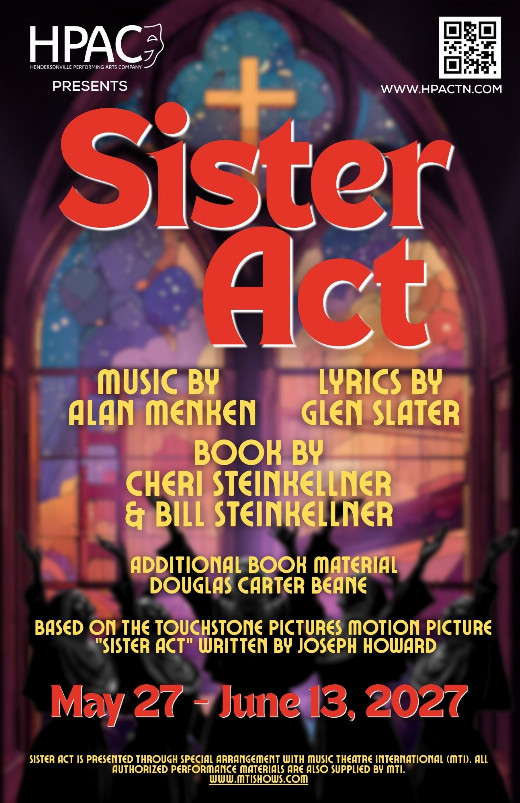
Sister Act Hendersonville Performing Arts Company (5/27-6/13) |

|
The Night Shift Before Christmas The Circuit Playhouse (11/20-12/20) |

|
Five Finger Death Punch, Cody Jinks & Eva Under Fire FirstBank Amphitheater (10/08-10/08) |
|
Come From Away Chattanooga Theatre Centre (9/01-9/30) |
|
Les Miserables Playhouse on the Square (5/28-6/27) |
|
ATRIUM TheatreWorks@TheSquare (1/08-1/24) |
|
An Enemy of the People The Circuit Playhouse (9/11-10/04) |

|
Ain't Too Proud Playhouse on the Square (3/26-4/18) |

Reader Reviews
To post a comment, you must register and login.