


REVIEW: The Festival d'Avignon Presents BÂTIR By Salim Djaferi and Clément Papachristou
The result is not merely an act of remembrance, but the possibility of a more honest reckoning.
Some performances in Avignon require me to put on my Euro-goggles. Sometimes the adjustment is one of taste: comedy, for instance, varies dramatically between American and continental European sensibilities. Other times, it is a matter of social vocabulary. Race functions very differently in American and European public discourse. I've been reprimanded in France for referring directly to "race" (a commonplace term in American conversation) because, as one friend insisted, "We are one race, the human race." On another occasion, I explained to a former professor the demographic voting patterns of the American electorate. He was scandalized. "How do you have this information? How is this legal?"
Where many Americans readily acknowledge race as a central organizing principle of public life, the French republican tradition often presents the state as color-blind and universalist, making racial categories themselves suspect. Salim Djaferi and Clément Papachristou's Bâtir, now performing at the Festival d'Avignon's Théâtre Benoît XII, patiently reveals the implicit and explicit legacies of racism embedded within France's universalist ideal.
The vocabulary surrounding race continues to evolve. In the United States, "people of color" has become the preferred terminology. In francophone Europe, personnes racialisées ("racialized people") has entered common usage. The distinction is significant: to be "racialized" describes something done to a person rather than an identity they choose to embrace. This summary inevitably simplifies a complex intellectual history, and Djaferi himself treats the language with considerably greater precision. He is, after all, a researcher. His performance unfolds through citations, archival documents, interviews, and meticulous historical inquiry.
Djaferi begins by describing the cité where he grew up in the banlieue. For American audiences, the closest approximation might be government housing in an outer borough, though the comparison remains imperfect. He outlines the standardized architecture of these housing projects before recounting his surprise at discovering striking similarities between their design and French colonial urban planning in Algeria.
That realization leads him to Algeria and to Diar el Mahçoul ("Promises Kept"), a housing development conceived as a site of coexistence between French settlers and indigenous Algerians. Yet coexistence did not mean integration. A single street divided the development: Algerian residents occupied cramped apartments with smaller windows, while French residents overlooked the Mediterranean. Contact existed, but it was carefully ordered, hierarchical, and segregated.
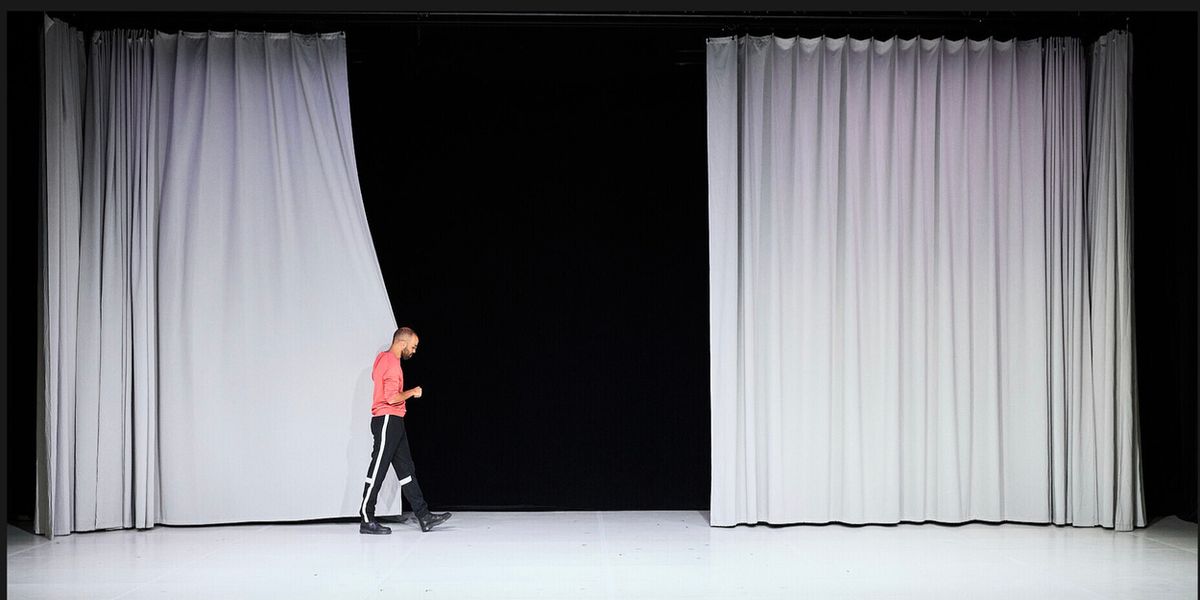
Djaferi presents this research with the measured clarity of a TED Talk. His delivery is patient and deliberate. Justine Bougerol and Silvio Palomo's clinical set surrounds him with white curtains positioned stage left, stage right, and upstage. At times throughout the performance, these curtains advance downstage, continually reframing the space. Their stark simplicity directs attention toward geometry, the geometry that structures both the stage and the modern cité.
As Djaferi explains the logic of urban planning, he accompanies his narration with repeated, mechanical gestures that mirror the regulated precision of architectural design. Beneath this objectivity, he examines subjective experiences. Interviews with his mother recount her family's experience navigating life in the banlieue, grounding the piece's historical argument.
When Djaferi recalls the demolition of the tower where he grew up, actor Sasha Martelli enters as a well-meaning but fundamentally uncomprehending advocate for its destruction. Martelli injects an energetic spontaneity into an otherwise rigorously controlled performance. His exuberance becomes a welcome splash of color across an intentionally monochromatic canvas.
What Martelli's character fails to grasp is that the cité is not simply a place to escape. It is home. Yet its residents, occupying an often precarious position as simultaneously Algerian, Muslim, and French, are repeatedly reminded through both policy and architecture that they do not fully belong. The violence of that exclusion becomes literal when Djaferi recounts an encounter with the police. Attempting to file a complaint only compounds the trauma: officers falsely accuse him of trying to flee.
He then returns to the same measured gestures that earlier mapped the geometry of the cité. Gradually, those movements transform into the signals of a traffic officer. Then, aided by Laurie Fouvet's lighting, the movements develop into the expressive vocabulary of vogue. The state may struggle to imagine a place for personnes racialisées, but they nevertheless build communities, create art, occupy space, and insist upon their own visibility.
Americans are often criticized for seeing race everywhere. Newspapers across the world routinely describe the United States as obsessed with racial identity. This has given many of us a fluency in racial dynamics. It shapes much of our literature, music, theatre, and political life. This has resulted in backlash, culture warring, and policy regression. Though it remains impossible to ignore.
In much of Western Europe, by contrast, race is more often obscured through the language of bureaucracy, universalism, and urban planning. Bâtir carefully strips away that veneer. Djaferi's performance presents the presence of French racism from city planning to administrative procedure to everyday experience, revealing how structures that present themselves as neutral continue to produce unequal opportunities. By weaving together scholarship and autobiography, he excavates histories buried beneath concrete and bureaucracy alike. The result is not merely an act of remembrance, but the possibility of a more honest reckoning.
Photo Credit: Christophe Raynaud de Lage
Recevez l'actualité de Broadway sur WhatsApp
Recevez les dernières mises à jour, les nouvelles de dernière minute et une couverture exclusive directement dans l’application.

|
ANNE BAQUET CHANTE AU PARADIS THEATRE PARADIS DU LUCERNAIRE (6/17-8/23) |
|
STEPHAN EICHER TH DU ROND POINT-SALLE RENAUD BARRAULT (9/30-10/04) |
|
LE GUIDE DU PARFAIT GENTLEMAN ASSASSIN THEATRE DU PALAIS ROYAL (8/22-10/17) |
|
|
LA TRESSE THEATRE DE LA RENAISSANCE (9/25-1/10) |
|
|
ART RADIANT - BELLEVUE (4/10-4/10) |
|
|
LA FOLLE JOURNEE OU LE MARIAGE DE FIGARO - LA FOLLE JOURNEE OU LE MARIAGE RADIANT - BELLEVUE (2/04-2/05) |
|
|
UNE HISTOIRE DE FRANCE RADIANT - BELLEVUE (11/27-11/27) |
|
|
SAX AU FEMININ LE FUNAMBULE MONTMARTRE (7/15-8/20) |
|
|
ET N''OUBLIEZ PAS LA PIECE LA GAÎTÉ-MONTPARNASSE (9/22-5/25) |
|
|
ROBERT BADINTER LA GAÎTÉ-MONTPARNASSE (9/23-1/03) |