S.E.M. ENSEMBLE to Present MUSICA ELETTRONICA (II) at Paula Cooper Gallery
The program pairs a premiere of Schumacher's Room Piece New York with the complete version of Kotik's Kontraband t.
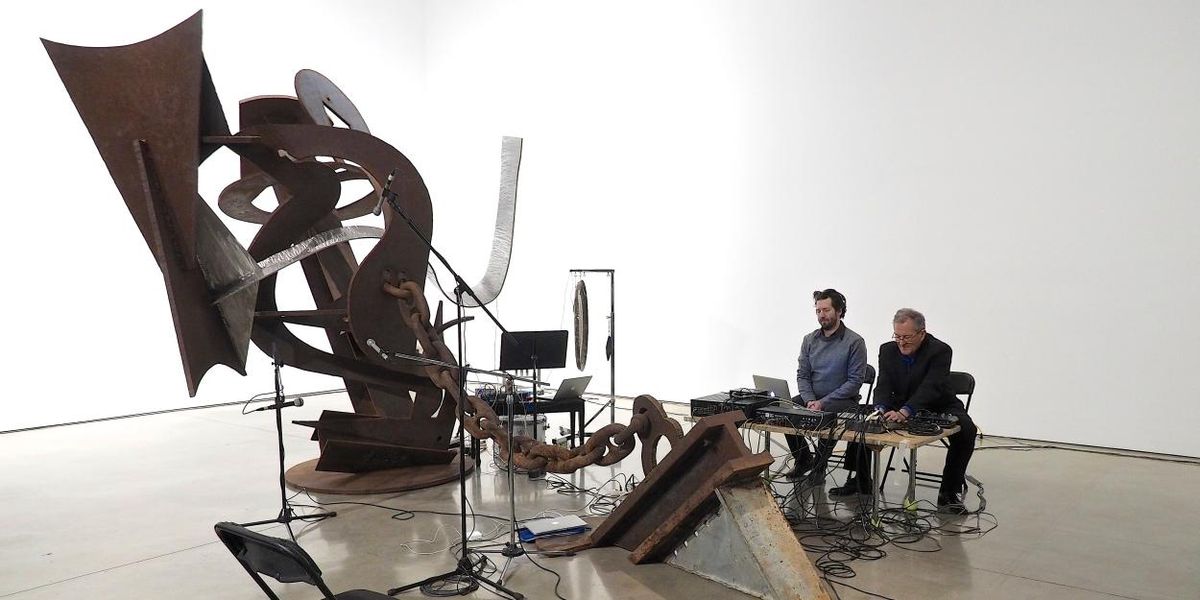
S.E.M. Ensemble will present MUSICA ELETTRONICA (II) at Paula Cooper Gallery, 534 W. 21st St, New York, on Tuesday, September 15th at 7:30pm. Tickets are $15 in advance and $25 at the door.
The program, titled 'Beginnings (1967) & The Present (2026): Two Compositions of Electronic Music,' pairs the premiere of Michael J. Schumacher's Room Piece New York 2026 with the complete version of Petr Kotik's Kontrabandt (1967), also receiving its premiere in that form.
Program
Michael J. Schumacher – Room Piece New York 2026 – premiere
Petr Kotik – Kontrabandt (1967) complete version – premiere
The concert will be performed by S.E.M. Ensemble, directed by Petr Kotik, and will feature Sam Boston, Petr Kotik, Ron Kuivila, Emma Mistele, Chris Nappi, Ben Neill, and Michael J. Schumacher. The concert will last approximately 90 minutes.
A preview of the program will take place Sunday, September 13 at 7:30pm at Willow Place Auditorium, 26 Willow Place, Brooklyn Heights, with free admission.
About the Artists
Michael J. Schumacher has worked at the intersection of sound and algorithmic composition since the late 1980s. He is best known for long-form, multichannel, generative 'Room Pieces' presented in galleries, museums, and concert halls. XI Records released a DVD of five of his sound installations as computer applications. Other notable projects include Living Room Pieces, a generative installation for home listening, and the Portable Multichannel Sound System, a suitcase-scale immersive rig with which he has toured the U.S., Europe and Japan.
ROOM PIECES is Schumacher's evolving series of multichannel, extended-duration sound installations. Since its first realization - a twelve-channel work installed in a New York apartment in 1991 - ROOM PIECES has appeared in private spaces as well as in galleries, museums, concert halls, public spaces, a bar, a hi-fi store. Each version is a response to the acoustic, architectural and social character of its location.
Distributed across multiple loudspeakers, hundreds of autonomous sound modules - sine tones, instrumental and synthesized sounds, field recordings, and fragments drawn from films, recordings, and the internet - combine through algorithmic processes. The result is a continuously shifting spatial geometry: sounds appear near or far, persist or vanish, demand attention or quietly merge with the environment. Coincidental juxtapositions create fleeting clusters, remembered places and unstable relationships.
Rather than re-constructing an illusion of a 'real' world, ROOM PIECES intersects with and undermines the world already present. It invites listeners to move between concentration and distraction, foreground and background, conscious attention and involuntary hearing. Never experienced in precisely the same way, the work makes listening itself - its rhythms, memories, and changing states - the subject of the installation.
Schumacher's music has been presented by GRM (Paris), Roulette, Issue Project Room, Artists Space, Ostrava Days, Transmediale, Klangraum Krems, and The Dream House, among others. Releases appear on Superpang, XI Records, Sub Rosa, Entr'acte, Quecksilber, and Sedimental.
Petr Kotik (born 1942) became involved with electronic music in 1959, at the start of his compositional efforts. At the Vienna Academy of Music (1963-66), he took instructions in electronic music composition in the class of Friedrich Cerha and the technical team of Capitol Records, which closely collaborated with the Vienna Academy, having its studios next door at the Vienna Konzerthaus.
In 1966, the Electronic Studio at the West German Radio (WDR) in Cologne, Germany, commissioned Kotik to create an electronic music composition, with a residency at WDR to realize the piece (in the 1950s and 60s electronic music was solely realized on magnetic tape in specially-equipped studios). Kotik spent the first three months of 1967 in Cologne, creating Kontrabandt, a composition for 2 to 6 performers, 20 to 60 minutes in duration. The performance of the piece is a hybrid between live-produced sounds and the recorded segments created at the Studio. Kontrabandt has received many performances since 1967. This will be the first performance of the complete score, with 6 performers, 60-minute duration.
Historical Background
The invention of recording music on magnetic tape in the late 1940s caused an enormous explosion in the technology of sound recording and playback. Radio stations throughout Europe (all publicly funded with large budgets) started to be equipped with this technology and were the logical place for musicians to start experimenting with mechanically and electronically produced sounds that could be further altered and modified. The first such studio was at the French Radio in Paris in 1948, creating 'Musique concrete.' Not much later, in 1951, another studio already called Electronic Music Studio opened at the West German Radio (WDR) in Cologne, Germany. In 1956, this WDR Electronic Music Studio produced, one can say, the first true masterpiece in electronic music, the Gesang der Jünglinge (1956) by Karlheinz Stochausen – four channels, with loudspeakers surrounding the audience. Ten years later in 1966, WDR Studio commissioned Petr Kotik, a young composer from Prague, Czechoslovakia, to create an electronic music piece. By then, Karlheinz Stockhausen was the WDR Studio's director.
Petr Kotik Remembers
In the spring of 1965, I took the train from Vienna to Utrecht to attend the Gaudeamus performance competition. On my way, I stopped in Cologne, Germany to see Otto Tomek, whom I met at the Warsaw Autumn festival. We got to know each other well – Tomek visited Prague a few times and was familiar with my music and the concerts I did in Prague.
Otto Tomek was the head of the New Music Department at the West German Radio (WDR), which also included the Electronic Music Studio, headed by Karlheinz Stockhausen. Tomek was interested in everything going on in new music behind the Iron Curtain, especially in Czechoslovakia and Poland. He visited Prague often.
I arrived in Cologne early in the morning, and when I got to Tomek's house, he suggested that I accompany him to WDR. When we arrived, he said 'Karlheinz is in the Studio, you should meet him.' When we entered the Studio, Stockhausen was working there with his assistants. I must have been one of very few people from Prague whom Stockhausen had a chance to talk to, so after Tomek introduced us, we struck up a conversation. When Stockhausen found out that I was a composer, he asked whether I had any of my music with me. I did, and we listened to all the 15 minutes of Music for 3 from 1964. Afterwards, he suggested that we have dinner later that evening. He must have found my music peculiar and was intrigued enough to laugh, making references to myself and my friend Michael von Biel. He said, 'These young composers are doing things differently...' In the evening, we met at the WDR basement cafeteria and talked long into the night. Beside Stockhausen and Tomek, there also was Jaap Spek, Stockhausen's right-hand man, who designed the recently-refurbished WDR Studio.
It may have been the result of my Cologne visit that I received, in the fall of 1966, a commission from WDR to create a piece of electronic music there. Before taking residency at WDR in early 1967, I visited Cologne again in November to make myself familiar with the studio and talk to Jaap Spek (Stockhausen was in Japan at that time).
Electronic music was conceived in the early 1950s as something to be recorded and fixed on magnetic tape. That was still the case in the 1960s. Pieces of electronic music existed only as recordings that were done in studios with multiple tape recorders, the sounds mixed and altered, the tapes spliced—and all of that was fixed in its final form on the master magnetic tape. The idea and practice of live electronics was in its infancy, and no one knew much about it. The first real musician to do live electronic performances was David Tudor, and later, parallel to David's work, Robert Moog assembled the first synthesizer that contained electronic sound sources controlled by a keyboard. These first steps, however, were not known in Europe until the very late 1960s and were not embraced by the composers and musicians there. Especially at WDR, electronic music at that time was just a fixed recording on magnetic tape, very much the way it had been done since the mid-1950s.
Electronic music interested me enormously; in fact, it was my involvement with electronic music in 1960 that got me started as a composer. But by 1966, that interest had faded. Mainly, the concept of music as a fixed object on magnetic tape turned me away from this medium. I realized then that music is a process that cannot be 'fixed' as an 'object.' Once music becomes fixed, it loses its raison d'être (reason to exist), and as music it dies in the end.
However, I accepted the WDR commission without question. The task for me was to find a way to reconcile my feelings about recorded music with the WDR expectations. I decided to create a live electronic piece in which segments of electronic music were recorded on tape, which would serve an instrument itself and would be used as one of the 'sound sources' in a live performance. It meant incorporating fixed segments, 'objects,' into a live musical performance (the durations of the segments being between 1 second and 2 minutes).
The title of the piece emerged naturally: combining the German words 'kontra' [against] and 'band' [tape] into Kontraband. When I made my visit to Cologne in November 1966 and told my idea for the title to the people there—I distinctly remember walking down the street with Jaap Spek and Otto Tomek and telling them the title, 'Kontraband'—Tomek suggested that I add the letter 't' at the end. Why he suggested it, I have no idea. I thought that it was to make the title more ambiguous. Anyway, this is how the title 'Kontrabandt' came to be.
The premiere of Kontrabandt was performed by the QUaX Ensemble, which I started in the Fall of 1966, after returning to Prague from my studies in Vienna. The piece was part of a WDR concert on April 28, 1967, one of the concerts of the series 'Musik der Zeit.' When we (QUaX Ensemble) came to the hall to set up and rehearse, we discovered several large sound sculptures in the corner of the stage. They were sound objects/instruments by the French Baschet brothers. The Baschet instruments sounds, amplified by the contact microphones, seemed perfect, and, as no one objected, we used them for the performance. Later on, someone at the WDR Studio told me that when the Baschet brothers heard about it, they were not very happy.
S.E.M. Ensemble performances are made possible with the support of the New York City Department of Cultural Affairs in partnership with the City Council, the New York State Council on the Arts with the support of governor Kathy Hochul and the New York State Legislature, as well as individual donations: Noni Pratt, Thomas Buckner, Stephen Deutsch, Rotraut Moquay, Daniel Costello, Beth Greenberg and James Wright, Catherine Bandet, Victoria Newhouse, Steven Holl, Renée Levine Packer, and an anonymous donor. Additional thanks to supporters Dexter Dine, Bruno Ferrandis, Stephanie Griffin, Lawrence Kim, Mary Elizabeth Pratt, Ben Richter, and Gary VanderPutten.
The S.E.M. Ensemble also recognized past major supporters in memoriam – Virginia Dwan, John Cage, Herman Gersten, Sheldon Berlow, and Robert Rauschenberg.
S.E.M. Ensemble Board of Directors: Noni Pratt, Lucas Cooper, Renáta Spisarová, Samuel Boston, Thomas Buckner, Dexter Dine, Petr Kotik, and Renée Levine.

Sign up for all the news on the Fall season, discounts & more...
.jpg?format=auto&width=300)