



Season 2, Episode 5: Behind every summer is a community that keeps Fire Island alive. This episode explores the history of the beloved Pines Pantry through the eyes of its iconic Pantry Girls, alongside the volunteer firefighters of The Pines and Cherry Grove who protect the island from fires, hurricanes, beach erosion, and an uncertain future.
The Curious Journey of THE CURIOUS CASE OF BENJAMIN BUTTON
The Curious Case of Benjamin Button will run through December 6 at the Public Theatrer.
By: Joey Sims
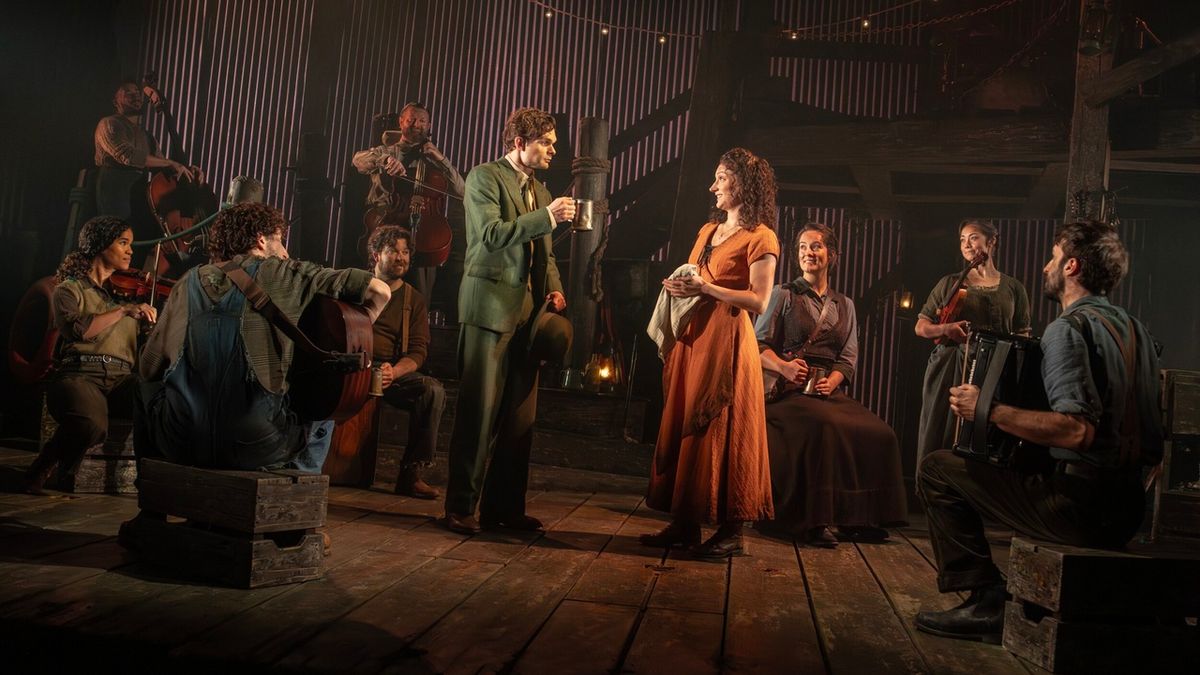
The co-writers of The Curious Case of Benjamin Button are quick to acknowledge the strange geographic journey behind their eagerly anticipated musical: an American short story set in Baltimore, firrst adapted into a movie set in New Orleans, and now transposed for its stage debut to a Cornish village off the coast of Great Britain.
“We are under no illusion how curious it must feel,” writes composer and lyricist Darren Clark in his playbill note for Benjamin Button, which opens off-Broadway at The Public Theater on October 21 following an Olivier Award-winning run on the West End.
Not that Clark and his collaborator Jethro Compton, the show’s co-lyricist, book writer and director, are the first to reinvent Benjamin Button’s legendary tale, which has seen a few life cycles since novelist F. Scott Fitzgerald’s original short story was published in 1922.

THE SHORT STORY
A celebrated novelist, essayist and short story writer, Fitzgerald is best known for his 1925 masterwork The Great Gatsby (also theatricalized into musical form in a still-running big budget Broadway adaptation). Rising to prominence in the “Roaring Twenties,” Fitzgerald not only published multiple novels, but also 164 short stories in the period spanning 1920 to 1931.
One of those short stories was entitled “The Curious Case of Benjamin Button,” published in 1922 in Collier’s magazine. (It was later included in Fitzgerald’s anthology Tales of the Jazz Age, which included “Button” alongside 10 other short tales.) The story’s fantastical premise concerned a man aging in reverse, born in old age and dying as an infant.
In the original short story, Benjamin is born to Mr. and Mrs. Roger Button, a prominent couple in the antebellum society of 1860s Baltimore. Horrified by his child, Roger treats him with disdain for many years, during which time the “younger” Benjamin (appearing elderly) spends most of his time with his grandfather. As Benjamin moves into middle age, life becomes easier for a time. He joins his father’s company and soon marries Hildegarde Moncrief, who is unaware of Benjamin's condition.
As the years pass and Benjamin grows more youthful, he becomes distant from Hildegarde. A restless Benjamin likes to stay out late dancing, while Hildegarde grows older and loses her natural energy. Benjamin ultimately volunteers to fight in the Spanish-American War to escape home, serving with honor.
In his later years, a youthful Benjamin passes off his business to his son and attends college. But as his life moves into adolescence, Benjamin begins to forget things. Sports and academics grow more difficult as he regresses. Benjamin is finally forced to move in with his son, Roscoe, who grows to resent his father’s condition.
Soon, Benjamin is a child, first happily attending kindergarten, then becoming a toddler. Finally he forgets his life. Now simply a baby, crying when hungry, the Benjamin we’ve grown to know fades away, as Fitzgerald hauntingly describes in a final passage: “He did not remember clearly whether the milk was warm or cool at his last feeding or how the days passed—there was only his crib and Nana's familiar presence. And then he remembered nothing.”
At heart of every iteration Benjamin Button is the fleeting nature of life, that most wondrous of things over in a flash, and valuable only for the precious moments along the way.
“In the theater, [this story] forces us to look anew at every aspect of how we live, at what we consider valuable,” writes Oskar Eustis, artistic director of The Public Theater, in his own program note for the new adaptation. “Knowing that our time is limited makes the moments we have all the more precious.”
THE FILM ADAPTATION
Multiple attempts were made at adapting Fitzgerald’s story into a film over the years. Director Frank Oz was attached to the project in the late 1980s, with actor Martin Short considered to star as Benjamin. Screenwriter Robin Swicord wrote a draft in 1990 that was later considered by director Steven Spielberg, who spoke with Tom Cruise about potentially starring. Ron Howard was later attached for a time, as was director Spike Jonze.
From an early stage in the developmental process of a Benjamin Button film adaptations, elements of Fitzgerald’s story were adjusted and reworked. Swicord’s draft was credited as the first to depart significantly from the source material, centering on Baltimore’s jazz music scene. That script was later rewritten by Academy Award-nominee Eric Roth.
When Roth met with director David Fincher and the film’s producers, talk quickly turned to the transient nature of life, and those few moments that make it count.
“I think it’s the kind of movie that puts you in touch, in an odd way, with how you define yourself or how you were defined by certain moments in time, and what that stuff really means to us all,” said Fincher in a later interview.
Roth shifted Button to a New Orleans setting, and began the tale with Benjamin’s birth in 1918 rather than 1860. In Fincher’s film, Benjamin’s mother dies in childbirth. His father, who owns a button business, abandons Benjamin on the steps of an old folk’s home. (‘Older’ Benjamin cannot initially speak, though he speaks cogently in Fitzgerald’s story and the musical version.) Benjamin is taken in by Queenie, who runs the home and raises Benjamin as her own.
A side note: Taraji P. Henson, recently seen on Broadway herself in Joe Turner’s Come and Gone, earned an Academy Award nomination for the role of Queenie. The film’s leading man Brad Pitt was also nominated for his work as Benjamin.
While Benjamin still serves in the military, the film shifts that service to World War II. The love of Benjamin’s life is Daisy Fuller (Cate Blanchett), a childhood friend and later a successful ballet dancer. The two criss-cross over the years, moving in and out of one another’s lives, before finally settling down and having a daughter in 1968. However, Benjamin grows convinced he cannot be a reliable father due to his condition, ultimately fleeing once again.
Fincher’s adaptation of Benjamin Button was released in 2008 to positive reviews, ultimately earning 13 Academy Award nominations. The film was also a box office success, grossing $336 million worldwide. Benjamin’s reverse aging was brought to life in part through groundbreaking visual effects, particularly in the film’s early scenes depicting Benjamin as a young man with all the physical maladies of old age.
THE MUSICAL ADAPTATION
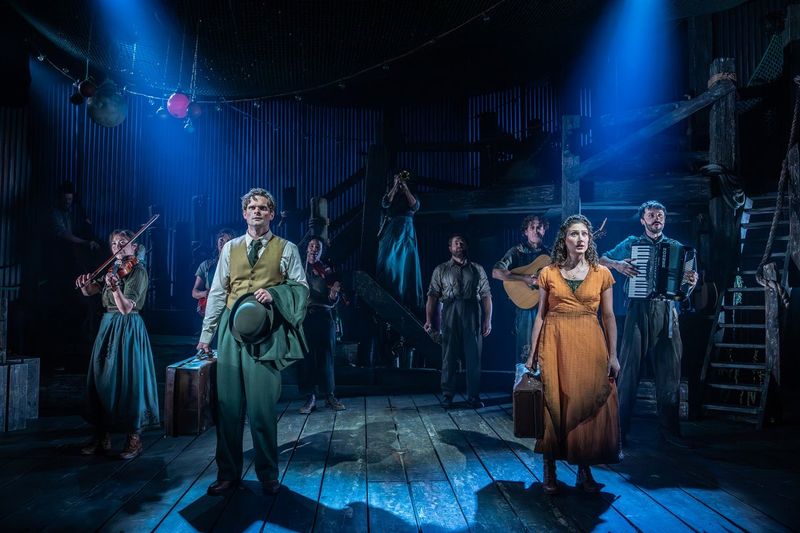
When songwriting duo Darren Clark and Jethro Compton met up in a small cafe in 2018 to discuss adapting Benjamin Button into a musical, the two honed in on Benjamin’s open-hearted, generous spirit “, and a story celebrating the innate “otherness” within us all.
The two set out transposing Benjamin’s story to the Cornish harborside, at the southwestern tip of England. Compton knew the area well, having himself grown up in the Cornish town of Bude—an early version of the show was actually performed above a bowling alley in Bude. It then traveled to the Salisbury Playhouse in Wiltshire, followed by a run at London’s Southwark Playhouse in 2019. The musical returned to the same venue in 2023 in a reworked and expanded version, which then transferred to the Ambassadors Theatre on the West End.
The new setting allowed Clark to craft Celtic-themed folk ballads performed by a cast of 13 musician-performers, who operate roughly 30 instruments in total. The opening and closing lines of the show are sung in Kernewek, a Celtic language native to Cornwall.
The show’s creative team experimented with multiple approaches to Benjamin’s backward aging, with early versions utilizing puppets for portions of Benjamins’ life. But ultimately, Compton and the creative team opted to keep the staging as simple as possible, trusting in the audience’s imagination to help fill in the gaps. Somehow, improbable as it may sound, one actor portrays Benjamin for the entirety of his life in the musical’s final iteration.
Benjamin Button was led on the West End by John Dagleish, who earned an Olivier Award for his performance. The show also won the Oliviers for Best Musical and Outstanding Musical Contribution, while Clare Foster earned a nomination for her work as Benjamin’s lifelong love Elowen Keene. For the musical’s New York bow, an entirely new American cast has been assembled, led by Tony Award nominee Andrew Durand as Benjamin and Kelsee Kimmel as Elowen.
As to how the saga of Benjamin’s life has been reshaped again—well, we wouldn’t want to give everything away. Suffice to say that the story again begins in 1918, as it did in Fincher’s film version. And also in the film, Benjamin serves in World War II. Much is familiar, much else entirely unexpected. Benjamin’s story continues to grow and change as it moves through new creative hands, taking on new and more beautiful forms of life.
Photo Credit: Joan Marcus
Broadway news in your inbox
Weekly top stories - unsubscribe anytime.
Weekly top stories - unsubscribe anytime.
|
Powered by

|
Popular episode




Tickets From $59

Tickets From $70

Tickets From $59

Tickets From $101