


Review Roundup: James Graham's New Play, THE STANDARD OF LIVING
The show runs at the Theatre Royal Haymarket until 12 December

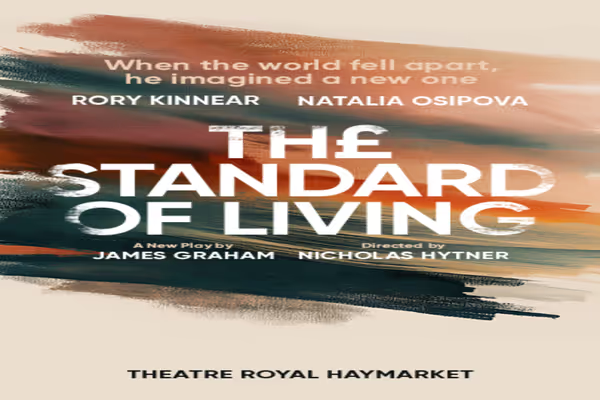
Olivier Award winner Rory Kinnear stars as John Maynard Keynes, the radical economist and member of the influential Bloomsbury Group who became the singular driving force behind arts funding in Britain and built a new and fairer financial model, that ultimately helped reshape the Western World in the aftermath of the First World War. Royal Ballet Principal Natalia Osipova makes her West End debut as the celebrated ballet dancer Lydia Lopokova, a soloist with Diaghilev's Ballets Russes who was considered the embodiment of the new era of modernist ballet.
Can you put a price on happiness, beauty and love? What did the critics think?
The Standard of Living runs at Theatre Royal Haymarket until 12 December
Photo Credit: Manuel Harlan
 Aliya Al-Hassan, BroadwayWorld: James Cousins's movement direction is wonderful, using lyrical snippets of ballets such as Firebird and Les Sylphides, as well as an inspired scene where Keynes and Hayek fight out their respective economic theories as they dance a tango. "Tighten your belt," exclaims Hayek. "Buy a new belt," Keynes counters. It's very cleverly done and highly effective; a literal and figurative dance around the issues. Ironically, given the fear that so many will hold about a play about an economist, more structure and focus on the economic tussles within the play would only have enhanced it. But even if this is not a James Graham classic, there is much to enjoy here and not a moment to be bored.
Arifa Akbar, The Guardian: Keynes explains his theories in lectures but also cleverly crafted dialogue so it does not feel leaden or expository. We learn how he espoused government intervention and a culture of state spending after the war to bring the bombed economy back on track. Written off as socialist by some, he is the one who secured credit from America to rebuild Britain. He was also a fierce advocate of the arts and helped to create the Arts Council (he was its first chair). Alongside the serious stuff is rigorously researched and amusing detail, with Keynes keeping an inventory of past lovers in a little black book and talking of flirtations with Albert Einstein.
 Dominic Cavendish, The Telegraph: The piece grew out of Graham’s tribute to Keynes (1883-1946) aired on Radio 4’s Great Lives, mid-pandemic. His deep-rooted engagement with the subject enables him to compress vast volumes of material as we move from the First World War, through Keynes’s due ire at the Treaty of Versailles and his evolving theory about the need for governments to spend their way out of slumps, past the Second World War and his visionary hand in the establishment of the Arts Council.
Marianka Swain, London Theatre: Rory Kinnear brings typically deft nuance to Keynes, a man who gleefully tots up sexual conquests in his little black book (he even flirted with Albert Einstein) but is felled by his surprising love for Lydia: “I’m unmoored,” he confesses. In fact, the whole play is enjoyably upended by Lydia, played by Royal Ballet principal Natalia Osipova in her terrific acting debut. The Russian dancer is hilariously blunt (“You must finish” is her assessment of Vanessa Bell’s modernist painting), but, in palpably loving fashion, also supports and fuels Keynes’s revolutionary mission. We get the added bonus, too, of some beautiful dance interludes from Osipova.
Dominic Maxwell, The Times: Kinnear excels, however, as Keynes the man arguing against the laissez-faire economics that dominated, Keynes the godfather of the welfare state. The schools of thought are personified by the double act of Keynes and his Austrian rival Friedrich Hayek (Laurie Kynaston). One guy loves state intervention, the other loves the free market and both guys kinda love each other. Their tangy exchanges are the evening at its most ideas-driven and most entertaining.
Andrzej Lukowski, TimeOut: It is still pretty damn good: nobody brings the past to life with the verve of Graham. It is, to be fair, almost certainly the most enjoyable play about an economist ever written. Kinnear is a delight as Keynes, who combines starchy Victorian gent, idealistic Boy Scout and sexually liberated bohemian in equal measures: he’s like an overgrown child prodigy who is is socially awkward in pretty much every given situation other than when it comes to shagging anything that moves. I wasn’t sure about his co-star Osipova: the Royal Ballet principal is actually fine in the role of Lopokova but the character does feel very ‘light relief Eastern European’ and she exists more of a disruptor of Keynes’ world than as somebody Graham seems seriously interested in.
Alice Saville, The Independent: This is a play of ideas, but unlike Tom Stoppard's brilliant, recently-revived Arcadia, it can't turn the abstract territory of maths and logic into something richly emotive. The closest it comes to touching your heart is in the final scenes, depicting how Keynes laid the foundation for a Britain where everyone could access the arts. We all owe him a debt of gratitude, but this play probably isn't the way to pay it.
Sarah Crompton, WhatsOnStage: Graham clearly loves and admires Keynes, and Kinnear creates an unforgettable portrait of a man who bestrode his times with a gentle modesty that belied his cleverness. But the play’s lesson for today isn’t only economic. The entire production is a plea for the value of beauty, of art, of dance, of lives that are full of something more than the day-to-day grind. That was Keynes’ greatest lesson: it is important to know how to live as well as how to spend. This is art about the importance of art and is both uplifting and hopeful.
Maryam Philpott, The Reviews Hub: No other contemporary playwright has delivered such a consistently insightful and significant body of work in the last 15 years, significant because it uses historical settings to examine how we live now, explicating the mechanisms, decisions and tides in the affairs of men that shape the society we have today. The Standard of Living stops short of that, telling us little beyond the flip-flopping between two economic models. It may be a commercial theatre pressure to play down the complex financial discussions in favour of bitchy chat among the snobbish privilege of the Bloomsbury Group, but the play is the poorer for it.
Average Rating: 64.4%
Prefer BroadwayWorld in Google Search?
Add us as a preferred source so our stories show up more often in Top Stories and Google’s AI answers — for you.
- To read more reviews, click here!
- Discuss the show on the BroadwayWorld Forum

Sign up for all the news on the Fall season, discounts & more...
|
Powered by

|







Reader Reviews
To post a comment, you must register and login.