

Review: Hannigan is a ‘Double Threat’ - Singing/Conducting LA VOIX HUMAINE at the NY Philharmonic
She Proved She Could Do Double Duty – But Did She Have To?
There was a time early in this century when conductor Lorin Maazel (NB: music director of the New York Philharmonic from 2002-2009, among countless accomplishments) led performances of Massenet’s opera THAIS. He surprised audiences by picking up a violin during the entr’acte of Act II to play the work’s famous “Meditation”—usually the realm of the concertmaster—while still going about his business as head of the ensemble.
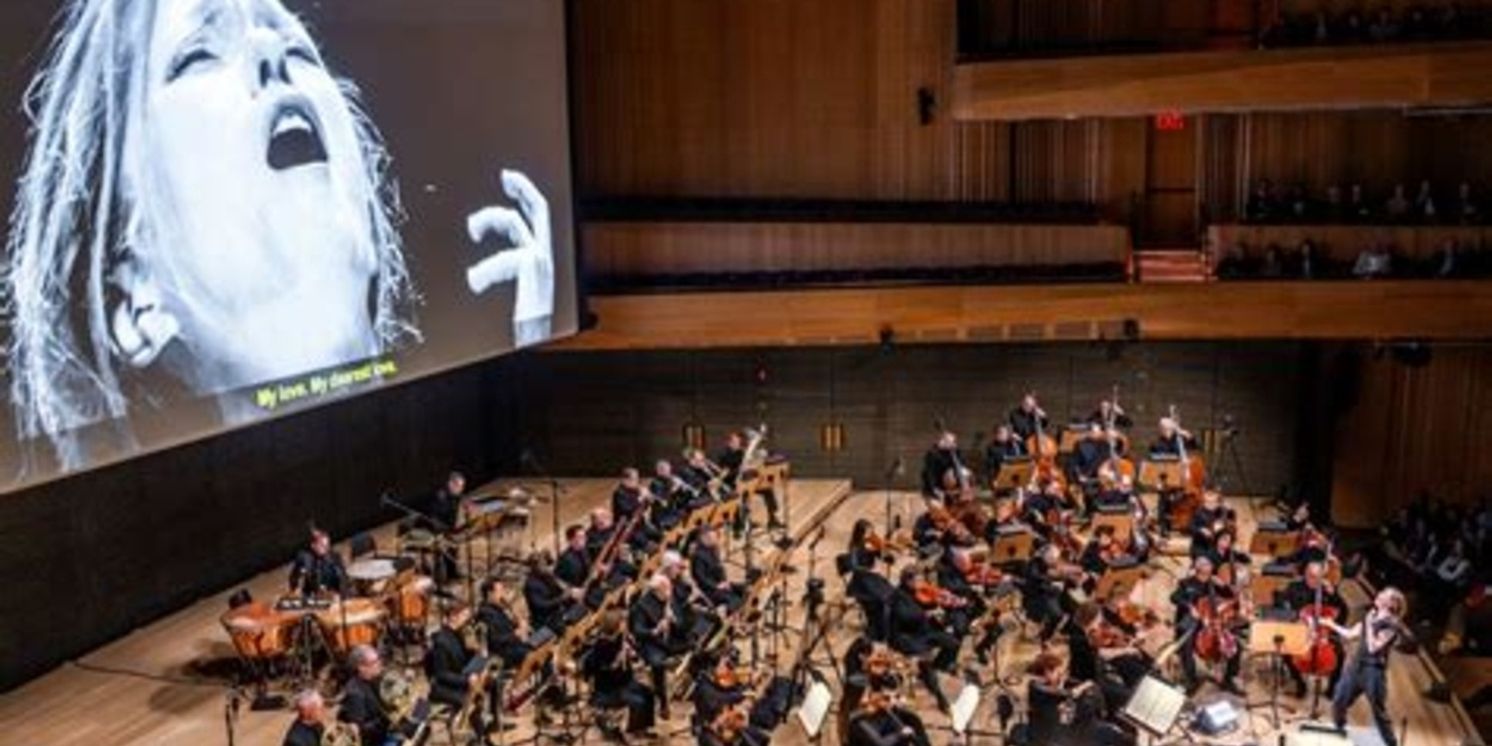
At the Philharmonic’s performance of Poulenc’s monodrama, LA VOIX HUMAINE, on Thursday, soprano/conductor Barbara Hannigan did him one better.
Never stopping to breathe, she seamlessly went from conductor of the opera to its star, simply called “Elle” (“She”), and back again. In a performance shown mostly “live” in detail on a screen towering over the orchestra with her back to the audience (she only occasionally faced us). Hannigan was in fine voice and is a compelling actress, dressed here in the equivalent of a catsuit. She had the audience in her thrall, never forgetting her vocal obligations while leading the ensemble in a thoroughly satisfying performance.
Yes, this Empress had clothes. But was the costume necessary?
Frankly, to me, it came across as a stunt—a brilliantly executed one, to be sure, but still a gimmick. What did we miss by her performing double duty? We saw her expressive face on screen while she performed both parts of her task for the evening and we heard how the orchestra responded to every movement of her hands. Certainly, we did not feel short-changed by anything we heard.
Yet… and yet, we’ll never know for sure what might have been. For someone with her prodigious gifts, we can dream of a VOIX even more fully realized, breathtaking and soulful. Did she have to have the distraction of shared duties?
It’s obvious why she was attracted to the drama of the role. It’s a plum. Simply as drama (also adapted for the screen), from playwright/poet Jean Cocteau, “La Voix Humaine” has long been catnip for stars of a certain age. Ingrid Bergman loved it, Sophia Loren won a special Donatello award (Italy’s Oscar) for her performance in “La Voce Humana,” inspired by a movie she had seen as a teenager with the great Anna Magnani. The Spanish director Pedro Almodovar did a version with the formidable Tilda Swinton, his first film in English.
While there may not be the same sized pool of sopranos to make this operatic work their own, there have been many notable performances since the French singer Denise Duval had the composer's ear in crafting the role for herself. And Poulenc’s orchestral writing was undoubtedly a challenge for any ensemble.
{Still, there's also the matter of what companion pieces would be appropriate for the piece to be performed in the opera house. Like SALOME, for example, this is a work that could dramatically stand on its own, but clocking in at less than 45 minutes, it's not, as the Marx Brothers might say, "a night at the opera."
(Though done on its own today, early on, SALOME had some odd pairings, like GIANNI SCHICCHI, which I happened to see in San Francisco with VOIX and a third opera, IL PRIGIONIERO, by Dallapiccola. But VOIX is much shorter than other dramatic pieces like Strauss's ELEKTRA or the more dramatic parts of of Puccini's TRITTICO.)
I’m glad I was there, at Geffen Hall. But what wasn’t "there"? Perhaps someday we’ll find out, when Hannigan takes on a single task in a performance of the work.
The evening started out—VOIX runs about 45 minutes—with a performance of Richard Strauss’s “Metamorphosen: A Study for 23 Solo Strings.” Written in 1945, after the Vienna State Opera was burned before the end of World War II, the work was a muted exercise in harmony, gorgeously and thoughtfully composed and richly played by the Philharmonic.
Caption: Barbara Hannigan on screen and conducting LA VOIX HUMAINE at the NY Philharmonic
Credit: Chris Lee
Reader Reviews
Videos