

Season 2, Episode 5: Behind every summer is a community that keeps Fire Island alive. This episode explores the history of the beloved Pines Pantry through the eyes of its iconic Pantry Girls, alongside the volunteer firefighters of The Pines and Cherry Grove who protect the island from fires, hurricanes, beach erosion, and an uncertain future.
Review: COME FROM AWAY at NEW TAMPA PLAYERS
A moving story of human connection meets an ambitious, occasionally disjointed production, which played its final performance October 25,2026.
By: Drew Eberhard
“You are here, at the start of the moment. On the edge of the world, where the river meets the sea...”
“Tonight we honor what was lost, but we also commemorate what we found...”
We all remember the exact moment in history when the world as we knew it changed forever. We remember where we were, what we were doing, and how an otherwise ordinary day became something none of us could have anticipated.
For me, that moment came during eighth-grade Home Economics class. What began as a routine school day quickly became something entirely unfamiliar. As we continued through the motions of our school day, teachers ushered us from classroom to classroom while parents remained uncertain about whether they would be able to reach us. Lesson plans disappeared. Extracurricular activities were abandoned. In their place came a day defined by presence, uncertainty, and the need to simply be there.
In the wake of such terrible devastation, we found ourselves sitting in front of our televisions, unable to look away. As children, we watched the events unfold before our eyes without fully understanding the magnitude of what we were witnessing.
Now, 25 years later, regional theatres across the country have the opportunity to bring audiences a truly remarkable and groundbreaking work: Come From Away.
Written by Irene Sankoff and David Hein, who contributed the book, music, and lyrics, Come From Away is set in the small Newfoundland town of Gander. The musical recounts the days following the September 11 attacks, when 38 planes carrying nearly 7,000 passengers were diverted to Gander International Airport. The characters are inspired by actual Newfoundlanders and the stranded passengers they welcomed, sheltered, and fed during an extraordinary moment in history.
At the 71st Annual Tony Awards, Come From Away received seven nominations, including Best Musical, Best Original Score, Best Book of a Musical, and Best Featured Actress in a Musical for Jenn Colella. The production won Best Direction of a Musical for Christopher Ashley.
Running approximately 100 minutes without an intermission, Come From Away unfolds as a single act. Although the events depicted are rooted in real experiences, Sankoff and Hein gathered far more stories than could ultimately be included in the finished musical. During the show's development, the writers spent a month in Gander in 2011 interviewing the people whose experiences would inform the piece. Their research became a 45-minute treatment, which was first developed through the Canadian Music Theatre Project in 2012. After failing to attract a Canadian producer at that stage, the musical entered Goodspeed Musicals' workshop program in 2013. Following a New York showcase production, it was picked up by Junkyard Dog Productions.
The characters are tributes to the real people whose experiences inspired them, rather than exact reproductions of those individuals. That distinction is important. At its heart, Come From Away is not simply a historical retelling. It is a story about humanity, empathy, and the extraordinary connections that can emerge from unimaginable circumstances.
New Tampa Players is the latest company to take on this ambitious musical, presenting its production at the New Tampa Performing Arts Center.
For this production, New Tampa Players chose an approach that differed from the more intimate ensemble staging audiences may be accustomed to seeing. Rather than having performers embody multiple characters throughout the piece, the company divided certain roles among several performers.
Anyone familiar with Come From Away understands that its performers regularly transition between their Newfoundland characters and the displaced passengers they portray. These transformations are central to the show's theatrical language. The actors must become different people before our eyes, often with little more than a shift in posture, an accent, or a change in physicality. There is something remarkably intimate about watching those transformations happen in real time.
Which raises an important question: At what point does an alternative staging approach compromise that intimacy in favor of giving performers more individual space onstage?
It is a question that immediately came to mind while watching this production.
The choice reminded me, in some ways, of casting multiple adults in a production of Spring Awakening. Part of that musical's impact comes from the tension between the authority imposed by adults and the youthful rebellion of the characters. When that dynamic is altered, the oppressive nature of the society in which the young characters live can lose some of its menace. A similar principle applies here. The power of Come From Away lies partly in watching its performers inhabit multiple lives and experiences within a shared theatrical space. When those transformations are distributed across a larger group, some of that immediacy can be lost.
One of the show's greatest strengths is its rejection of traditional theatrical conventions. Entrances and exits are often fluid rather than literal, and applause between musical numbers is generally reserved for specific moments. The storytelling depends on continuity, intention, and an almost documentary-like sense of immediacy. We should feel as though we are witnessing these people navigate the events as they happen, rather than watching a succession of carefully separated scenes.
When the production leans too heavily into conventional staging, it risks interrupting that momentum. The story should feel grounded, intentional, and raw. As an audience, we need to experience the characters' reactions as though we are flies on the wall, witnessing history unfold from just a few feet away.
Strip away the excess. Let the people and their stories take center stage.
Musical Director G. Frank Meekins gets a great deal out of his performers vocally. There are moments of genuine strength throughout the score, although some harmonies were difficult to distinguish, and the crispness of several numbers suffered from pacing issues. With 19 performers onstage, one might reasonably expect a full, resonant sound. Instead, the vocals occasionally felt as though they were being swallowed by the room. This may have been a matter of acoustics, but the result was that some of the dialogue and musical delivery lacked the impact they needed.
Christian McLaurine's choreography gave the performers opportunities to move throughout the space as the story progressed. However, whether the issue stemmed from the choreography, the direction, or the transitions between scenes, the production frequently felt as though it were unfolding in stop-motion. Individual vignettes would begin, reach their conclusion, and dissolve, but the connective tissue between them was not always apparent. Rather than feeling like one continuous journey, the evening sometimes played as a series of disconnected moments.
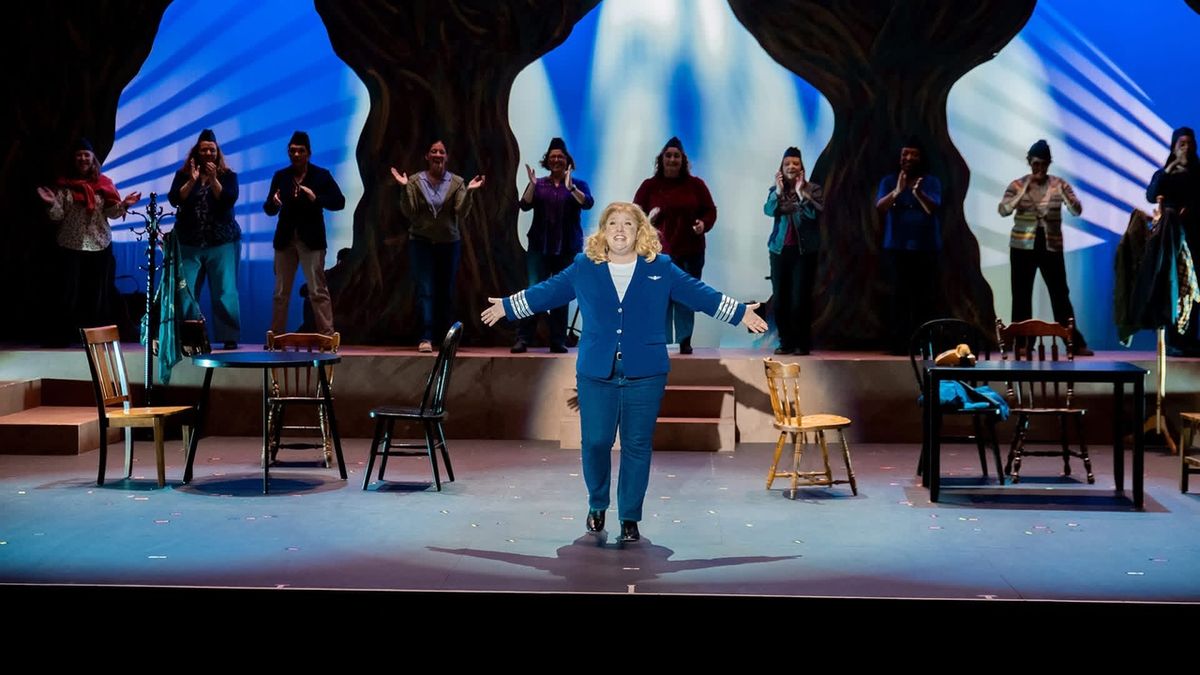
Scenic design by Paul McColgan, with scenic artistry by James Cass, was functional for the most part, providing the performers with a space in which to move freely within the confines of the story. However, the trees forming the backdrop looked strangely storybook-like and whimsical, an aesthetic that occasionally clashed with the grounded realism the material demands.
I understand the practical consideration of concealing the band, but in a space of this size, was the visual trade-off necessary? The platforms occupied a substantial portion of the playing area without always being used to their full potential. At times, they felt like platforms for the sake of having platforms.
More importantly, their prominence seemed to distance the audience from the physical and emotional realities of the story. These characters were living through an exhausting, disorienting experience. Some went without sleep until the ordeal was over. Their exhaustion, uncertainty, and determination should be felt in their bodies as much as in the dialogue and music.
The platforms stretched nearly from one side of the proscenium to the other, creating an impression that occasionally felt closer to a concert staging than an intimate theatrical portrait of a harrowing historical event. All that seemed to be missing was a choir stretched across the back of the stage.
The band, led during our performance by David Estevez, kept the music moving throughout the evening. The ensemble featured Rick Barclay on keys, Sarah Biser on whistles, Charlotte Lewis on fiddle, Keith Meek on guitar, Mark Warren on mandolin and guitar, Marc Ensign on electric and upright bass, and Erin Morgan on percussion.
The musicians remained in sync and made the most of the score. However, some significant tempo choices undermined the emotional weight of key moments. "Something's Missing," for example, felt far too fast for the introspective quality of the scene. Conversely, "Heave Away/Screech In," which should build into a rollicking celebration of Newfoundland culture, felt disjointed and never quite achieved the uninhibited pandemonium the sequence demands.
In a musical so dependent on the rhythm of storytelling, these distinctions matter. The score must do more than keep the action moving; it must help us feel the emotional shifts taking place beneath the surface.
Under the direction of Nora Paine, New Tampa Players' cast brought considerable heart to their roles. For several performers, that emotional investment translated into particularly memorable moments, even when the production as a whole struggled to maintain a consistent sense of connection.
Karissa Barber, as Beverly Bass and others, delivered a well-rendered portrayal of Beverly, balancing the character's humor with strong vocals that stood out among the company.
Deon Barksdale Jr., as Bob and others, presented a confident performance that did not shy away from Bob's underlying worry and uncertainty.
Richard Brown, as Kevin T. and others, gave an admirable performance, but I often felt he was relying too heavily on impressions rather than fully embracing the humanity beneath his characters. The distinctions between the people he portrayed sometimes felt more external than internal.
Jonathan Coppola, as Oz and others, delivered clear vocals that cut through the ensemble. He also supplied several effective comedic moments and offered a well-rounded portrayal.
Cassia Dixon was spot-on as Janice, bringing an infectious energy to the role. Her performance conveyed the character's drive and the urgency behind her every step.
Lukas Fives did fine work as Kevin J. and others, although his portrayal occasionally came across as unnecessarily abrasive. Rather than allowing the character's personality and circumstances to reveal his rough edges, Fives sometimes seemed to push too hard into making him unlikeable. As a result, some of the humanity beneath the character's behavior was lost.
Joy King delivered a beautiful vocal performance as Hannah. Her exchanges with Kari Ann Stamatoplos as Beulah were particularly entertaining, providing moments of warmth and connection amid the larger story.
Scott Paine brought what he could to Claude, but I wanted a stronger commitment to the character's gruff nature. There was not always a sufficient distinction between his portrayal of Claude and the other characters he embodied, making some of the transformations less apparent than they could have been.
Michele McCarty was wonderful as Bonnie. She brought tremendous drive to the role and established a clear through-line for the character from the beginning. Her intentions were evident throughout, allowing the audience to follow Bonnie's emotional journey, and her vocal moments were consistently crisp and effective.
Angelina Samreny, as Diane and others, offered a solid portrayal but missed several comedic opportunities. As a result, some of her interactions with Adam Shoemaker's Nick failed to land as effectively as they might have.
Shoemaker, as Nick and others, delivered a generally effective character arc. However, like Diane, Nick's humor did not always register in the moment. The character's distinctive British sensibility occasionally seemed to become an afterthought, diminishing the charm and specificity of the portrayal.
Kari Ann Stamatoplos created an entertaining version of Beulah. Beulah should serve as a grounding force within the Academy, and there were moments when Stamatoplos did not fully establish the character's authority. This occasionally pulled focus from the scene's intended dynamic. Her interactions with Hannah, however, were engaging and offered some of the production's more enjoyable exchanges.
Nicole Beach (Britany and others), Steven Cragg (Doug and others), Lianne McDonnell-Kruger (Micky and others), Kelly Nowicki (Delores and others), Amy Rothman (Crystal and others), Cristopher Sosa (Ali and others), and Alicia Wlodynski (Martha and others) all provided valuable support throughout the production. Their contributions helped fill out the ensemble and reinforce the company's collective sound.
Under Nora Paine's direction, New Tampa Players presented a commendable interpretation of Come From Away. Despite technical mishaps, uneven pacing, and some questionable musical tempo choices, the performers and production team clearly gave the show their all.
The pacing, however, remained a significant concern. A musical typically presented in approximately 100 minutes somehow stretched to an hour and 45 minutes in this production, and the additional time was noticeable. Combined with the disconnected transitions and inconsistent momentum, the extended runtime occasionally made the evening feel as if it needed to be tightened up overall.
My greatest reservation, however, has less to do with any single technical or artistic decision than with the overall effect of the production.
The story of Come From Away was undeniably present. Its themes of compassion, community, and human connection remained visible throughout the evening. Yet something continued to trouble me long after the performance ended.
This is a story about people coming together in the face of extraordinary circumstances. It is about strangers becoming family, about fear giving way to generosity, and about the ways in which people can find one another when the world seems to have fallen apart. Its power comes from the characters' shared humanity and from watching that humanity emerge through the smallest gestures, the most unexpected encounters, and the simplest acts of kindness.
At times, though, this production felt less concerned with allowing those connections to develop organically and more concerned with giving performers the opportunity to perform this remarkable musical. There were moments when genuine connection emerged, and those moments reminded me of the extraordinary power of the material. But there were others when the production felt fragmented, as though we were watching 19 different interpretations of the same show rather than one cohesive company telling a unified story.
I applaud New Tampa Players for taking on such an ambitious work and for attempting to approach it from a different perspective. Come From Away is no small undertaking, and its emotional and technical demands are considerable. There is value in taking creative risks, and not every unconventional choice will yield the intended result.
Still, when a musical is so deeply rooted in connection, intention, and the shared experience of its characters, one must ask: Do we really need to reinvent the wheel?
Sometimes, the most powerful thing a production can do is trust the material. Allow the performers to inhabit these lives, let the moments breathe, and give the audience the opportunity to witness the extraordinary humanity at the heart of the story.
Because ultimately, Come From Away is not about the people performing the story. It is about the people who lived it, the people who opened their homes and hearts to strangers, and the connections that endured long after the planes departed Gander.
That is the story worth telling, and that is the connection that must never be lost.
Come From Away closed on October 25, 2026. For information about upcoming performances and opportunities to get involved, visit New Tampa Players.
PHOTO CREDIT: TALL TALE PRODUCTIONS
Broadway news in your inbox
Weekly top stories - unsubscribe anytime.
Weekly top stories - unsubscribe anytime.
Popular episode


|
Hans Zimmer Benchmark International Arena (3/14-3/14) |

|
James and the Giant Peach East Bay Theatre (11/05-11/07) |

|
Job The Fringe Theatre (4/29-5/16) |

|
Little Shop of Horrors Carrollwood Cultural Center (7/23-8/01) |

|
Dancing Lessons The Off-Central (2/18-2/28) |

|
Raising Twelve on a Nickel and a Prayer Hillsborough College Theatre (12/16-12/20) |

|
Wicked Straz Center [Carol Morsani Hall] (2/03-2/28) |

|
Who Goes There? (the Thing's the play) Carrollwood Cultural Center (4/24-4/25) |

|
Damn Yankees Eight O'Clock Theatre (2/26-3/07) |

|
Big Fish Eight O'Clock Theatre (4/30-5/09) |
Reader Reviews
To post a comment, you must register and login.