


Review: ARCADIA, Duke Of York’s Theatre
Order, chaos and the beautifully flawed human condition

Returning to the West End in a breathtaking production directed by Carrie Cracknell, this revival confirms that Tom Stoppard created one of the finest works in modern theatre. Having studied the play extensively and seen numerous productions over the years, I can confidently say this is the finest interpretation I have experienced. Cracknell’s direction is insightful, intelligent and wonderfully inventive, illuminating the layers of Stoppard’s writing while allowing the emotional core of the play to shine.
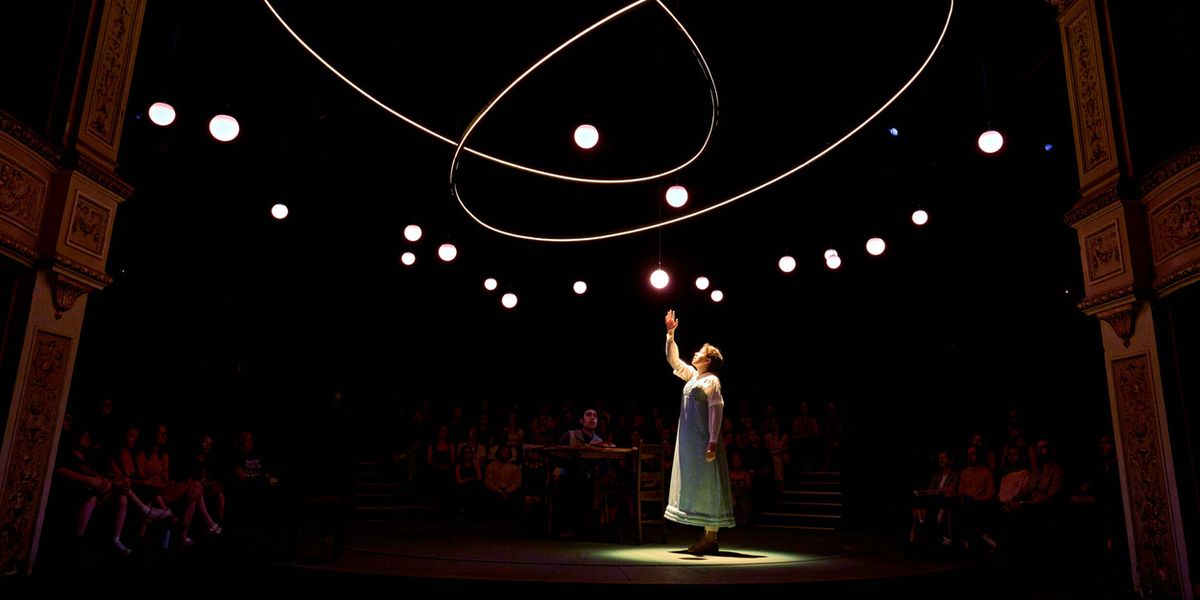
Cracknell’s blending of the two timelines is masterful, with the transitions between past and present unfolding with extraordinary fluidity and purpose. Rather than feeling like separate narratives which weave eventually, both worlds exist simultaneously, constantly informing and enriching one another. Performed in the round with rows of audience sat on the stage, the production immediately immerses its audience. Alex Eales’s deceptively simple set, with its interlocking elevated oval design, elegantly reflects the play’s two intertwining eras while evoking its central ideas of order and disorder, certainty and chaos. Every creative element serves the storytelling with remarkable precision, allowing Stoppard’s extraordinary writing to remain firmly at the centre of the production.
Set in a fictional Manor House, Sidley Park in Derbyshire across two centuries, the play examines free will, self determination, scientific discovery, literature and the unpredictable nature of human behaviour. We are invited into a world where mathematics sits comfortably beside romance, where knowledge wrestles with desire, and where every action creates consequences that echo across generations. At the centre of the production is an astonishing performance from Isis Hainsworth as Thomasina Coverly. She captures every facet of the teenage prodigy with breathtaking sensitivity, balancing dazzling intellectual brilliance with youthful innocence, curiosity and vulnerability. Hainsworth’s Thomasina is endlessly captivating, inquisitive, energetic with warmth and humanity.
Hainsworth develops Thomasina’s relationship with Septimus Hodge, played with effortless intelligence by Seamus Dillane, to provide the emotional heart of the production. An unforgettable highlight is the scene regarding literary loss, delivered with stunning delicacy as Thomasina is distraught over the destruction of the Library of Alexandria and the knowledge forever lost within its flames. Septimus gently reassures her that future generations will rediscover what has vanished and write those discoveries anew. It is captured as an exquisite tender moment which perfectly encapsulates Stoppard’s enduring faith in human curiosity and learning, while also revealing the tenderness beneath their intellectual sparring.
%20and%20Isis%20Hainsworth%20(Thomasina%20Coverly)_%20Credit%20-%20Manuel%20Harlan_%20(3).jpg?format=auto&width=800)
Photo Credit: Manuel Harlan
The contemporary storyline offers a sharp contrast in tone while remaining compelling. Oliver Chris is gloriously infuriating and charismatic as Bernard Nightingale, whose arrogance, misogyny, impatience and willingness to sacrifice evidence for personal glory make him a blend of determined, enthusiastic and unlikeable. Opposite him, Nikki Amuka-Bird delivers a wonderfully composed Hannah Jarvis, dismantling Bernard’s ego with intelligence, wit and unwavering integrity. Their rivalry provides some of the evening’s funniest exchanges particularly during the delivery of the literal, symbolic and thematic ‘Ha ha’ while exposing the dangers of allowing sensationalism and ambition to eclipse truth.
The play constantly reminds us that while science seeks perfection, humanity rarely cooperates. In both eras sex, pride, vanity and manipulation repeatedly and cyclically interrupt reason, turning elegant theories into glorious disorder. Themes of creation, growth, turbulence and unpredictability ripple throughout the production viscerally. Thomasina’s observations are later echoed through Valentine’s mathematical research, illustrating how ideas survive across centuries even when the people who first imagined them do not.
Act Two deepens these ideas with remarkable confidence, exposing Bernard’s reckless determination to publish fabricated claims about Lord Byron without sufficient evidence. It becomes a fascinating meditation on sensationalism, a rejection of ethical scholarship, ego and the responsibility that accompanies imparting knowledge. The entire company performs with extraordinary assurance, navigating Stoppard’s intricate dialogue with clarity, humour and emotional truth. What could easily become an intellectual exercise instead feels deeply human, with every revelation carrying genuine emotional weight.
_%20Credit%20-%20Manuel%20Harlan_.jpg?format=auto&width=800)
Photo Credit: Manuel Harlan
The play comes to a crescendo as Thomasina is on the verge of making extraordinary mathematical discoveries whilst the fragility of life is addressed. Extraordinary ability, the peculiarities of chance and scientific understanding unfold and feel weighty. This magnificent revival also serves as a poignant reminder of the incomparable genius of Tom Stoppard himself, whose ability to unite philosophy, mathematics, science, history, comedy and profound human emotion remains unmatched. It is possible to teeter on the edge of whether there is any suggestion that the fire was intentional to stop oncoming marriage plans, however this goes beyond the scope of the play. Thomasina is fascinated by heat, entropy and the mathematics of irreversible change and fire becomes the ultimate expression of those ideas.
Arcadia remains a remarkable exploration of the eternal battle between science and passion, literature and mathematics, order and chaos. This interpretation is profoundly funny, intellectually exhilarating and quietly heartbreaking. Arcadia is a celebration of curiosity and of humanity’s endless desire to understand the world, even when certainty remains forever beyond our reach. This production is nothing short of exceptional. Intelligent, moving, exquisitely acted and beautifully realised, it is a theatrical triumph to translate the complex and plentiful themes so accessibly. Arcadia is sublime five star theatre at its very finest.
Read our interview with Isis Hainsworth, who plays Thomasina here.
Arcadia runs at the Duke of York’s Theatre (soon to be renamed The Tom Stoppard Theatre) for 12 weeks only until 12 September
Photo Credits: Manuel Harlan
Prefer BroadwayWorld in Google Search?
Add us as a preferred source so our stories show up more often in Top Stories and Google’s AI answers — for you.

Sign up for all the news on the Fall season, discounts & more...

|
Powered by

|
.jpg?format=auto&width=300)






Reader Reviews
To post a comment, you must register and login.