


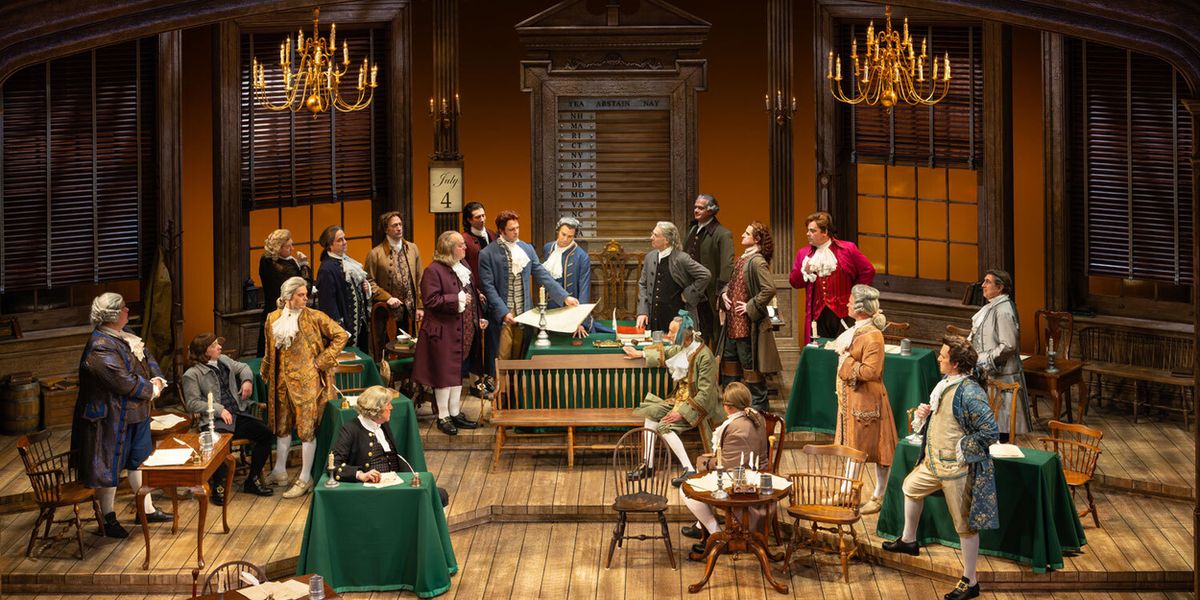
The Walnut Street Theatre’s opening night production of 1776 is, quite simply, magnificent. It arrives not merely as a theatrical event, but as something more essential—an experience that feels necessary. For the audiences who will undoubtedly fill the seats of America’s oldest theatre, this production offers both exhilaration and reflection. At a moment when civic discourse often feels strained, 1776 reminds us—powerfully—of the messy, fragile, and ultimately inspiring birth of American democracy.
Director and choreographer Glenn Casale has shaped this production with extraordinary precision. Like a pointillist master—one thinks of Georges Seurat’s A Sunday Afternoon on the Island of La Grande Jatte—Casale assembles countless fine details into a cohesive and luminous whole. Every moment feels deliberate, every gesture purposeful, resulting in a staging that is both visually striking and emotionally resonant.
The production is anchored by a formidable cast drawn from the Philadelphia region’s finest talent. Ben Dibble leads with vigor and nuance as John Adams, capturing both the character’s relentless drive and underlying vulnerability. Jeffrey Coon brings gravitas and flair to Richard Henry Lee, while Scott Greer offers a warm, wry, and deeply human Benjamin Franklin. Fran Prisco’s Robert Livingston adds further strength to the ensemble, and the company as a whole operates with seamless cohesion. Each performance contributes to a collective energy that drives the narrative forward with clarity and conviction.
Lucy Horton’s Abigail Adams brought both grace and emotional resonance, her mellifluous voice soaring in the duet “Till Then,” imbuing it with a palpable sense of longing and devotion. Kathryn Brunner’s Martha Jefferson offered a striking contrast, infusing “He Plays the Violin” with playful sensuality and suggestive nuance that added unexpected texture to the evening.
The close of Act I proved deeply sobering. As the Courier, Isaac Ripley became the human cost of revolution incarnate—his tear-filled eyes reflecting the burden of young lives lost to war, a moment that visibly rippled through the audience with shared emotion.
Equally arresting was Ben Michael’s 2nd Act commanding rendition of “Molasses to Rum” as Edward Rutledge. Delivered with searing intensity, the number exposed the stark hypocrisy within the Congress (many Northerners had slaves) and became a dramatic fulcrum, driving the uneasy compromise on slavery with chilling clarity.
Design elements across the board are exemplary. From the beatific scrim that greets the audience upon entering the theatre to Roman Tatarowicz’s richly realized period set, the visual world is immersive and evocative. Mary Folino’s costumes are elegant and historically grounded, while Ryan O’Gara’s lighting design enhances both the intimacy and scale of the storytelling. Ed Chapman’s sound design ensures clarity and balance, and Carissa Thorlakson’s wigs and makeup provide the finishing touches that bring these historical figures vividly to life. There is a remarkable absence of flaws—an achievement that speaks to the production’s meticulous craftsmanship.
Music Director Chris Burcheri leads a superb ten-member orchestra that feels fully integrated into the performance. The musicians do not simply accompany; they participate, underscoring the drama with vitality and precision. The vocal performances are equally thrilling, with harmonies that echo the richness and authenticity of the original Broadway production.
At its core, 1776 is a story of individuals—flawed, passionate, and often divided—grappling with the immense challenge of forging a new nation. The musical captures the debates, compromises, and personal sacrifices that shaped the Declaration of Independence. It is a narrative filled with tension and humanity, reminding us that democracy is neither simple nor inevitable, but rather the product of courage, persistence, and collective will.
This production does more than entertain; it invites reflection. It asks us to consider the meaning of leadership, the value of dissent, and the enduring importance of striving toward a more perfect union. It asks us to put into historical prospective and thereby evaluate what this present administration under the Orange Jesus is doing to alter democracy into authoritarianism.
The audience was both moved and inspired by this production. Aisle Say considers himself privileged to witness it.
Through May 31
1776 The Musical -- Walnut Street Theatre -- Philadelphia, PA -- Official Website
Sign up for all the news on the Fall season, discounts & more...
|
Beetlejuice JR. Second Street Players (10/09-10/18) |

|
Run For Your Wife Kent County Theatre Guile (9/11-9/26) |

|
Hedwig and the Angry Inch Milton Theatre (10/21-11/01) |
|
SLOW FOOD Resident Ensemble Players (2/07-3/07) |
|
GASLIGHT Resident Ensemble Players (4/22-5/09) |

|
FIREFLIES Resident Ensemble Players (10/29-11/15) |
|
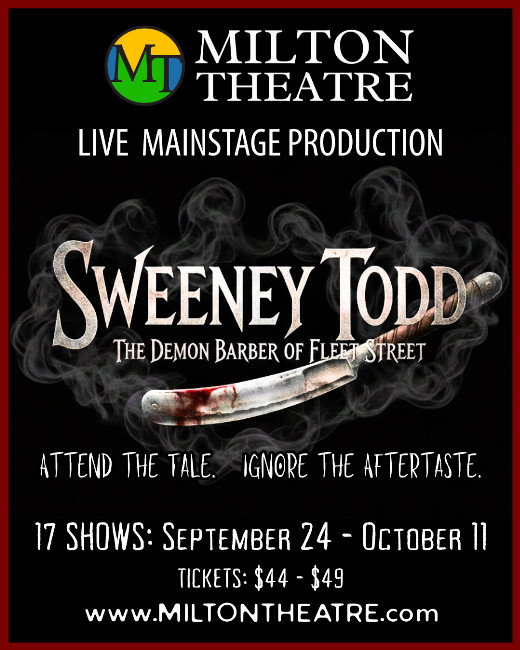
Sweeney Todd: The Demon Barber Of Fleet Street Milton Theatre (9/24-10/11) |

|
Winter Lights & Voices: A Holiday Celebration in Delaware The Grand Opera House (8/03-8/01) |

|
ELF: The Musical Milton Theatre (11/19-12/13) |

|
She Loves Me Possum Point Players (11/13-11/22) |

Reader Reviews
To post a comment, you must register and login.