Photos: SOMM Recordings to Release Chamber Works by Ivor Hodgson and Sir George Dyson
The label continues its partnership with I Musicanti for releases of string quintets, a septet, and a violin concerto.

SOMM Recordings continues its partnership with the mixed-instrument ensemble I Musicanti in a release of chamber music for strings by the British composer Ivor Hodgson. I Musicanti and its founding artistic director, double bass virtuoso and conductor Leon Bosch, share with SOMM a commitment to artistic enterprise, and their collaboration, combining advocacy, scholarship, and performance, has built a distinctive and critically acclaimed discography.
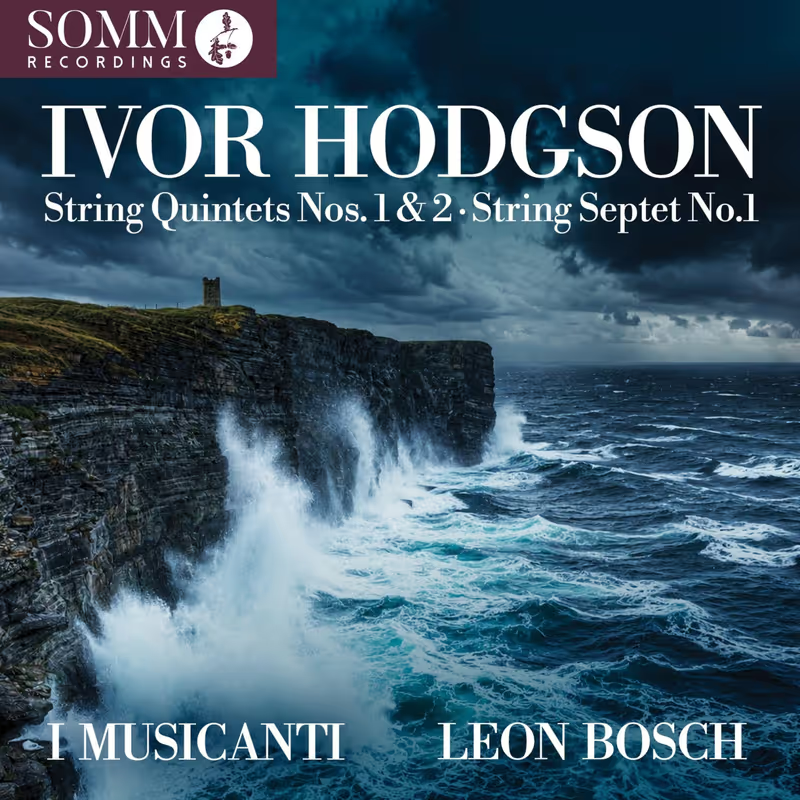
The release, SOMM 0734, is titled Ivor Hodgson: String Quintets Nos. 1 & 2; String Septet No. 1, and is set for release on 20 November 2026.
Hodgson's 2025 SOMM debut featured his first Piano Quintet performed by I Musicanti and Peter Donohoe on a release of British Piano Quintets (SOMMCD 0707). This new release features three of his chamber works: his String Quintet No. 1, 'Sonata da chiesa;' String Quintet No. 2, 'Twinkle, Twinkle Little Star;' and String Septet No. 1, 'The Women of Gairsay.'
Although Hodgson has composed a great variety of music in all genres, it is perhaps chamber music that lies closest to his heart, and the three significant works on this release are indicative of his inherent mastery of the genre. His proficiency is fully demonstrated in his earliest composition, the String Quintet No.1, 'Sonata da chiesa,' which takes its name from the musical form that emerged in Italy at the beginning of the 17th century. Hodgson's sonata is in three movements: 'Come una chiesa' (Like a Church); 'Processione;' and 'Pregare' (To Pray). The composer displays his structural and expressive command in music that finds depth in what might at first appear to be quite simple material.
Whilst Hodgson's String Quintet No.1 was his first completed composition, his String Quintet No. 2, 'Twinkle, Twinkle Little Star,' is his most recent. It was inspired by a Dark Sky experience in New Zealand that sparked an idea for a piece that would portray the continual shifting of light and distances involved in travelling through space. Each movement reflects on the beloved nursery rhyme: 1: 'Twinkle, twinkle, little star, how I wonder what you are;' 2: 'Up above the world so high, like a diamond in the sky;' and 3: 'Twinkle, twinkle, little star, though I know not what you are.'
The poem 'The Women of Gairsay,' written for Hodgson by the Scottish journalist and writer Erlend Clouston, weaves together themes of Viking journeys, the resilience of the women left behind, and the interplay of hope and loss, with the sea ever present. The seven movements of Hodgson's String Septet No. 1, 'The Women of Gairsay' quote from the work—Women's lament | Chorale of the dragon men | Bury the drum beat | Raven's beak | Skimming stones | Glacier wind | The boat that never came back—providing an outline to the poem and the music it inspired.
Sir George Dyson: Violin Concerto; Hierusalem & At the Tabard Inn
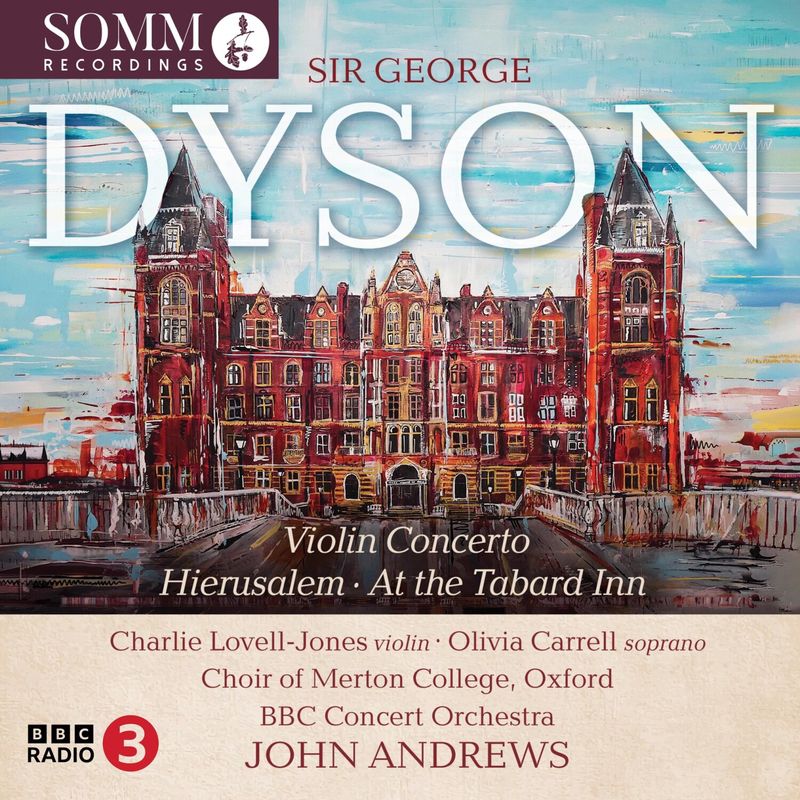
SOMM's second November release, SOMMCD 0735, is Sir George Dyson: Violin Concerto; Hierusalem & At the Tabard Inn, also releasing 20 November 2026.
The presence of several recordings of Sir George Dyson's music in SOMM's past catalogue bears witness to the label's strong advocacy and affinity for the Yorkshire-born composer and organist. They include a release of his Choral Music conducted by Sir David Willcocks (SOMMCD 014); premiere recordings of St. Paul's Voyage to Melita and Agincourt with Vernon Handley conducting the Bournemouth Symphony Orchestra & Chorus (SOMMCD 234); and The Open Window, Complete Music for Piano with Simon Callaghan (SOMMCD 0622-2), which was selected for a Gramophone Critic's Choice and received a four-star review from BBC Music Magazine. With their latest release, SOMM reminds us of the true worth of Dyson's music, which still remains unaccountably neglected.
This new release includes Dyson's 1943 overture, At the Tabard Inn; his Violin Concerto from 1941; and a hymn from 1956, Hierusalem, with the BBC Concert Orchestra and Choir of Merton College, Oxford led by John Andrews, who has conducted many of the UK's leading ensembles and is an exponent of neglected English music. The vocal soloist in Hierusalem is London-based lyric soprano Olivia Carrell, noted for her 'silvery soprano' and 'stunning' singing. Welsh violinist Charlie Lovell-Jones has been recognised as one of the most promising international soloists of his generation since making his sold-out Royal Festival Hall debut at the age of 15.
George Dyson (1883 – 1964) showed early talent as an organist and, in 1900, he won an open scholarship to the Royal College of Music, where he studied organ with Dr William Stevenson Hoyte and composition with Sir Charles Villiers Stanford. In 1938 he became the first alumnus to be appointed director of the RCM.
Among his most notable works of this period is the four-movement Violin Concerto, which was favourably received by both the press and the public. The Italian-born violinist, composer, and critic Ferruccio Bonavia noted that '…every note, every phrase is essentially 'violinistic,' conforming in every way to the special genius of the instrument.'
Following the success of his Violin Concerto, Dyson returned to his internationally renowned 1931 choral masterpiece The Canterbury Pilgrims, which is unique in that no other composer before or since has devoted such attention to Chaucer's epic of mediaeval English literature. Dyson added to his oratorio the full-scale overture At the Tabard Inn. Named for the Southwark hostelry from which the pilgrims set out on their journey, this is a work of great charm and brilliance.
Scored for soprano soloist, choir, string quartet, and string orchestra, Hierusalem evokes a vision of heaven that is at once melancholy and tender, yet also luminous, delicate, and joyful. There is a sense of retrospective contemplation, as though Dyson, in declining health, might be reflecting on the nearness of his life's end.
Bruckner: Symphony No. 8 (Newly Remastered)
SOMM's third November release is Bruckner: Symphony No. 8 (Newly Remastered), ARIADNE 5052, also releasing 20 November 2026.
SOMM Recordings is paying tribute to the 50th anniversary of legendary conductor Rudolf Kempe (1910 – 1976) by re-issuing his 1971 ex-libris stereo recording, which was first released in 2000. This performance of Kempe conducting the Tonhalle-Orchester Zürich in the Symphony No. 8 in C Minor by Anton Bruckner was recorded at the Zürich Tonhalle Studios, and it now features remastering by Lani Spahr.
Kempe served as the Chief Conductor of the Tonhalle-Orchester Zürich from 1965 – 1972, and this rare recording of Bruckner's Eighth Symphony is an important memorial of his tenure. His sudden death at the age of 65 in May 1976, ten months after being appointed chief conductor of the BBC Symphony Orchestra in London, was truly a profound shock to the world of music.
Robert Matthew-Walker writes: 'Kempe's knowledge of the score – he almost invariably conducted from memory – combined with his sensitivity and deep musicianship, his experience as an orchestral player and his imaginatively flexible approach to structure and phrasing marked him out as a true master. We must profoundly regret that he did not record more Bruckner: in his hands, the Eighth Symphony is a tremendous revelation of the composer's genius, for he shows it to be one of the greatest symphonies of any period, enormously powerful, vast in conception, full of wonderful melody and orchestrated magnificently.'
Bruckner's Eighth is his last completed symphony and the only one to be published before its first performance, which took place in 1892. Two complete autograph manuscripts of the symphony exist, dating from 1887 and 1890, and there are multiple editions. The first edition, containing some relatively minor changes from the 1890 manuscript, was the version used at the first performance. The Austrian musicologist, Robert Haas, took what he admired from Bruckner's different versions and combined them into his own edition. His version has proved enduringly popular, and it is the one used by Rudolf Kempe.
SOMM has embraced historical recordings from its founding in 1995. Since its first forays, much has changed in the field of re-issued historical performances. Most notable, for SOMM, is the label's close collaboration with audio restoration engineer and producer Lani Spahr, which began with the issue of a four-CD set, Elgar Remastered, in 2016 and has since produced a multitude of critically acclaimed recordings. Gramophone has noted, 'There are historic releases that make the grade because they are just that – 'historic' – and there are releases that make history because they are musically overwhelming. This set is both.'



Sign up for all the news on the Fall season, discounts & more...
.jpg?format=auto&width=300)