
Interview: Tony Winner Susan Hilferty On Dressing WICKED's Ozians & More
The musical runs through November 15 at the Citizens Opera House.
Costume Designer Susan Hilferty – who amassed a mantel-full of awards, including the Tony, Drama Desk, and Outer Critics’ Circle Awards, for the musical “Wicked,” being presented by Broadway In Boston at the Citizens Opera House through November 15 – got an early start on a career that so far includes 27 Broadway shows, including the Tony Award-nominated revivals of “Parade” (2023), “Funny Girl” (2022), and “Present Laughter” (2017) as well as 2005’s “Into the Woods” and 2006’s “Spring Awakening.”
Indeed, the costume and scenic designer began making her own clothes as a 12-year-old growing up in Arlington. In her early life, Hilferty also tried her hand at acting in high school productions. During her undergraduate years at Syracuse University, she majored in painting with a minor in fashion design, and credits her junior year studying abroad in London as the experience that led her to design for the theater.
After graduating from Syracuse, Hilferty relocated to New York City, working as a freelance Costume Designer and as a draper for a few years before earning a Master of Fine Arts degree in theater design from the Yale School of Drama. Currently Hilferty is a full Arts Professor in the Department of Design for Stage and Film at New York University’s Tisch School of the Arts, having served as chair for 25 years.
Her design credits include some 400 theater, opera, and dance productions around the world, including 45 collaborations with the late South African playwright and director Athol Fugard as well as Taylor Swift’s “Speak Now World Tour.” Hilferty is best known, however, for “Wicked,” the Stephen Schwartz musical, with book by Winnie Holzman, set in the Land of Oz before Dorothy Gale’s arrival. Loosely based on the 1995 novel “Wicked: The Life and Times of the Wicked Witch of the West” by Concord’s Gregory Maguire and inspired by L. Frank Baum’s 1900 novel “The Wonderful Wizard of Oz,” the show opened at Broadway’s Gershwin Theatre in October 2003 – with original stars Kristen Chenoweth as Glinda Upland and Idina Menzel as Elphaba Thropp – where it continues to play to sold-out audiences.
.jpg?format=auto&width=800)
On a recent sunny day, Hilferty was sitting outside the Baruch Performing Arts Center on the Manhattan campus of Baruch College during a break from a meeting about her latest project, “Galileo: A New Musical,” which opens at Broadway’s Shubert Theatre in November, when she took a Zoom call to discuss “Wicked,” "Galileo: A New Musical" and more.
How has “Wicked” changed your life?
I landed “Wicked” at exactly the right moment in my life. If it had come along any earlier, I would not have been able to engage in it in the same way. Five years earlier I might not have had the power or strength even to have imagined the kinds of designs I created for “Wicked.” This show gave me the opportunity at the precisely right moment to move into a type of storytelling that I really love.
How would you describe your role as the Costume Designer for a Broadway show?
I believe that with every show I design, I am creating a culture and a world. The role of the designers is to find the clues in the text that not everybody sees. Not everyone will get that Elphaba and Glinda’s friendship is being presented in “Wicked” as a meeting of equal forces from the earth and sky. What the audience can relate to, though, is that they have conflict, they learn about each other, and then, as the song goes, they’re changed “for good.” I still enjoy their journey, and I love that my costumes help bring it to life.
When did you know that you hit your target in designing the costumes for this show?
I had done piles of sketches and then there was a moment when I knew, in one sketch, that I had captured something that I call “twisted Edwardian,” meaning that the costumes are influenced by the Edwardian era, because the novel was written around the turn of the last century, but in "Wicked" it's twisted. I had a lot of dressmaking experience so what I did also involved traditional millinery – it’s tailored – but there’ll be a coat with three sleeves, or something that’s done backwards.
Did you know from the beginning that “Wicked” would become one of the most successful shows in Broadway history?
Not at all. This was an example of how you stay alive when you’re working on a new show. When we did “Wicked” out of town, in San Francisco, the reviews were mixed and the whole experience was very fraught.
Give me an example of what you mean?
In act two, I had Nessarose, Elphaba’s younger sister and the governor of Munchkinland, dressed as if she were a Hollywood starlet. She was all made up and she had on a pink robe, and a glamorous one at that. If you know “Sunset Boulevard,” then you know how Nessarose was originally done. At the time, I thought, “That’s how she should look – that’s her world.” But I looked at the stage and thought, “Oh no. This is wrong. This is totally wrong. Nessarose needs to be the opposite. She needs to be withdrawn, almost like she’s in widowhood.”
Once you get the go-ahead to make a change, how quickly does it happen?
It depends, you never know. It’s about compromise and collaboration. You’ve got to deal with that. It depends on the maker. If you need anything made, the wardrobe staff can make the change. In the process of developing a new show, it’s all about how you stay open. For me, that’s terrifying. Everything that I put into the costume designs, all that energy and all the money that we put into “Wicked,” but there were times when I had to say, “You know what? It’s not telling the right story.” And we had to let something go.
In terms of changing costumes, what presents the biggest challenge?
When we do things involving changing the order of a song, nothing could be more traumatic. But it’s important if you have a song in the wrong place. that you move it. That often means, however, that every cue will have to change, including all the actors’ entrances. It could impact their costume changes, too, but that’s what we’re doing. That’s what we all understand. Everything is focused on the story and the music, not the budget.
Not the budget? Not at all?
Well, of course, the budget is always a part of it, and time is as well. There’s never enough time and there’s never enough money. You have to decide whether something is important enough to make a particular change.
But it is if it tells the story. And nobody ever knows, you know. “Wicked” is a perfect example of a show that had gone through so many shifts and changes by the time it opened. But once you get the go-ahead to make a change, it’s all about how quickly that can happen.
The 1939 movie “The Wizard of Oz” was produced by Metro-Goldwyn Mayer, and the distribution rights are now controlled by Warner Bros., while Universal Stage Productions is behind “Wicked.” Did you encounter any rights issues with your designs?
Yes, and to be very clear, legally that was an interesting part of the process for me. I wasn’t remotely interested in the movie because I was finding my own way into the story, and “Wicked” is very different from “The Wizard of Oz.” But at the same time, because Warner Bros. has the distribution rights to the movie, and Universal was producing “Wicked,” we were told we were not allowed to use anything from the movie.
Instead, the design team had to use illustrations from the Baum books as our influence. For instance, one of the reasons we could use the bubble machine was because in one of the books, the Wizard is shown to have invented it. The bubble machine didn’t come from the movie – it came from the books.
.jpg?format=auto&width=800) What about Glinda’s gown, which may remind some of the Adrian design worn by Billie Burke in the movie?
What about Glinda’s gown, which may remind some of the Adrian design worn by Billie Burke in the movie?
In that case, I had to literally present my case to a group of lawyers, because they did not want to be in a position where they might be called out by Warner Bros. on it. So I did a presentation of my design, inspired by Queen – then Princess – Elizabeth II’s 1947 wedding dress by Norman Hartnell.
The wedding dress has a silhouette like Glinda’s gown. My ideas for that silhouette and design were to connect Glinda to the sky and Elphaba to the Earth.
What did you think of Paul Tazewell’s costume designs for the feature films “Wicked” and “Wicked: For Good”?
When it comes to the stage and film productions of “Wicked,” Paul Tazewell, who did the costumes for both movies, talks openly about being influenced by my Glinda dress. Paul knew that there were certain things he had to use, and he understood that I had created iconic costumes for “Wicked.” It was all fine, though, because Paul is a friend and we respect each other’s work.
In the stage show, what makes the gown more than just fashion?
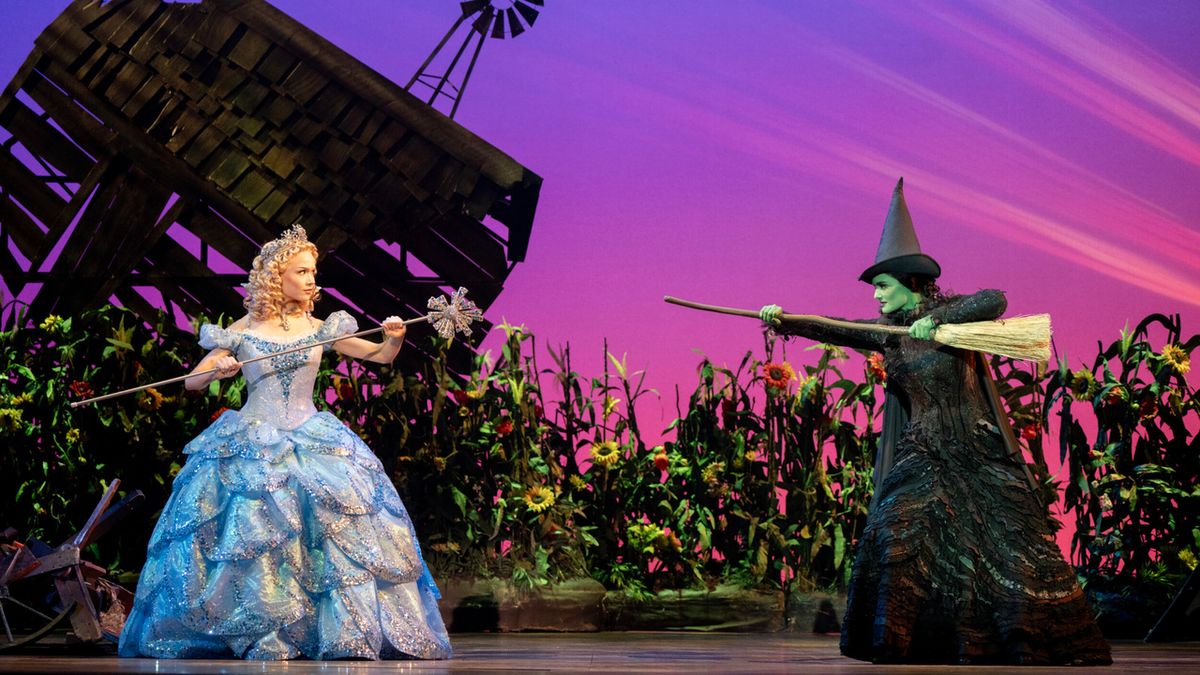
That while it looks like a ball gown, it can also fly. It’s a question of physics. It’s made to look light and airy when Glinda wears it to glide in on her bubble, but there are 68,000 hand-sewn sequins on the garment so it’s quite heavy. I designed it, though, to remind fashion-conscious audience members of Dior. It was important to me that people know that Glinda shops from the House of Dior Oz.
The blue dress’s real achievement, though, is that it serves both fashion and function. Instead of being a Dior corset, the inner structure of the dress is strong enough to hold a safety harness, so the performer is always protected.
Fiyero, the handsome young male lead, is dressed for success, too? What were the inspirations for that character’s look?
My research for Fiyero took me to princes not only of Europe but of Hollywood. The idea of princes led me to polo and riding clothes, which led to the creation of one of the most-discussed items of clothing in the show – Fiyero’s pants. I don’t know what polo looks like in Oz because it’s not clear what kind of animals they’re riding, but I know that polo comes with physical effortlessness. So, when Fiyero arrives, you’re immediately conscious of his physicality.
Not many shows are still going strong 23 years into their Broadway run, while also touring North America and the world. As you see it, what makes “Wicked” so enduringly popular?
Nobody thought it would run for a long period of time. But once it opened on Broadway, it took off and before long, it became a phenomenon. One of the things that’s made the show so successful is the support of our producers, because they made the commitment at the beginning that the tour would look exactly like Broadway. That’s a huge commitment on their part. There are many other people who, when a show goes on the road, take an “it doesn’t make any difference” approach.
What does maintaining the show at the very highest level mean in terms of the costumes?
It's all about not compromising. We have the show that’s on stage, but we also have a lot of actors ready to go into certain roles. Those are called swings. And over the years, I designed a set of swing clothes. Because all the clothes are one of a kind on stage, you can’t have an understudy wearing what’s already on stage. They have to have their own track of clothes.
Does that create challenges?
It certainly can. About nine months ago, we ran out of understudy clothes. It was just the way it was working, sometimes two swings would show up, and they had the same track of clothes. I had to design eight new costumes that would fit into a show that I had designed 25 years earlier. That was an unbelievable lesson for me. I thought, “What is my instinct? What is the idea? How do I make these new costumes work in the tracks that they might go into?”
It was quite an experience to have to do that because it included the millinery, the garments, the shoes, all the pieces that I designed. I was starting from scratch – taking what I learned over time and working with the people on the road, including my gifted and passionate Associate Costume Designer Amanda Whidden, the costume coordinator of “Wicked” Worldwide, who take care of my stuff. We needed certain exact fabrics, so I designed them and had them specially woven.
What’s your favorite show you’ve worked on?
Every show I work on is my favorite show. For me, the only way to work is to say, “This is my favorite show, and it’s the best play ever.” Now it’s “Galileo: A New Musical,” a terrific new rock musical starring Raúl Esparza, Joy Woods, and Javier Muñoz, about Galileo defending his findings about the universe from the Catholic Church.
The score is by Michael Weiner and Zoe Sarnak, and the book is by Danny Strong. Michael Mayer – who I worked with on “Spring Awakening” 20 years ago, and more recently the “Funny Girl” revival – is directing and that makes me very happy, because I love working with him.
Do you have a favorite costume from “Wicked”?
That’s an easy one to answer. Every actor comes up to me and whispers, “I have the best costume.” And I tell the person, “Yes, that’s my favorite, too.” What I would say to you is that every costume is my favorite. They’re all telling stories of either the maker or the actor. And they all have memories attached to them.
Photo caption: Above, Claudia Bennett as Glinda and Aline Mayagoitia as Elphaba in a scene from the North American tour of “Wicked.” Photo by Joan Marcus. At left, headshot of Susan Hilferty and one of her costume sketches for Glinda, courtesy of Broadway In Boston.

Sign up for all the news on the Fall season, discounts & more...
|
Powered by

|