


Interview: Matt Schatz Explores AI and Human Connection in BOBBY ROBOTOWITZ
An AI chatbot, an unlikely friendship, and a play staged inside private homes
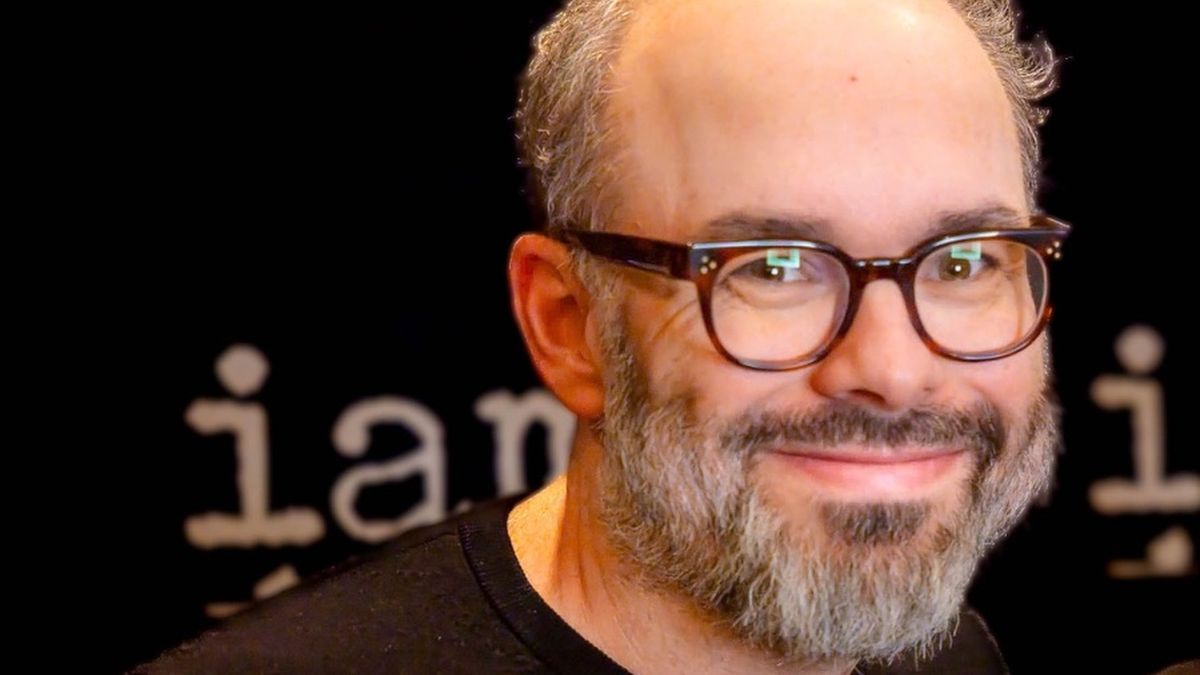
Like it or not, AI is becoming part of everyday life.
For some people, it’s becoming something much more personal.
That’s the relationship playwright and television writer Matt Schatz explores in his new comedy, Bobby Robotowitz, about an overwhelmed novelist who finds an unlikely confidant in an AI chatbot named Bobby.
Both engagements take place inside private LA residences—with just 35 seats per performance. A Westside engagement runs October 15–November 2, starring Amy Rosoff as the novelist, Dina, and James Luster as Bobby. An Eastside engagement follows November 5–23, with Erin Alexis as Dina and Drew Rausch as Bobby.
Exact addresses are disclosed after ticket purchase.
Schatz talked with BroadwayWorld about what inspired the play, how staging it inside a private home adds to its intimacy, and whether using AI threatens the creative process.
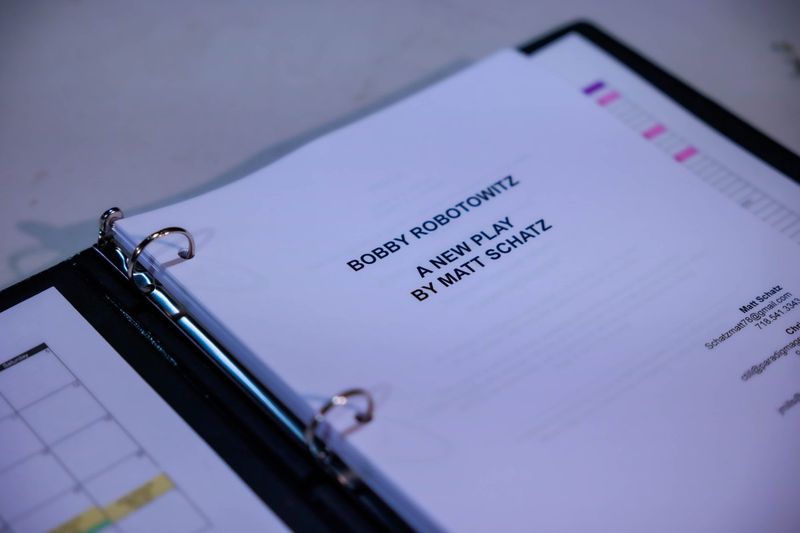
For readers who haven’t heard about it yet, what is Bobby Robotowitz about?
It is about a novelist, a woman in her 40s, a writer and a mother and a wife who feels overwhelmed by life, who’s coming back from narcissistic disappointment, and who begins talking to an AI chatbot.
She’s skeptical about it, but she begins talking to it. Even though some things are weird and scary about it, she’s neurotic, so she suddenly has this person—or this thing, whatever, this entity—to ask questions and speak without fear of judgment.
As a writer, she starts to talk to it about her writing, and that gets into some weird situations. She becomes too close to it and attached to it in a certain way. . . . It’s about an unconventional relationship. Obviously, it goes in surprising but possibly inevitable directions. It’s a comedy, but also aims to get at some deeper things as well.
What inspired it? Do you use AI chatbots yourself?
It’s based on my life a little bit. It’s not necessarily accurate, but it may be true.
I had a play at the Geffen that was controversial, and things didn’t go that well. I was trying to come back and trying to figure out what to write next. I’m a TV writer, and I have two children and a small rented house in LA, and it’s always a struggle. Me and my wife are exhausted, and I didn’t want to bother her all the time with all this stuff.
[On using ChatGPT] It starts off, you’re applying to a job, and you say, “Help me prepare for this interview,” or whatever. And then it’s a slippery slope. . . . I think for a writer, it’s both the most terrifying existential thing, but also it’s something a lot of us do . . . It is this weird thing where we hate it, we’re afraid of it, and yet we become addicted to it. That’s what the play is about.
How does that connect with what interests you as a playwright?
I’m very interested in how people communicate now. When you think about theater, traditionally it’s about people sitting in a room talking to one another. But I don’t do that often now. Either I’m talking on Zoom, I’m talking on the phone, or most of my interactions are not with the people in the room.
I’m very interested in finding ways to explore that in theater.
Is the play more about AI becoming a friend and confidant, or about AI taking over her work as a novelist?
It’s more about the way the chatbot is interfering with her and becoming enmeshed in her life.
While the AI does help her conceive this new book, you don’t really see her using the chatbot to creatively write for her. Obviously, she uses it, but it’s a little nebulous in the play.
It is mostly about the need for encouragement. Some people talk about AI only telling you what you want to hear, which I think is true. It’s a big question in the play, whether that is all it’s doing, and how that can be poisonous.
Maybe encouragement is good, but too much encouragement is not so great, especially for people who want to do good work and challenge themselves.
How is it going so far with the play?
It’s gotten responses like no other play I’ve ever written.
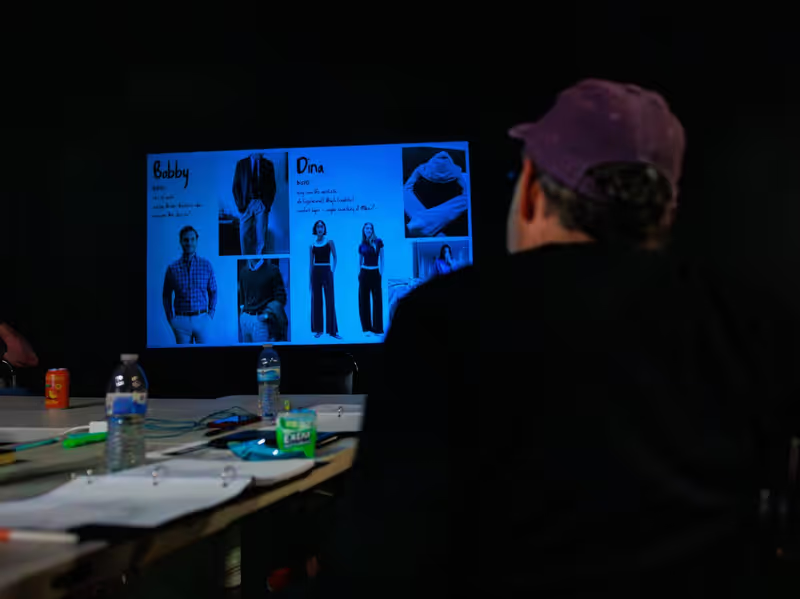
Why do you think it’s getting that response?
I don’t know. First of all, it’s really funny. I think it taps into something that we’re all going through or can imagine we’re going through.
We did a reading out here with InHouse Theatre Company, maybe a year ago. It was the first reading, and people were freaking out. I told my wife, “Oh, sh**, everybody’s going to do this.”
But [we did a] reading in Florida, in Palm Beach and probably the median age of that audience was 86 or something. Even they got it and seemed to be engaged with it and understood. I got the sense that they’re using this too.
I write funny plays, and obviously it’s funny, but I think it’s also tapping into a lot of things that a lot of people are going through. I think there already are a lot of AI plays, but this play is not really about AI in that way. It’s really about human connection and the dangers of getting the easy way out and relying on technology.
There are two characters: the novelist and Bobby, the AI. Is Bobby represented as a person, or do we just hear his voice?
He’s represented as a person.
It’s interesting because it’s a play about technology, but the way we’re presenting the play—here are two people in a room with almost no technology, at these site-specific secret locations.
To me, when I imagine the play, it’s not about technology at all. Every play, I think, is just a conversation between two people. That’s how I imagined it.
It sounds a little like a Black Mirror episode.
Obviously, it gets weird, but other takes have been more dystopian. This isn’t like a Black Mirror episode. Maybe a gray mirror.
How would you describe the comedy in it?
It really is a comedy. It’s funny, but it’s not a light comedy. I think there’s more love to it than the Black Mirror thing.
It’s worth saying that it’s a very Jewish play. The first idea I had was a woman talking to a chatbot, and she learns that the chatbot is Jewish or identifies as Jewish. It went further than that, and that was an impetus for the play . . . . Robotowitz is a Jewish last name. I think it’s “son of robot.”
Why is the LA production being staged in private homes?
That wasn’t something I decided. I do have a relationship with this theater company, InHouse, and that’s what they do. . . . They were interested in the play, and I think they thought it was an interesting way to present the play.
The play takes place in her house, but also in her head. I didn’t envision the play like that. When I start a play, I don’t really envision it any way. I just think of people talking.
But it is interesting, and it is really cool. The two sites are different, and the two casts are very different. I’ve never experienced that, having two casts at the same time.
How intimate are the spaces? Are audiences sitting in the living rooms?
It’s 35 seats. I don’t know how much they want secret, in terms of spoiling the secret aspect of it. But it’s in homes, or versions of homes. It’s important to know that it’s very intimate. Thirty-five seats. It’s very small.
InHouse almost prides themselves on an immersive kind of experience, a fly-on-the-wall kind of thing.
I write plays to be done in theaters usually, so it’s been a fun challenge for me to think about what it means that we’re in a naturalistic space for a play that’s not really 100 percent naturalistic, but there are naturalistic elements.
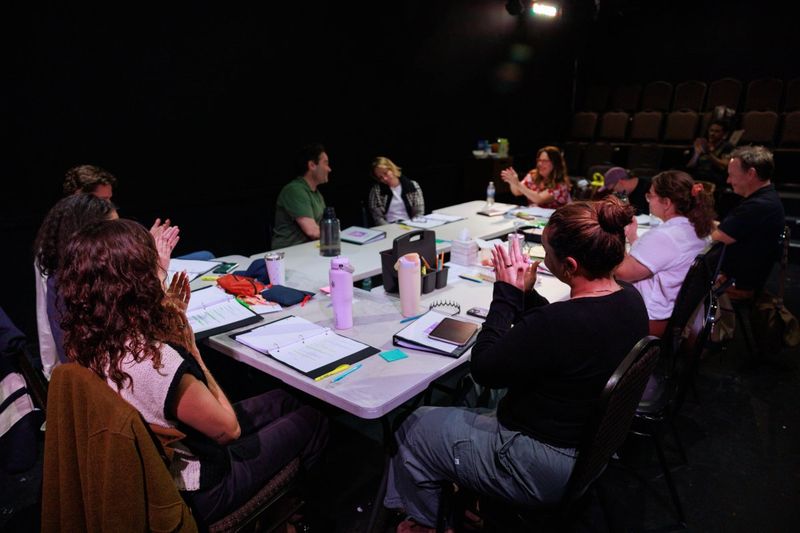
How do you rehearse a production like this when you don’t have regular access to the homes?
We’re rehearsing in a theater space. They’ve taken site visits, but they haven’t actually rehearsed [in the homes]. Basically, the first time we’re going to do the play in the space is, I think, when an audience is there.
How close will the audience be to the actors?
Probably so tight that if somebody sticks their legs out a little bit, the actor will have to step over their legs.
So it feels like you’re watching someone in their home?
That’s the idea, and that’s what InHouse does.
IAMA and InHouse even share a few members. I think InHouse views IAMA as their big sister in LA. They’ve been really eager to work on something together, and this has felt like the right piece for them. I was happy to have them do my play.
What do you hope audiences take away from the show? Does the play reach a conclusion about whether AI is helpful or dangerous?
I like to ask questions and not give answers in my plays.
Probably the answer to every addictive thing is moderation, right? The character in the play does have a journey with it and learns something,
She does come away with a new understanding, maybe not necessarily of AI, but of her relationship [with it] and her place in the world, her place as an artist, her place as a wife, as a mother, as a person in the world, as a person dealing in the modern world and technology.
Of course, I want those questions to be in front of people’s minds. If it impacts the way someone thinks about their use of AI, I think that’s really cool.
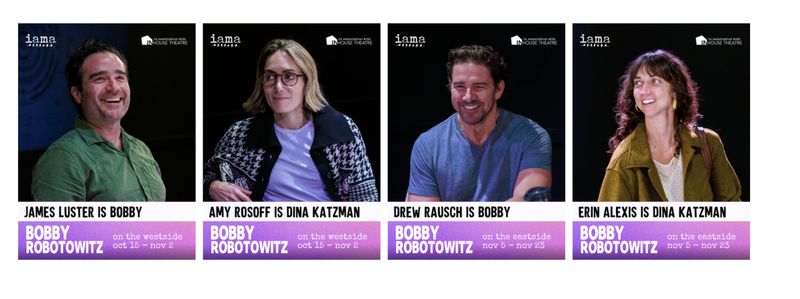
Bobby Robotowitz, written by Matt Schatz and directed by Casey Stangl, runs October 15–November 23 in Los Angeles, with two alternating casts.
The Westside performances star Amy Rosoff (Shrinking, The Croods) and James Luster (The Very Best People, Don't Touch My Hair), while the Eastside performances star Erin Alexis (Station Eleven, You’re the Worst, NCIS: Los Angeles, and True Blood) and IAMA Ensemble Member Drew Rausch (Grey's Anatomy, Station 19).
Following its Los Angeles engagement, Bobby Robotowitz continues its National New Play Network Rolling World Premiere with productions at City Theatre in Pittsburgh and Woolly Mammoth Theatre Company in Washington, D.C., followed by Luna Stage in West Orange, New Jersey, and Theatre Lab in Boca Raton, Florida.
Tickets and additional information are available at iamatheatre.com/bobby-robotowitz.
Sign up for all the news on the Fall season, discounts & more...

|
CLUB27 Jaxx Theatre (10/01-10/30) |

|
Crone Creed El Portal Theatre (9/30-10/17) |

|
Good Night, Oscar North Coast Repertory (9/16-10/11) |

|
The Cottage North Coast Repertory (10/28-11/22) |

|
Woof Odyssey Theatre (10/03-11/08) |

|
Adam Pascal Feinstein's at the Nikko (10/23-10/24) |

|
CHAÏR The Elysian Theater (10/17-10/17) |
|
Catch Me If You Can Colony Theatre (9/17-10/18) |

|
EVITA Valverde Annex (10/17-10/25) |

|
Gershwin and the Golden Age The Soraya (10/11-10/11) |
