Interview: John Ortiz on Finding Humanity & Hope in DOG DAY AFTERNOON
The acclaimed actor discusses uncovering the humanity beneath Detective Fucco's badge and why DOG DAY AFTERNOON feels more relevant than ever.

When John Ortiz stepped onto the stage of Dog Day Afternoon, it marked the end of a long absence from theater. “It's been 13 years since I've been on stage,” he explains, “and like 15 in New York.” His return wasn't something he had been actively pursuing. In fact, Ortiz thought much of his theatrical exploration had already happened earlier in his career.
“In those 13 years, I thought I had done it all when it came to theater,” he says. “It was in my 20s and 30s especially that I kind of exhausted whatever I had inside of me to explore with characters.”
Then came his 50s. “I hit my 50s, I'm reading plays, and I'm thinking, ‘Oh, these characters are a little different. I'm definitely different. Maybe it's time to go back.’” That opportunity arrived through playwright Stephen Adly Guirgis, whose adaptation of Dog Day Afternoon has become one of Broadway's most talked-about productions this season.
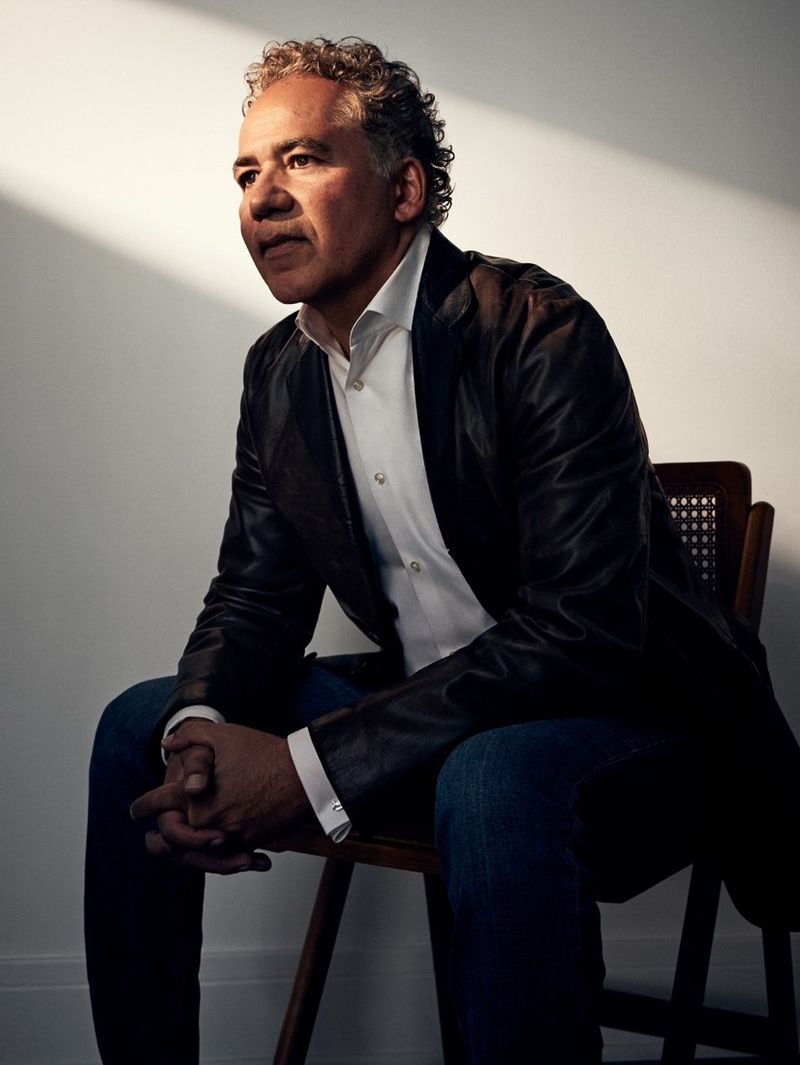
Photo courtesy of Polk & Co.
Ortiz has a long creative relationship with Guirgis and was familiar with the project's development from its earliest days. “I can't say no to Stephen,” Ortiz reveals. “And I thought, ‘Well, maybe it's time to go back to the theater.’”
What ultimately drew him to Detective Fucco was discovering the humanity beneath the badge. “I found Fucco to be really interesting,” Ortiz admits. “And Steven imagined something deeper in it if I was going to play him.”
That depth became especially important given the legacy of the source material. Like many theatergoers, Ortiz considers the 1975 film a classic. “I saw the film many years ago and was blown away,” he says. “I never saw anything like that on film. It was so powerful and emotional and raw.”
Initially, he questioned whether the story should even be adapted. “When I heard that they were doing a stage adaptation of it, at first I thought, ‘Why would you mess with something like that? It's kind of sacred.’” But he trusted Guirgis to find something new. “He just has that touch which hits deep into the heart and soul of people who are like a lot of the characters in this story,” Ortiz states.
One of the biggest differences between the film and stage versions, Ortiz notes, is how much more fully realized many of the supporting characters become. “You really didn't get a sense of who [Fucco] was behind the badge,” Ortiz says of the film. “Stephen wrote a great deal of that, and so much that it inspired me to do a lot of work that was not necessarily on the page.”
The result is a Detective Fucco who surprises audiences. Throughout the play, Fucco demonstrates flashes of empathy toward Sonny and Leon, particularly after learning more about their relationship. For Ortiz, that emotional shift comes from recognizing the character's own personal regrets.
The actor developed an extensive backstory for Fucco, imagining a once-promising officer whose life was derailed by tragedy, failed marriages, and missed opportunities. “One of the wrongs were his marriages,” Ortiz explains. “When he becomes familiar with the kind of love that Sonny and Leon share, it hits him,” he posits. “It hits him in a way that is personal, and he's affected by it.”
That recognition creates a softening. “It's all about, ‘I want that, I could have had that, and I can't anymore, but I can appreciate that in others.’”
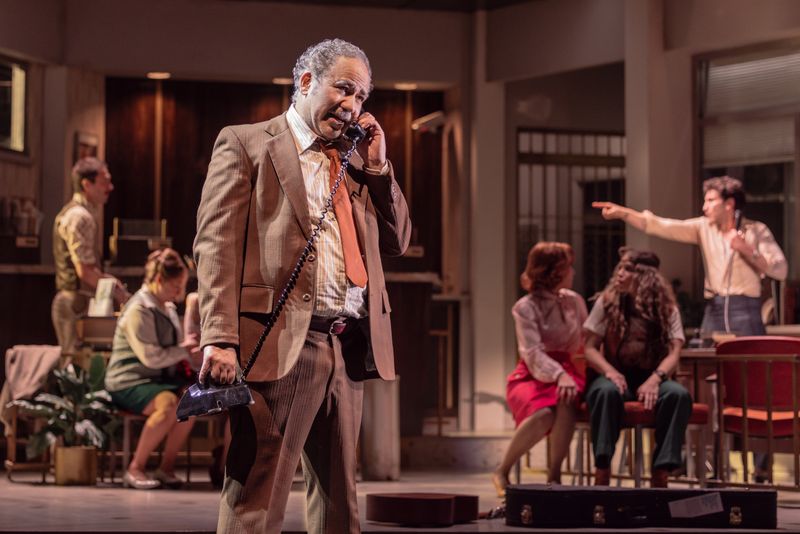
Photo by Matthew Murphy and Evan Zimmerman.
Those moments feel especially resonant given the production's LGBTQIA+ themes. “It's really cool that you take issues that happen in life—and because they're so guarded and taboo, or folks are afraid of them—you expose them in art,” Ortiz points out. “It's what makes theater what it is to folks like me.”
He believes those conversations remain just as relevant today as they were in 1972. “I got to say, it's not so different what's going on now with what happened then.” That same observation extends to the show's broader themes, as well.
Dog Day Afternoon explores distrust of institutions, economic desperation, media sensationalism, and ordinary people feeling left behind. Night after night, Ortiz watches audiences respond viscerally to those ideas. “The audience's reaction at the end of Act 1, when the participation that we ask of the audience is at full tilt, is powerful in the most visceral way I could have ever imagined,” he says. “It's like, ‘Yeah! Something is going through them that they can relate to.’”
Ortiz believes audiences recognize themselves in the story. “They're human beings, they're citizens living today in this city, in this country. Who feel like upset, and want change, and finally have the opportunity to say something.”
The production also manages a delicate balancing act between comedy and tragedy, something Ortiz credits directly to Guirgis' writing. “He's [Guirgis] so funny,” Ortiz explains. “His humor is always there. But it's not the most important thing.”
Instead of chasing laughs, Ortiz focuses on truth. “I choose to be as truthful as possible with what's happening.” And, the laughter follows naturally. “The real meal is if you stay on the track of playing the truth of what Stephen is writing.”
That balance extends throughout the entire production, where humor and heartbreak often coexist within the same moment. “Both of those things have to be there, battling each other at all times,” Ortiz notes.
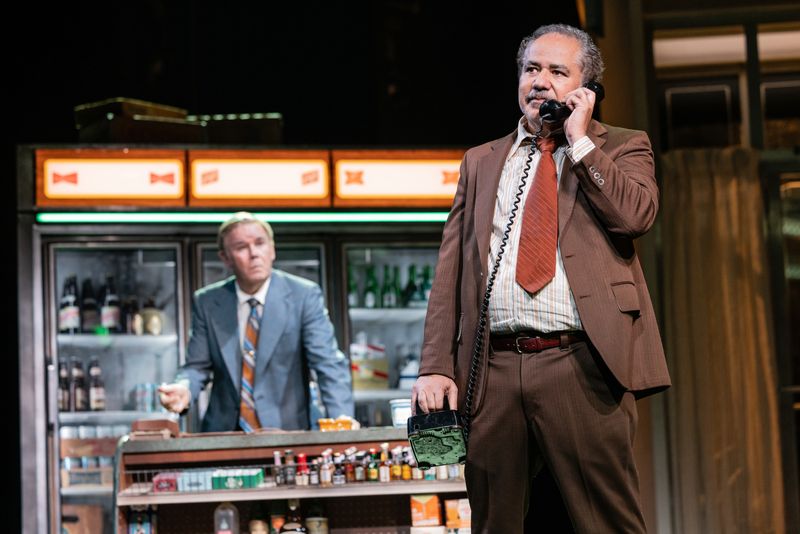
Photo by Matthew Murphy and Evan Zimmerman.
Naturally, Ortiz is equally enthusiastic about the Tony-nominated creative team helping bring the world of Dog Day Afternoon to life. Speaking about David Korins' scenic design, Ortiz described the experience as transformative.“It makes it more exciting. It makes it helpful. Very helpful,” he elaborates.
The actor also praised the work of lighting designer Isabella Byrd. “The lights are amazing and the design is just so good,” he says. Meanwhile, Brenda Abbandandolo's costume design helped him unlock Fucco almost instantly. “This was the only show that I stepped into a fitting with the very first suit I wore, I tried on, that was it,” he adds. “I really felt like I found a big part of Fucco once I put that suit on.”
As Dog Day Afternoon heads toward the end of its Broadway run, Ortiz hopes audiences leave carrying more than just memories of a powerful night at the theater. “I imagine them speaking about how they must act out on who they really are and what they really believe in, and love who they want to love, and to not be afraid of anything,” he says. Because ultimately, he says, fear is no match for what lives in the human heart. “Fear is just in your head. And what we have in our hearts is so much bigger.”
Dog Day Afternoon runs through July 12, 2026 at the August Wilson Theatre (254 West 52nd Street, New York). Tickets and additional information are available at www.DogDayAfternoon.com.

Sign up for all the news on the Fall season, discounts & more...
Powered by

|
.jpg?format=auto&width=300)