


Interview: Chelsea Haaland EXECUTIVE DIRECTOR at Des Moines Playhouse

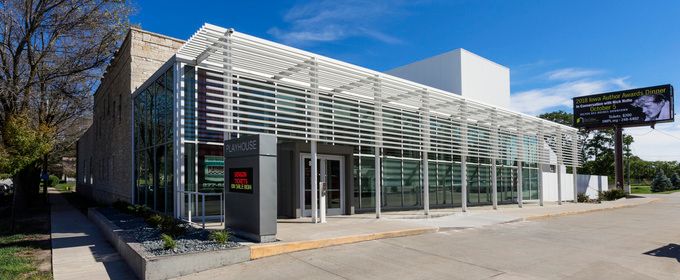
A new theatre season is here. With a new season, we are also welcoming a new Executive Director to Des Moines Playhouse. After a multi-month search, Des Moines Playhouse announced its new Executive Director, Chelsea Haaland. Watching the response to the announcement showed how much of an impact Chelsea had already made at Des Moines Playhouse and the community. I know I was among the people excited to see Chelsea step into the position, so when the opportunity arose to do an interview, I was excited to say yes.
DC Felton (DF): Des Moines Playhouse audiences have seen your name before as an actor, director, stage manager, etc. What is something that audiences might find surprising about you?
Chelsea Haaland (CH): I think many people assume that someone who chooses to be involved in theatre is probably fairly extroverted. I am quite introverted and I enjoy watching a crowd rather than being in one. Because of that, it is easy to keep my interests fairly siloed. I think that people who know me from one domain are sometimes surprised to discover my involvement in another area. My education colleagues were surprised I performed, my performance colleagues were surprised I directed, and so forth. Theatre has been a special interest of mine since childhood, and I have enjoyed being involved in every facet possible.
If you’re looking for “fun fact” trivia: I got ordained online so that I could officiate the wedding of one of our favorite couples, and I know more than a little about antique “orphan baby” cars thanks to my dad’s lifelong automotive history interest - my birth announcement even ran in an international car club newsletter.
DF: What got you interested in theatre?
CH: My first involvement in theatre was when I was seven years old. My childhood church put on elaborate productions every summer and every Christmas. I was terribly shy - like, hid inside of circular department store clothing racks to avoid friends I didn’t expect to see - and my mom thought being part of a play would help. I was cast in the Christmas show and played a girl named Wendy who whined, “Oh, no!” every scene until the redeeming end when I finally said, “Oh, yeah!” All of my grandparents attended and people laughed at my lines. I remember feeling very important, and from then on, I was regularly cast in parts at church.
It wasn’t until middle school when I branched out to other opportunities. In sixth grade, I was cast as an orphan in the high school’s production of Oliver!, directed by the late Denis Hildreth - whom I later succeeded as director of the Hoover High School Drama Department. In seventh grade, I worked on a show with teacher Cate Miller (then known as Ms. Seeley), someone who is now a Playhouse regular! I had great examples of theatre as a tool for belonging and engagement thanks to the experiences they fostered.
Perhaps my most pivotal moment, however, was seeing the second national tour of Miss Saigon at the Civic Center in 1998. Before then, theatre was an activity I did for fun. It was not an event I had witnessed myself, and I certainly had not seen performances of that caliber (or spectacle: I could feel the wind from the helicopter blades). I distinctly remember my dad crying at the ending, and this, more than the show itself, was a moment that moved me significantly. Theatre holds tremendous power, and there is great responsibility in determining how we will use that power to move an audience to think, act, or feel. I wanted that moment again and again.
DF: When did you start getting involved in the Playhouse?
CH:My first involvement in theatre was when I was seven years old.
My first show at the Playhouse was in 2000. I had only recently become aware of the Playhouse through a voice teacher who performed in The Secret Garden. Shortly after that show, some classmates were discussing a callback list for a production of Charlie and the Chocolate Factory that was going to include original music by someone who played piano for the choral program at my school. I lamented to him that I hadn’t known about auditions, and he suggested I confidently show up at callbacks like I was meant to be there and I wouldn’t be turned away. I ended up being cast in the ensemble (with current Front of House Manager Jake Skarin) and had the absolute best time. That’s the most “not me” story, as I am very much a rule-follower, but I am incredibly thankful to that pianist because without their suggestion, I may have never set foot in the Playhouse to this day!
After that, my family and I enjoyed attending shows, but I would not end up being in another show at the Playhouse for 19 years! Instead, I interned with the education staff in 2005-2007 and taught summer camps for many years after that, staying busy directing and coaching speech and theatre students. In 2019, I returned to the stage in Freaky Friday, and have since performed in School of Rock and Waitress, directed Charlotte’s Web, and stage managed Frozen. My daughter made her debut in 2022 in Matilda and has also been part of School of Rock, The Diary of a Wimpy Kid, and The Lightning Thief.
DF: What do you bring to the Playhouse from your work with arts in the Waukee School District and your involvement with the IHSSA and IHSMTA?
CH: During my interview process for the Playhouse position, I shared that I recognized I was likely an atypical candidate for the position. My background is entirely in public education, with 12 years of speech and theatre classroom experience and another six as the district point-person for all fine and performing arts programming; I also held a state officer position with the Iowa High School Speech Association, adjudicated for the Iowa High School Musical Theatre Awards, and regularly presented professional development sessions at arts conferences around the state. I think this work has provided me with three important and unique perspectives:
1) I once read an article defending that a high school theatre director plays the roles of 15-20 other people in a typical production. They are the director as well as the producer, production manager, PR director, safety compliance officer, HR, ad sales executive, designer, and the designated trainer for all other roles all bundled up into one person, and attempting to allow dozens of teenagers the right to apprentice them in those same areas. It provides a fantastic view of all of the moving parts of a successful theatre program, which is very different from those who may have specialized in an area; this has aided in my ability to collaborate with many personnel.
2) When I am directing a show, that becomes the frame within which my worldview is focused. It can be the ultimate tunnel vision. One of the gifts of working at district and state levels was the ability to look at how a show fit into a larger system: calendaring, facilities, safety and compliance, legal code or programming rules, and even interpersonal relationships. It helps prioritize the perception of the size of the fires, so to speak, and has helped me reframe a variety of topics with facts, data, and logic rather than the urgency that can be generated by the tunnel vision of a show. I also had the opportunity to observe many other successful programs who operated differently than the one I had led, and this was an excellent way to add tools to my toolbox.
3) In my most recent position as a district arts curriculum facilitator, I was responsible for bringing together teams of passionate and talented teachers who had all experienced individual success in their classrooms. For a variety of reasons, as our school district grew, it was increasingly important that we define what success looked like for that content team or course regardless of school or teacher. Teams had to both generate a vision for the finish line and the pathway to get there. This work could be equally contentious and beautiful, but ultimately, a collective commitment to centering a positive student experience always made for the most effective plan. Similarly, the work I have been asked to lead at the Playhouse parallels this: we will collectively design and commit to a new vision for our next chapter, develop the pathway to get us there, and center the positive experience of our volunteers and patrons along the way.
DF: What does it mean to you to be the second female executive director, with the last being 100 years ago, and also being the first Asian American Artistic Director at the Playhouse?
CH:Josephine Hunter Ray is listed as the first paid director of “The Little Theatre”, which is the Playhouse’s original name. When I researched her, I discovered that she was also an instructor of speech and theatre at postsecondary institutions around the country. I found this a very fitting parallel. My appointment to follow in this line as the second woman and the first Asian-American Executive Director of our community theatre is both humbling and a reminder that progress doesn't happen automatically. Asian-American women hold a very small percentage of leadership positions, and any addition to that pool allows for increased representation and visibility for others. Ultimately, I hope that my hiring is a sign that leadership opportunities in our region are expanding in such a way that the demographics of a hire no longer merit a headline; I am hopeful that the culture of the Playhouse during my time connected to it will similarly be known for an inclusive culture - one where people of all backgrounds feel they belong, their voices are valued, and they have meaningful opportunities to create, learn, and lead.
DF: I loved how you talked about the Playhouse having a legacy as a cornerstone of arts and culture in Iowa. What do you hope your legacy with the Playhouse is?
CH: I hope my time with the Playhouse is defined by leaving it stronger than I found it. I hope this era will be marked as one of meaningful artmaking that is financially sustainable, deeply connected to the community, and a place where staff, volunteers, students, and patrons all feel seen and set up for success.
DF: What words of advice do you have for students who might be looking to pursue a career in the arts?
CH: Do everything. Don’t pigeon-hole yourself into a specialty track early; work onstage and behind the scenes. Learn about all the elements that make a show work. Build a flat, hang a light, stitch a hem, call cues, design a poster, learn a dance, block a scene. It will make you a more empathetic and intelligent collaborator - and your ability to consider all those other intersectional nuances will make you a more interesting performer or designer.
Also, read the play. (Or, as my directing professor would bellow and smirk, “Read the damn play!”) The answer is always in the text. If you can’t find it, read it again. But always make sure you read the play. You would be shocked by how many people don’t - and doing it will set you up for success.
DF: Anything else you would like to share with our audience?
CH: We open our next season on September 11, 2026 with our production of Come From Away. Tickets are on sale now at dmplayhouse.com; we are eager to welcome you! Please introduce yourself to me when you attend; I am looking forward to meeting every one of the amazing volunteers, donors, and season subscribers who make the Playhouse community a home.
A big thank you to Chelsea Haaland for taking the time to let us get to know her and share about her journey to becoming the new Executive Director at Des Moines Playhouse. I know I am looking forward to seeing the work she will be doing with the Playhouse, and where that may lead in the future. When you are seeing your next show at the Playhouse, introduce yourself to her if you don't already know her.

Sign up for all the news on the Fall season, discounts & more...

|
Offenbach’s THE TALES OF HOFFMANN Blank Performing Arts Center (7/22-7/22) |
|
Philip Glass’s ORPHÉE Blank Performing Arts Center (7/11-7/11) |

|
Offenbach’s THE TALES OF HOFFMANN Blank Performing Arts Center (7/04-7/04) |
|
Philip Glass’s ORPHÉE Blank Performing Arts Center (7/24-7/24) |

|
Offenbach’s THE TALES OF HOFFMANN Blank Performing Arts Center (7/17-7/17) |

|
Anne of Green Gables: A New Musical Des Moines Playhouse (3/05-3/14) |
|
Philip Glass’s ORPHÉE Blank Performing Arts Center (7/03-7/03) |

|
Mean Girls Des Moines Playhouse (7/09-7/25) |
|
Broadway 2026-27 5-show Adler Theatre (6/24-6/24) |

|
Offenbach’s THE TALES OF HOFFMANN Blank Performing Arts Center (7/02-7/02) |
