


Broadway's Family Legacy: A History of Sibling Writers
It doesn't begin and end with the Gershwins. Siblings continue to write some of Broadway's biggest shows.
Do you have a burning Broadway question? Dying to know more about an obscure Broadway fact? Broadway historian and self-proclaimed theatre nerd Jennifer Ashley Tepper is here to help with Broadway Deep Dive. BroadwayWorld is accepting questions from theatre fans like you. If you're lucky, your question might be selected as the topic of her next column!
Submit your Broadway question here!
Over the years, Broadway has seen a number of family acts sharing the stage. It’s extra special when family members team up to write a Broadway show together. The Great White Way has seen many instances of this historically, in a variety of different situations. While last week’s column focused on spouses penning shows together, this week is all about blood relatives partnering to write work.
Perhaps the most famous brotherly writing team in Broadway history is the Gershwins; after all, they even have a Broadway house named after them. With George Gershwin on music and Ira Gershwin on lyrics, the first generation Americans whose real family name was Gershovitz came to embody the Great American Songbook and the American dream. The big dreamers from Brooklyn who grew up in the Yiddish theatre district in the East Village got their start at a young age, collaborating with others on songs for the stage. But they would have their biggest successes and spend most of their careers collaborating with each other. Together, the Gershwin brothers wrote the songs for Lady, Be Good! (1924), Oh, Kay! (1926), Funny Face (1927), Strike Up The Band (1930), Girl Crazy (1930), the Pulitzer Prize-winning Of Thee I Sing (1931), and Porgy and Bess (1935), among many others. George Gershwin tragically passed at the age of 38, in 1937, and Ira carried on their legacy. Gershwin tunes have been heard in many forms of media for over a century, including several successful Broadway jukebox musicals from My One and Only (1983) to Crazy for You (1992) to Nice Work If You Can Get It (2012). Songs written by the Gershwin brothers include “Someone to Watch Over Me”, “I Got Rhythm”, “Summertime”, “They Can’t Take That Away From Me”, and many more.
Even before the Gershwin brothers were writing up a Jazz age storm, the brothers Johnson made a significant mark on Broadway. James Weldon Johnson and J. Rosamond Johnson broke major ground as writers, including collaborating on the song “Lift Every Voice and Sing”, known as the Black National Anthem. Leaders and artists of the Harlem Renaissance, both brothers wore many hats; James Weldon Johnson was a poet, author, activist, politician, songwriter, and lawyer among other roles while J. Rosamond Johnson was mostly a songwriter, performer, conductor, and music director. Among their many theatre accomplishments together, The Johnsons (alongside frequent collaborator Bob Cole) crafted shows with political and social justice-minded intent. Their presence as Black writers on Broadway penning varied shows in the first years of the 20th century laid meaningful groundwork for the art form.
In the mid-20th century, the Goldman brothers each found success on Broadway and beyond. While their successful projects were mostly not created together, James Goldman and William Goldman did collaborate on the play Blood, Sweat and Stanley Poole (1961) and the musical A Family Affair (1962) on Broadway. James is best known for writing the play The Lion in Winter (1966) as well as the film adaptation, for which he won an Oscar. He also penned the original book to Stephen Sondheim’s Follies (1971) as well as collaborated with Sondheim on Evening Primrose. William also found major success in screenwriting, from Butch Cassidy and the Sundance Kid to The Princess Bride. He is admired in theatre circles for his book, The Season: A Candid Look at Broadway.
The legendary Neil Simon ruled Broadway as a playwright and book writer of musicals from the early 1960s onward, with hits from Barefoot in the Park (1963) to The Odd Couple (1965) to Sweet Charity (1966) to Brighton Beach Memoirs (1983) and beyond. But when he was just getting started in the 1940s and 1950s, he worked with his brother, Danny Simon, penning sketches for theatre, radio, and television. Danny Simon became a major comedy television writer and also directed several of his brother’s plays. In addition, he was the inspiration for several well known characters in his brother’s plays, including Felix Unger in The Odd Couple.
The Sherman Brothers may have had more success on screen than on stage, but their scores that have hit Broadway are certainly beloved. In 1974, Robert B. Sherman and Richard M. Sherman wrote the score for the patriotic, World War II-set Over Here! (1974). Both brothers write both music and lyrics together in this duo. After Over Here! the Shermans found major success in Hollywood, including penning the beloved scores for Mary Poppins and Chitty Chitty Bang Bang, which both hit Broadway later on as well. Sherman tunes also include iconic theme park numbers like “There’s a Great Big Beautiful Tomorrow” and “It’s a Small World (After All)” for Disney. In 1995, the Shermans took aim at Broadway with a new musical not first seen on screen, Busker Alley, but it closed on the road.
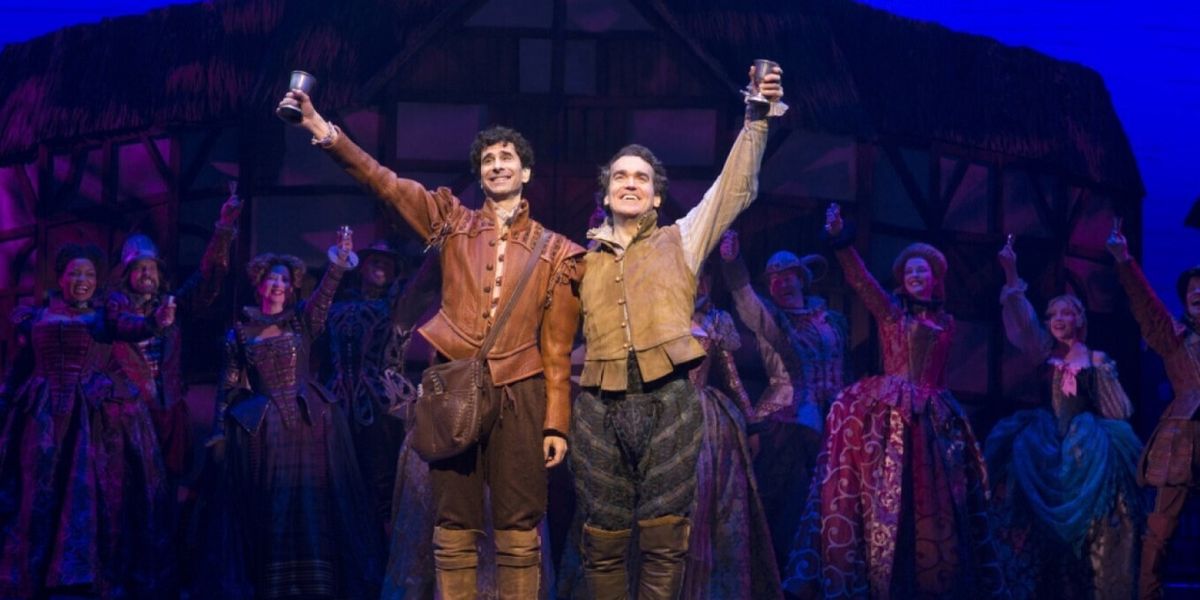
Most recently, the Kirkpatrick brothers have given Broadway audiences major hilarity with 2015’s Something Rotten! and 2021’s Mrs. Doubtfire. Wayne and Karey Kirkpatrick also write both music and lyrics together. In the case of both shows, Karey co-wrote the book with John O’Farrell as well. Something Rotten! marks a rare moment of Broadway brothers actually writing a show about brothers.
Of course, sisters have had their time in the Broadway spotlight as well. My book, Women Writing Musicals, highlights a number of sister pairs who made Broadway history and should be remembered more than they are. Like the Johnson brothers, the Hyers sisters were also pioneers in early musical theatre in America. Because Anna Hyers and Emma Hyers were largely working in the 1860s and 1870s, they were not always appropriately credited in the way writers would be today, although they made significant contributions as writers to shows that they were seen as only performers on. In 1876, their In and Out of Bondage chronicled the story of a Black family before and after the Civil War.
The Beaumont sisters, Nellie and Rose, had eighteen Broadway credits between them, largely as performers, at the turn of the 20th century. They played sisters in a 1900 musical called Mam’selle ‘Awkins, where they penned music and lyrics for their own number. This was common practice at the time, with Broadway scores pieced together using songs from different writers and tunes sometimes performed by their own authors.
In 1924, Topsy and Eva, an adaptation of Harriet Beecher Stowe’s Uncle Tom’s Cabin, opened on Broadway. The source material, book, music, and lyrics were all written by women. The Duncan Sisters, Rosetta and Vivian, were credited with music and lyrics. The duo had been a popular vaudeville act before they wrote and starred in Topsy and Eva. Although the show made history with its all-female writing team, it is little remembered and not revived today because of its racial stereotypes and problematic use of blackface.
Broadway got a unique entry in 1992 when “Poland’s first musical”, Metro, hit the boards. With original book and lyrics by sister team Agata Miklaszewska and Maryna Miklaskewska, Metro told the tale of young people in Warsaw living in subway tunnels and telling stories about their lives.
In 1993, the book Having Our Say: The Delany Sisters’ First 100 Years became a bestseller; it was an oral history about the lives of Sarah "Sadie" L. Delany and A. Elizabeth "Bessie" Delany, who were born to a father who was former enslaved and became civil rights pioneers. The book became a 1995 Broadway play by Emily Mann, based on the Delany sisters’ original words.
Somewhat more rarely, brothers and sisters have collaborated as Broadway writers. Perhaps the most well known and prolific brother-sister pair were Dorothy Fields and Herbert Fields. The entire Fields family was in the family business of Broadway, with Dorothy and Herbert following in the footsteps of their father Lew Fields alongside their fellow brother Joseph Fields. In fact, Dorothy and Herbert’s first Broadway collaboration was as lyricist (Dorothy) and book writer (Herbert) for a show called Hello, Daddy (1928) which starred and was produced by Lew, at the theater named after him. Dorothy and Herbert went on to collaborate on Annie, Get Your Gun (1946), Redhead (1959), and a slew of other shows. Independently, Dorothy Fields became one of the most major lyricists of her generation, with credits also including Sweet Charity.
Francine Pascal is best known for creating the Sweet Valley High franchise, but she is also a Broadway writer. Pascal co-wrote the book for the George M. Cohan- celebrating musical George M! (1968) alongside her brother Michael Stewart as well as her husband John Pascal. Following Michael Stewart’s death in 1987, Francine Pascal has also carried on his legacy, including updating his book of Mack and Mabel for new productions.
There are also instances of parents and children collaborating on Broadway as writers. In 1974, a musical that had been a sensation in South Africa, Ipi Tombi, came to Broadway, written by a mother and daughter team. Bertha Egnos penned the show’s book and music while her daughter Gail Lakier penned its lyrics. One example of a father-son writing team is J.C. Nugent and Elliott Nugent. The duo wrote over a dozen Broadway plays together from the 1920s through the 1940s.
Sign up for all the news on the Summer season, discounts & more...





Comments
To post a comment, you must register and login.