
Bill Irwin & Brandon J. Dirden Are Finding the Heart, Hilarity, and 'Radical Joy' of THE IMAGINARY INVALID
The Imaginary Invalid will be led by Irwin, with Rachel Bloom, Brooks Ashmanskas, Dylan Baker, and more.
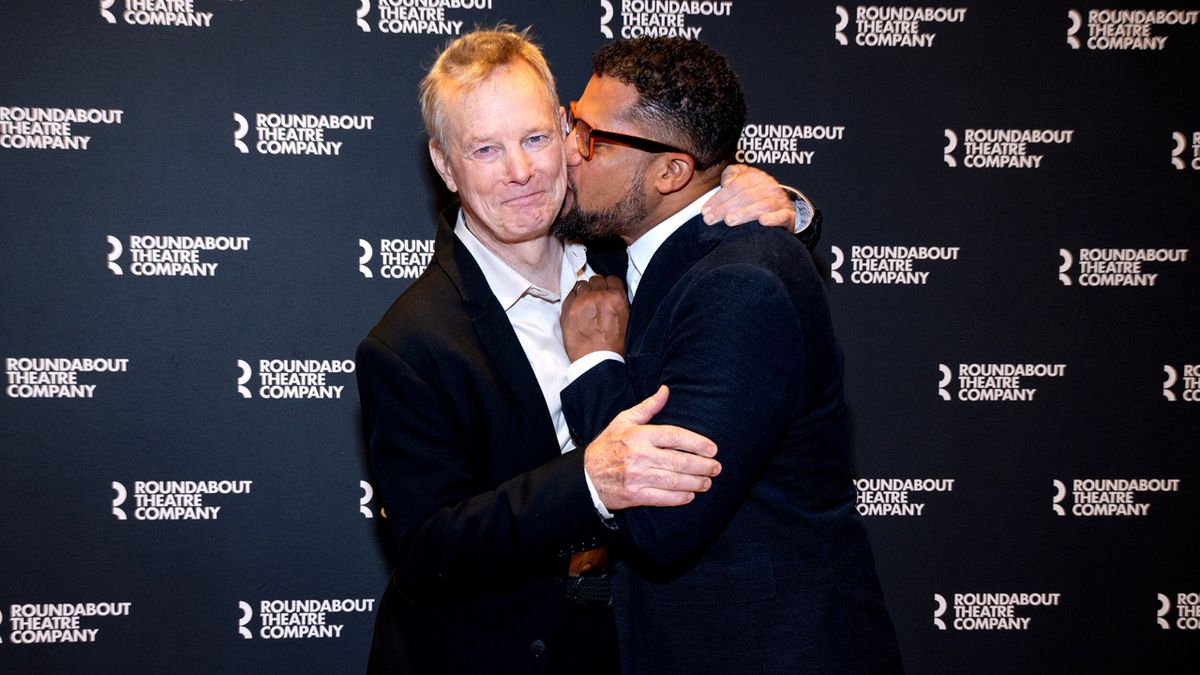
Molière’s The Imaginary Invalid may be more than 350 years old, but for director Brandon J. Dirden and adapter and star Bill Irwin, there is nothing dusty about it.
This season, the pair are bringing the classic comedy to Broadway in a new adaptation by Irwin, with Dirden at the helm. And, while the play arrives with centuries of history behind it, their approach to the material is decidedly alive: a company of expert comic actors in a room together, testing jokes, pushing physical comedy to its limits and searching beneath the farce for something recognizably human.
For Dirden, directing this particular group of actors hardly feels like work.
“I feel very guilty when I cash my paychecks on this one,” he joked. “It doesn't feel like work at all.”
In fact, Dirden realized early in the process that generating ideas would hardly be the problem. With a company filled with what he calls “comedic assassins,” his job is often knowing when to rein them in.
“My biggest challenge is not gonna be generating ideas or directing, it's actually going to be editing,” he explained. “This cast is chock full of just assassins, comedic assassins, and the way that they just go to the edges with the storytelling, I just have to make sure they don't fall off and bring them back some little bit here, little bit there.”
At the center of that room is Irwin, whose relationship with the material stretches back decades. But, before Dirden could help shape Irwin’s adaptation for Broadway, the two had to establish the kind of partnership that would allow them to keep questioning it.
Dirden describes Irwin as an artist whose extensive career has done little to diminish his curiosity. “He is one of the most curious. He has a childlike imagination,” Dirden said. “When you're working with something that pure, you want to bring your best self in partnership with that deep level of curiosity.”
That curiosity, Dirden says, is paired with a formidable work ethic. “He takes nothing for granted. He is the first one here. He is the last one to leave. He's emailing me nonstop about thoughts,” he said. “He leads with such generosity, but also such painstaking detail-oriented work and joy.”
That sense of joy has become central to Dirden’s vision for the production—and it starts with the people in the rehearsal room.
“One of my dreams in putting a company together is I wanted to have a room of people who love the theater,” he explained. “I think the audience can certainly feel… when they are in the presence of people who actually love their job and who respect them.”
He found exactly that. Dirden describes the company as a group with a “deep reverence for live theater,” and particularly for Broadway. “These are people who probably have encyclopedic knowledge of all things Broadway,” he said. “They're bringing that love to rehearsals every day and they're so hungry to share with these audiences.”
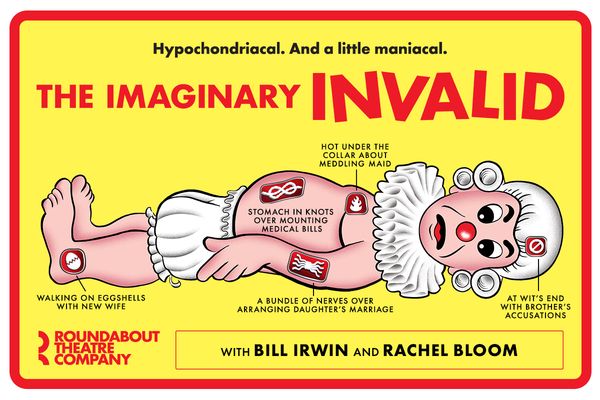
But, for all of the fun being had in the room, Dirden is conscious that The Imaginary Invalid cannot survive on zaniness alone. Molière’s final play follows Argan, a wealthy hypochondriac consumed by his ailments and the doctors and remedies he believes will save him. The outrageous circumstances provide ample opportunities for comedy, but Dirden believes treating the play simply as a farce would mean overlooking what Molière was trying to accomplish through it.
“One of the pitfalls of this thing, the early traps, is that we can make it all about the zaniness and we can lose sight that Molière—this is a satire, and he was actually trying to show us something about ourselves inside of this zaniness,” he said. “It's a spoonful of sugar with the medicine.”
Finding the balance between those two impulses—the wild comedy and the observations underneath it—has become one of the production’s guiding ideas.
“That has been so wonderful, to toe that line between making sure we give all the breath to the craziness and the entertainment and the folly that does exist, but also saying, ‘Hey, but this is also us. And do we want to be this?’” Dirden explained. “But don't forget to laugh. Don't forget to have a great time, because that is also a part of life.”
That led Dirden to a question that has stayed with him throughout rehearsals: Is joy itself enough?
“When I first started this play, I was like, ‘Is radical joy enough to bring audiences?’ And it is,” he said. “Every day I walk out of the room lighter, better, more inspired by humanity.”
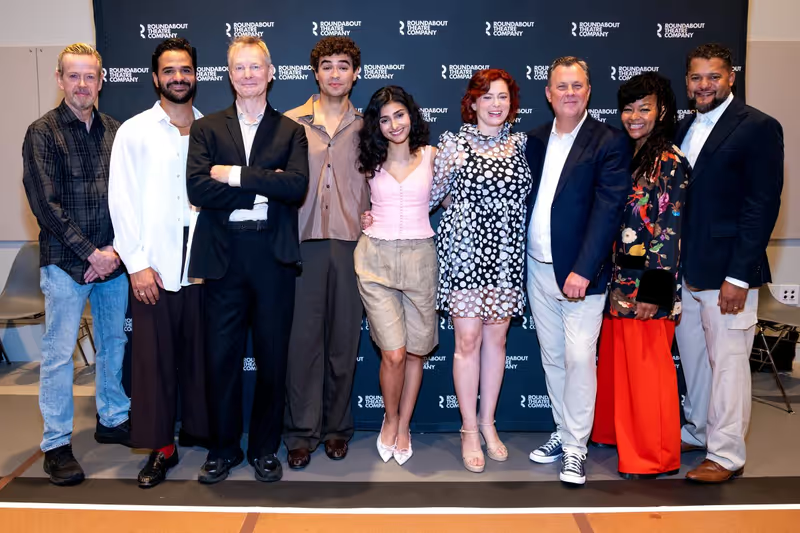
For Dirden, some of that optimism comes from watching a collection of people who were strangers just weeks earlier transform into a company. “Now, a couple of weeks later, we cannot wait to come here. We cannot wait to see what we can create together. And now we cannot wait to share it.”
For Irwin, The Imaginary Invalid is not simply another Molière play. It is his favorite.
“I know them all a little bit,” he said. While scholars might point to other Molière works as more elegantly constructed, that polish is precisely what attracts Irwin to Invalid less. “I like this one because it's ragged. It's like a fever dream.”
There is good reason for that feverish quality. Molière wrote the play near the end of his life and famously performed in it shortly before his death.
“He wrote it when he was sick and he wrote it so he could play it before he died, which he just barely made,” Irwin explained. “It is sort of stripped away of structural pretenses—just family play.”
And in that family dynamic, Irwin sees the seeds of a comic tradition that stretches all the way to modern television. “It is the forebear of all the sitcoms that we grew up on and we have running in our heads,” he said, invoking everyone from Lucille Ball to Everybody Loves Raymond. “All the other really great family stuff… you can feel it being born.”
Irwin’s history with Argan goes back much further than this Broadway production. He first played the role in high school. “I've been thinking about this role,” he said, describing Argan as “a guy who loves his family so much, I am ready to sell him down the river to get what I want.” For Irwin, that contradiction is quintessentially Molière.
“We love each other so intently, we don't have words for it, so we'll use profanity,” he said. “And I want you to be exactly what I want you to be. I don't have time for you to be anything except what I need you to be. Until some kind of revelation at the end where you realize, ‘Oh, I guess we all have to live our lives,’ whatever that means.”
Returning to Argan now, however, means understanding him in a way that a teenage Irwin simply couldn't. “I hadn't a clue in high school,” he admitted. “Now I just realized, oh yeah, death is not an abstraction.” That realization gets to the darker impulse underneath Argan’s comic behavior. His obsession with medicine and his attempts to control his family become ways of trying to exert power over the one thing he cannot command. “To keep away from death, I'll do—you know, these people I dearly love, I'll get them to do whatever I need them to do to protect me from the thing I can't control,” Irwin said.
If that mortality gives Irwin’s Argan his engine, the production’s comedy comes from the extraordinary collection of actors surrounding him. Irwin speaks about the company almost like a jazz ensemble, with each performer bringing a different set of comic instincts into the room. Younger cast members are learning from veterans, while the veterans are constantly responding to—and stealing from—one another. He has been particularly delighted watching Rachel Bloom work.
“Rachel comes into the room. She's a walking character actor encyclopedia,” Irwin said. “She says, ‘Now this joke—you want to come from this angle or this angle? I can do either one.’ And she can.”
Before the production, Irwin had never met Bloom. Now, he joked, “we're partners in a weird kind of character comedy crime.” Dylan Baker, meanwhile, has become something of a comic brother to Irwin. He recalled a rehearsal in which the company was struggling to solve a physical bit—one that, Irwin warned, involves “an enema mechanism.” After trying different approaches, Baker proposed a small adjustment. “Suddenly, [it] clicked into place,” Irwin recalled.
Those discoveries embody what excites him about the company: actors arriving with decades of experience and putting all of it at the service of the same joke, scene or moment.
“Everybody brings all their chops from all their time,” he said.
And then there is Brooks Ashmanskas, whom Irwin suspects may have a particularly direct connection to their playwright.
“I think he is directly descended from Molière,” Irwin joked, praising Ashmanskas’ ability to push pomposity and physical comedy to their outer limits.
Irwin’s metaphor for the entire ensemble is fittingly theatrical—and athletic. “We're like a pickup company. ‘Hi, how do you do? Hi.’ And now we have to become the New York Knicks really quickly,” he said. That transformation requires everyone to bring what Irwin calls their accumulated “decades” of comic and theatrical chops and somehow make them blend into one production.
Helping all of those disparate instincts cohere is Dirden. For all of Irwin’s enthusiasm about the actors and the material, he is clearest when asked what he is enjoying most about the process.
“Working with Brandon is my greatest joy,” he said. Their rehearsal process is filled with possibilities: this joke could go one way, a scene could go another, a bit could become bigger or smaller. Dirden, Irwin explained, has a knack for identifying what lies beneath all of those options.
“Brandon's saying, he's got this two-finger style: ‘I think that's too much, and I think the real heart of it is if you do this,’ and you suddenly go…” Irwin said.
Even late at night, the pair are still refining the adaptation. “We did some cutting last night at 11 p.m. that I think is gonna make the story just cohere,” he said. That work—cutting, shaping, playing, reconsidering—is ultimately at the center of this Imaginary Invalid. Irwin has spent decades thinking about Argan; Dirden is intent on preserving the satire beneath the silliness; and their cast has arrived armed with a formidable collective knowledge of comedy and theater.
The goal is not to tame Molière's fever dream, but to find its pulse—and to make sure that amid the doctors, hypochondria, family dysfunction and outrageous physical comedy, audiences can still recognize something of themselves.
And, as Dirden insists, have a great time doing it.
The Imaginary Invalid will open on Broadway on October 22 at the Todd Haimes Theatre.
Photo Credit: Jennifer Broski
.jpg?format=auto&width=800)
Sign up for all the news on the Fall season, discounts & more...
|
Powered by

|

.png?format=auto&width=365)




