

Review: OF MICE AND MEN at Kauffman Center For The Performing Arts
Dreams are dangerous things in Carlisle Floyd’s OF MICE AND MEN.
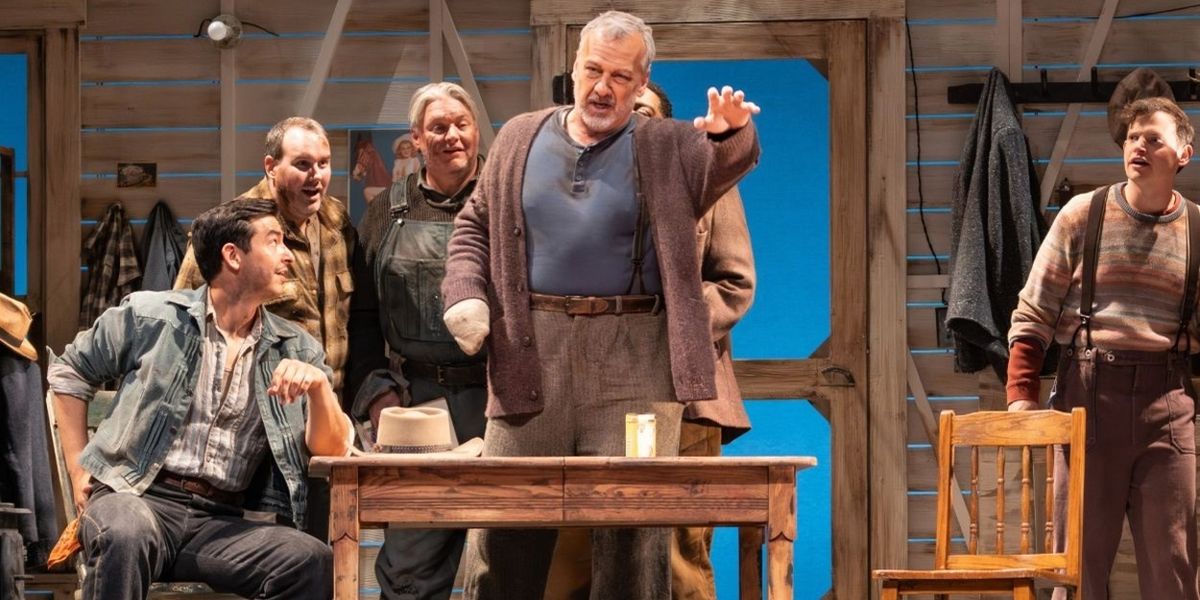
They keep people alive. They keep people moving. And sometimes, they keep people from realizing how impossible their lives have truly become. Lyric Opera of Kansas City’s production of OF MICE AND MEN does not treat John Steinbeck’s story as distant Americana or dusty literary nostalgia. Instead, this production reveals the emotional volatility hidden beneath the mythology of the American Dream — where loneliness, labor, masculinity, disability, poverty, and friendship collide under the crushing weight of survival during the Great Depression.
Based on Steinbeck’s novella, Carlisle Floyd’s operatic adaptation premiered in 1970 with Seattle Opera and has since become one of the most respected works in contemporary American opera. Floyd preserves the emotional directness of Steinbeck’s text while expanding its internal tensions through music of striking lyricism and dramatic urgency.
What unfolds at the Kauffman Center is not merely a retelling of a familiar story.
It is a meditation on companionship. On hope. On isolation. And on what happens when innocence collides with a world incapable of protecting it.
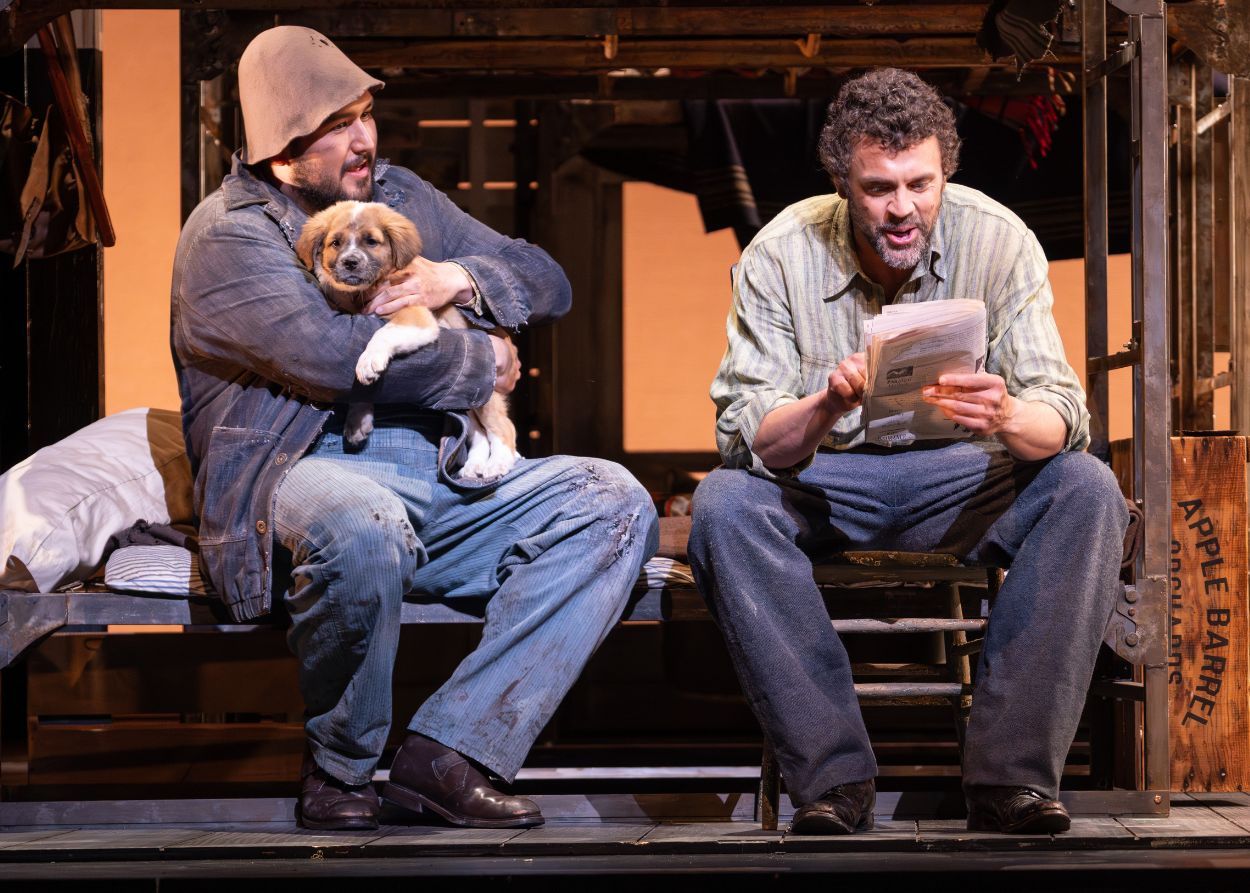
John Moore (George Milton)
Matthew Pearce delivers an emotionally shattering performance as Lennie Small. Rather than reducing Lennie to caricature or sentimentality, Pearce constructs a portrayal rooted in emotional transparency and instinctive innocence.
Vocally, Pearce’s tenor is astonishingly pure. Certain higher phrases emerge with an almost angelic sincerity, emphasizing Lennie’s childlike wonder and emotional vulnerability. His voice possesses softness without weakness — an essential balance for a character whose physical strength constantly threatens catastrophe.
What makes Pearce’s performance so extraordinary is his command of physical storytelling. Every movement communicates Lennie’s overwhelming sensory relationship with the world. Whether petting an animal, reaching for fabric, or reacting in panic, Pearce reveals a man seeking comfort while remaining completely unaware of the danger his strength creates.
The audience becomes trapped in emotional contradiction:
You fear for Lennie.
You fear for everyone around him.
Yet you desperately want him to succeed.
Pearce ensures that Lennie’s dream of tending rabbits and living peacefully on the farm never feels naïve. Instead, it becomes heartbreaking precisely because of its simplicity.
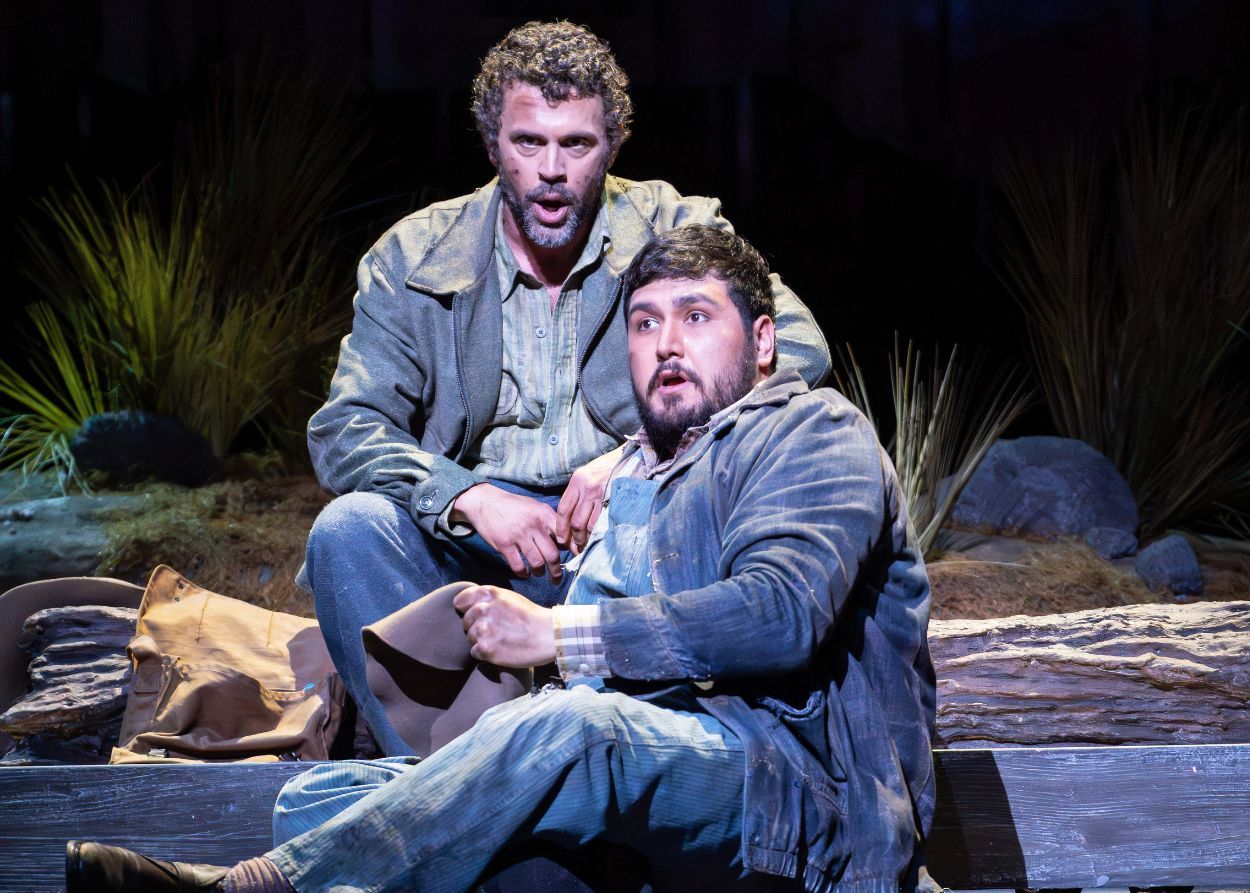
John Moore’s George Milton is deeply human. His baritone carries the fatigue of a man who has spent years surviving disappointment while still forcing himself to believe in the possibility of something better.
Moore understands that George exists in constant emotional conflict. He is protector, caretaker, older brother, frustrated companion, and reluctant dreamer all at once.
His chemistry with Pearce forms the emotional foundation of the entire production.
Together, the two performers establish a beautifully realized yin-and-yang dynamic that evolves organically throughout the evening. George’s bursts of anger never overshadow the love beneath them. Likewise, his tenderness toward Lennie never erases the emotional burden he carries daily.
Particularly moving are the recurring scenes involving the dream farm. Moore subtly shifts his vocal coloration during these passages, revealing that George himself may no longer fully believe in the dream — yet continues nurturing it because hope is the only thing keeping either man psychologically afloat.
In lesser productions, George can become hardened or cynical.
Moore wisely refuses that approach.
Instead, he portrays George as someone painfully aware that dreams may fail, yet unwilling to abandon the one person who still believes in them completely.
Sara Gartland brings striking complexity to Curley’s Wife. Her performance radiates glamour and danger, yet beneath that exterior lies crushing loneliness.
Gartland’s soprano is rich, alluring, and emotionally textured. From her earliest entrances, she commands the attention of both the ranch hands and the audience with remarkable ease. But her performance never relies solely on seduction.
Instead, Gartland reveals a woman desperately searching for acknowledgment within an environment that sees her only as distraction or temptation.
Her Hollywood fantasies mirror George and Lennie’s farm dream in fascinating ways. Both represent escape. Both are rooted in longing. And both may ultimately be impossible.
Gartland’s scenes with Lennie are especially devastating because she allows genuine vulnerability to emerge. The audience senses two isolated individuals briefly finding emotional connection — making the tragedy that follows feel horrifyingly inevitable rather than merely shocking.
Matthew DiBattista is superbly cast as Curley. The moment he enters, tension floods the stage.
DiBattista captures Curley’s volatility with unnerving precision. His physicality is restless and confrontational, while his vocal delivery cuts sharply through ensemble scenes with aggressive intensity.
Curley operates from insecurity disguised as authority, and DiBattista never loses sight of that truth. His suspicion toward his wife and obsession with dominance create an atmosphere where conflict feels unavoidable long before violence actually occurs.
Whenever Curley appears, the audience instinctively braces for chaos.
That psychological tension becomes one of the production’s greatest strengths.
Wayne Tigges delivers a profoundly moving Candy. His performance quietly becomes one of the emotional anchors of the production.
Vocally, Tigges sings with warmth and weathered vulnerability. His scenes discussing the possibility of joining George and Lennie’s farm carry heartbreaking sincerity because Tigges makes Candy’s desperation feel painfully real.
Candy understands something the younger men do not:
Once usefulness disappears, survival becomes uncertain.
His attachment to the dream farm is therefore not fantasy — it is survival.
Tigges communicates that fear beautifully.
Schyler Vargas’ Slim: Quiet Moral Authority
Schyler Vargas gives Slim remarkable steadiness and emotional intelligence. His presence immediately alters the energy of the stage whenever he enters.
Vargas sings with grounded warmth and calm authority, embodying the rare individual within the ranch world who possesses both wisdom and compassion.
Slim functions as the emotional stabilizer of the opera, and Vargas fulfills that responsibility with exceptional control and understated power.
Bernard Holcomb delivers a Carlson defined by harsh practicality. His resonant vocal presence reinforces the brutal realities of Depression-era labor culture, where weakness and sentimentality are viewed as liabilities.
Holcomb’s scenes involving Candy’s dog are particularly effective because of their emotional restraint. Rather than exaggerating cruelty, he presents Carlson’s actions as disturbingly normal within the environment these men inhabit.
That realism makes the moment land even harder.
David Pelino’s Ballad Singer serves as a haunting narrative thread throughout the opera.
His musical interjections add extraordinary atmospheric depth, grounding the production in a distinctly American musical landscape shaped by migration, labor, loneliness, and displacement.
Pelino’s voice often feels less like a character and more like the lingering spirit of the Depression itself — drifting through the lives of men searching endlessly for work, dignity, and belonging.
The ensemble work throughout the production is exceptionally strong. Harmonies are disciplined, emotionally connected, and dramatically purposeful.
The ranch community never feels generic or decorative. Each performer contributes to a believable social ecosystem shaped by exhaustion, competition, camaraderie, and suppressed vulnerability.
Under the baton of Joseph Mechavich, the orchestra performs with extraordinary sensitivity to Floyd’s distinctly American score. Mechavich demonstrates a sophisticated understanding of pacing, ensuring that rhythmic momentum consistently reflects the emotional temperature of the drama unfolding onstage.
His control of orchestral texture is particularly impressive. The singers remain fully supported without ever being overwhelmed, allowing Floyd’s musical language to breathe naturally.
Kristine McIntyre’s direction is intimate, psychologically grounded, and emotionally disciplined.
Rather than overstaging the opera, McIntyre allows relationships and silences to carry enormous dramatic weight. She trusts the material — and trusts the performers enough to let emotional truth emerge organically.
Luke Cantarella’s scenic and projection design is visually stunning.
The integration of projection mapping into the physical set creates a constantly shifting visual language that reflects both realism and memory. Expansive rural landscapes stretch across the stage in painterly compositions that evoke longing, instability, and emotional distance.
The barn structures and bunkhouse environments feel textured, weathered, and authentically lived-in.
Kara Harmon’s costume design demonstrates meticulous attention to both period detail and character psychology. Every garment enhances social status, labor identity, and personality without ever appearing theatrical for its own sake.
Kate Ashton’s lighting design subtly transforms the emotional landscape throughout the evening, guiding the audience from moments of warmth into spaces of dread, isolation, and inevitability.
Lyric Opera of Kansas City’s production of OF MICE AND MEN is emotionally devastating in the best possible way.
It understands that Steinbeck’s story was never simply about poverty or labor.
It was about people trying to survive emotionally in a world that continuously strips them of dignity, stability, and hope.
Carlisle Floyd’s score deepens those truths magnificently, and this production honors that emotional complexity with tremendous care.
At its core, OF MICE AND MEN asks one terrifying question:
What happens when hope is all someone has left?
George and Lennie continue chasing the dream farm not because it is realistic, but because abandoning the dream would mean surrendering entirely to despair.
That idea resonates profoundly in modern America.
This production reminds audiences that survival is not always physical.
Sometimes survival means continuing to believe that peace, belonging, and gentleness might still exist somewhere beyond the horizon.
Carlisle Floyd’s OF MICE AND MEN was presented May 1, 2, and 3, 2026, at the Kauffman Center for the Performing Arts by the Lyric Opera of Kansas City.
Go see work like this when companies are brave enough to produce it.
Support opera that tells human stories this raw and honest.
And allow yourself to sit with the uncomfortable realization that sometimes the most dangerous thing a person can possess is hope.

Reader Reviews

Videos
|
Wicked Music Hall Kansas City (8/12-8/30) |

|
Beehive: The 60's Musical Tent Theatre (7/08-7/18) |
|
Jefferson Starship Capital Region MU Health Care Amphitheater (9/27-9/27) |
|
Wicked Kansas City Music Hall (8/22-8/22) |

|
Around the World in 80 Days Tent Theatre (6/18-6/26) |

|
Xanadu Music Theatre Kansas City (7/17-7/19) |

|
Disney's Frozen The White Theatre at The J (7/08-7/26) |
|
Guns N’ Roses Busch Stadium (8/16-8/16) |

|
Wicked Kansas City Music Hall (8/12-8/30) |
|
Bryson Tiller Hollywood Casino Amphitheater (10/03-10/03) |
| VIEW ALL SHOWS ADD A SHOW | |