


Review: CATARINA AND THE BEAUTY OF KILLING FASCISTS, National Theatre
Celebrated and controversial Tiago Rodrigues' play is demanding and rewarding

Back when Facebook was innocent (well, I supposed it was) I posted a video of a butcher’s shop in Baku, just round the corner from my temporary office. Pig heads were displayed in the window, trotters toppling out of an overfilled bucket and blood ran down a narrow chiselled channel and out into the street. Friends were horrified. I just about avoided writing as a response, “But, but… you eat meat”. Moral? We screen out unpalatable truths to get by. I know I do after my failed attempt at veganism.
In the early naughties, I showed students the operatic opening of Triumph of the Will having carefully briefed them about Leni Riefenstahl’s misguided genius. I asked them to consider the photography of the country and of its people - and to understand that she was creating a new and dangerously potent visual language. Moral? Fascists are all absurd, many possess a low cunning, but not all of them are stupid.
In Roman Polanski’s The Pianist, the single most distressing scene is that of an SS man, young and handsome in that antiseptic Aryan way, who is executing old Jewish men in reprisal for an act of ghetto rebellion. That he is doing so like an automaton is distressing enough, but when the gun jams and he takes an eternity to load it again, the one man left of the ten still on his knees suffers unbearably. I’ve not been able to watch the film again. Moral? Proxity matters in such atavistic moments and executions are easier to imagine than they are to perform, unless you’re carrying a lot of evil inside you.
Tiago Rodrigues’ searing, coruscating, appalling Catarina and the Beauty of Killing Fascists, given its UK premiere at The National Theatre (which is exactly what it should be doing) provoked these reflections, and a terrifying kaleidoscope of other intrusive thoughts, insistently bubbled up while I was trying to watch the play. If the script occasionally threatened to dissolve into an overheated Oxbridge undergrad philosophy seminar - at one point, it did, but it was funny rather than tedious - the sledgehammer of its language (translation by Daniel Hahn) and the strength of the ensemble cast, maintained its extraordinary theatricality. Yet still those thoughts jabbed at my mind.
%20Joseph%20Banderet%201.jpeg?format=auto&width=800)
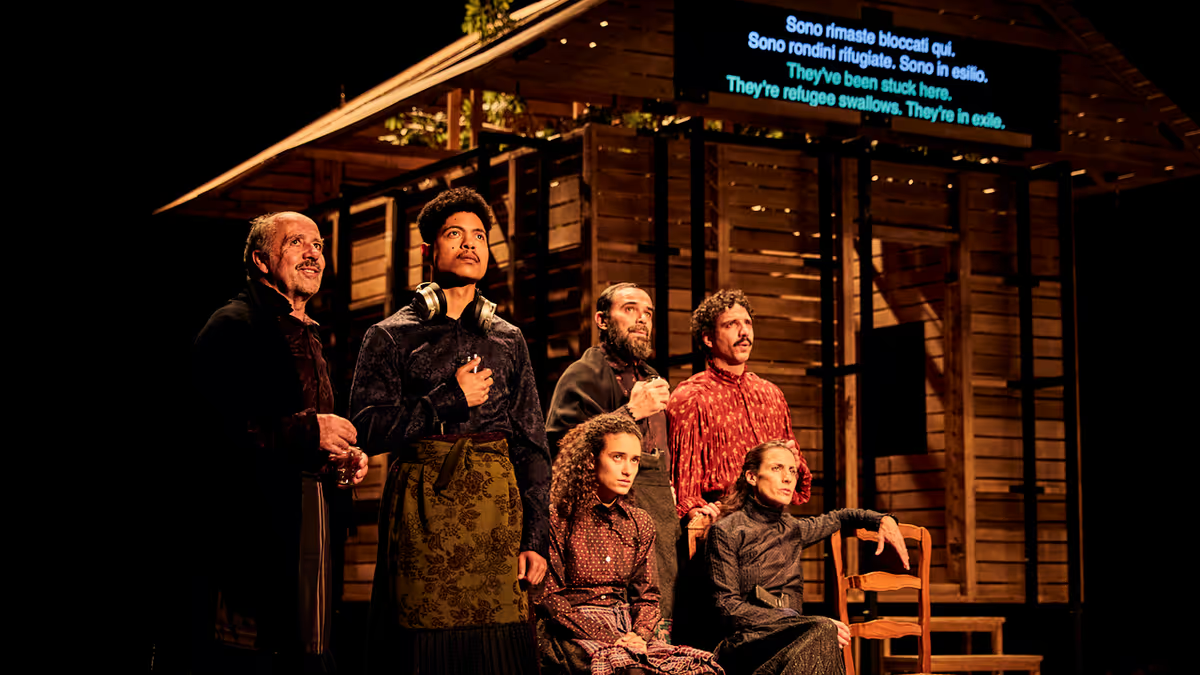
We’re in 2028 and we’re also in a world that has more in common with Lorca’s Blood Wedding than the Portugal of surfer beaches and CR7. A family, held together by little more than habit - which, after all, is all that stops many families from disintegrating - meet to kill a fascist. It’s an annual event, a ritual that falls to the next 26 year old Catarina (they’re all called Catarina) to commemorate, avenge, honour the memory of the first Catarina who took retribution for her cousin Catarina’s murder in the 1954 revolution by slaying her killer, Catarina’s husband. As with all civil wars, everything is very close.
At first, the family are happy-go-lucky types, not badly off at all, witty and warm, but soon fissures emerge. They’re all committed to the tradition and all but the youngest and her sister, this year’s lucky assassin, have passed the rite of passage, but 2028’s Catarina has misgivings. Eventually they tumble out, as she articulates the doubts that the others are dodging, some happily and with conviction, others warily and hesitantly with justifications that almost dry in their throats. Despite the morbid calculus such moral contortions demands (or maybe because of it, the writing often points both ways) these debates are often funny, if bleak. There is no level of depravity that is not backed up with a justification that might just excuse it and, eventually, what can you do but laugh at this darkness in their souls?
No such degrees of doubt exist in the play’s (in)famous closing tour de force, the kidnapped fascist’s speech articulating fascism’s 21st century manifestation. It’s almost impossible not to set up a mental tick box of Far Right (and not so far Right) shibboleths as he barks them out in this Nuremburg stylee coda. This house listened, some whistling, some walking out, but, as the cliché has it, other reactions are available and I’m sure some will be used during the run - additional shoes probably confiscated on the door. Maybe it’s just the centrist dad, educated liberal speaking here, but I don’t want this incendiary stuff censored in the arts, but I do want it censored on the streets. The Catarinas might be lining up to shoot me for such wishy-washy cowardice.
This is proper theatre though, the fourth wall too fragile to hold back the performance, the power and the horror, the horror as this heart of darkness is laid before us. The fascist’s lack of ambiguity is seductive or, as Rodrigues points out having interpolated many rebuttals to easy critiques into his characters’ speeches, it is if you have nothing to lose. Or, more accurately, if you’ve been convinced of that by the Goebbels Machine that passes for so much journalism and social media these days. It is probably that enduring tenet of fascist fundamentalist orthodoxy - “Only I can fix this by the establishment of ‘Ein Volk, ein Reich, ein Führer’” - that is so scary, whether it appears in politics, religion or relationships. Where is Christopher Hitchens now that we need him most?
One more memory rose unbidden to my mind. A lyric in Dexy’s Midnight Runners’ 1980 single, “There There My Dear” a song that has many similar themes to this play, a pop song that ferociously attacks those who prefer to solve political questions over a bottle or three of Chablis (I know, I was there, and often). At 17 years of age, its line, “The only way to change things is to shoot men who arrange things” felt overstated, but carried a disturbing kernel of truth. To all but a committed pacifist, it distilled the debate into not a question of if, but a question of when.
In the intervening 46 years, I’m no closer to an answer, despite all the reading, the thinking, the bottles of Chablis, The Good Friday Agreement and Nelson Mandela’s long walk to freedom. To the credit of this extraordinary and so, so timely production, I’m now further away than ever from knowing if it’s if or when and then comes the even more terrifying interrogative, how? I’m very uneasy though, more frightened of The Fash than of climate change or AI - and they’re not exactly lullabies are they?
I’ll be recalling this play if I can bear to watch the party conferences and conventions in 2028, the year in which it is set. Those recollections will not be neither happy nor hopeful. And they shouldn’t be.
Catarina and the Beauty of Killing Fascists at The National Theatre until 26 September
Photo images: Joseph Banderet
Sign up for all the news on the Fall season, discounts & more...
.jpg?format=auto&width=300)





Reader Reviews
To post a comment, you must register and login.