Feature: MY NEIGHBOUR TOTORO: Studio Ghibli’s Beloved Forest Spirit Comes To Life
A breathtaking celebration of childhood, imagination and the natural world.
Studio Ghibli’s beloved animated classic My Neighbour Totoro has reached its final three months in London’s West End, where the Royal Shakespeare Company’s award winning stage adaptation continues to celebrate the wonder of childhood, the strength of family and the extraordinary possibilities of theatrical imagination.
Playing at the Gillian Lynne Theatre, the production is adapted by Tom Morton Smith from Hayao Miyazaki’s celebrated 1988 animated film. Directed by Improbable co-founder Phelim McDermott, with puppetry designed and directed by Basil Twist, the production transforms the gentle magic of the original film into an immersive live theatrical experience.
The journey begins with a sweetly nostalgic car ride into the countryside, as young sisters Satsuki and Mei embark on an adventure towards their new home. There is an infectious sense of childhood excitement as the family leaves the city behind, although their new surroundings initially prove rather less welcoming than anticipated.
Their house is crumbling, its unfamiliar corners harbouring an unsettling atmosphere, while the neighbours warn of its supposedly haunted nature. Yet, rather than allowing fear to take hold, the family responds with laughter, finding solidarity in their shared willingness to “laugh at the spooky”. This early warmth establishes the emotional foundations of the story, reminding audiences that even unfamiliar and frightening circumstances can become manageable when faced together. The sisters have moved to the countryside to be closer to their mother, who is unwell in hospital. Beneath the playful adventures and supernatural encounters lies the more difficult reality of a family navigating illness and uncertainty. The production handles this subject matter with considerable sensitivity, allowing the anxieties of childhood to coexist with the freedom and excitement of discovering a new world.
Rather than rushing towards its more spectacular moments, the production embraces a deliberately gentle pace. Scenes are allowed to unfold with a mesmerising quality, creating opportunities for audiences to absorb the beauty of the surroundings and the subtle movements of the puppetry. Floating shadow sprites and delicate figures drift across the stage, creating an atmosphere which feels almost dreamlike. This measured approach is central to the production’s appeal. Its magic does not depend solely on grand theatrical effects, but on an appreciation of the smaller details, the quiet moments and the sense of wonder which can emerge from simply observing the world.
%20in%20My%20Neighbour%20Totoro%20at%20the%20Gillian%20Lynne%20Theatre%20(credit%20Manuel%20Harlan).jpg?format=auto&width=800)
Photo Credit: Manuel Harlan
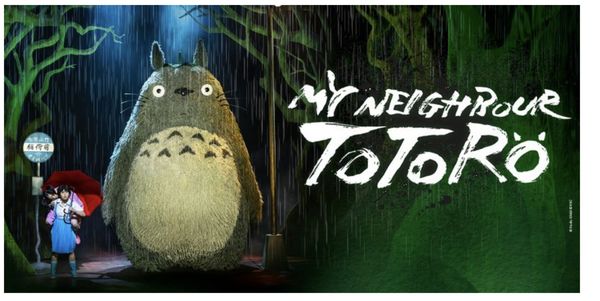
Victoria Chen brings delightful energy to Mei, capturing the curiosity, determination and uninhibited imagination of a four year old. Her performance is particularly effective in conveying the way a child’s attention can be drawn towards something extraordinary while adults remain preoccupied with more immediate concerns. Mei’s discovery of the forest spirits leads her towards Totoro, the ancient protector of the woodland. When the enormous creature finally appears, the scale of the puppet produces an immediate sense of awe. Totoro is otherworldly yet reassuring, a magnificent presence whose size and gentle nature inspire absolute joy.
The achievement lies in the balance between spectacle and intimacy. Totoro commands the stage, yet the character never loses the gentle, comforting quality which has made him such an enduring figure in popular culture. The puppetry gives physical form to something which might otherwise seem impossible to recreate outside the animated world, allowing audiences to experience the wonder of meeting this extraordinary forest spirit in person.
Helen Chong plays Satsuki with warmth and a convincing sense of responsibility. As the older sister, Satsuki must negotiate her own childhood anxieties while helping to care for Mei during their mother’s illness. Chong captures this tension with sensitivity, portraying a young girl who is still discovering the world herself while attempting to provide reassurance for her sister and strength for her father. The relationship between the sisters provides the production with much of its emotional weight. Their adventures are filled with excitement, but their connection remains the story’s central anchor. The magical world they encounter becomes a source of comfort and protection at a time when the family is facing uncertainty.
The forest spirits reveal themselves to the children, opening the door to a world which exists beyond ordinary human understanding. As the sisters explore this mysterious landscape, the boundaries between reality and imagination become increasingly fluid. The production’s vast stage is populated by a remarkable team of puppeteers whose presence is an integral part of the theatrical experience. Their work is intentionally visible to the audience, with performers break the fourth wall to bring the creatures to life. Rather than diminishing the illusion, this transparency becomes part of the production’s charm, allowing audiences to appreciate the extraordinary skill, coordination and physical precision required to create such convincing characters.
.jpg?format=auto&width=800)
Photo Credit: Manuel Harlan
Among the particularly delightful sequences is the presentation of a large group of inquisitive chickens, whose animated movements demonstrate the inventiveness and versatility of the puppetry. These moments bring humour and playfulness to the stage, ensuring that the production remains engaging even during its quieter passages. However, the larger puppets provide the most memorable theatrical images. Totoro’s upright appearance is a standout moment, while the arrival of the extraordinary Catbus introduces another spectacular creation. Both demonstrate the production’s ability to translate the visual language of Studio Ghibli into a live performance without losing the spirit of the original.
The Catbus is instrumental in helping the sisters reunite after Mei goes missing. Its arrival transforms a moment of anxiety into one of exhilaration, offering a thrilling reminder of the protective forces which surround the children. The eventual reunion allows the story to return to its central concerns of family, reassurance and belonging. The sisters are able to visit their mother, while their new home gradually becomes a place of comfort rather than uncertainty. Even the simple act of seeds growing in the garden becomes a wide celebration of renewal, patience and hope.
The creative team contributes significantly to the production’s distinctive atmosphere. Tom Pye’s production design establishes the scale and visual character of the world, while Kimie Nakano’s costume design and Jessica Hung Han Yun’s lighting design distinguish the familiar world of the family from the more mysterious environment of the forest. Movement by You Ri Yamanaka complements the physical language of the puppetry, while Basil Twist’s designs, created with puppetry associate Mervyn Millar’s Significant Object and Jim Henson’s Creature Shop, demonstrate an impressive understanding of how scale, movement and expression can communicate emotion without relying on conventional character performance.
Joe Hisaishi’s iconic music, performed live in a new orchestration by Will Stuart, further enhances the atmosphere. The score is an essential part of the story’s identity, supporting the moments of excitement and discovery while allowing the more reflective passages to retain their emotional resonance. Sound design by Tony Gayle and video design by Finn Ross and Andrea Scott complete a theatrical world which feels both expansive and intimate.
%2C%20Victoria%20Chen%20(Mei)%20and%20in%20My%20Neighbour%20Totoro%20at%20the%20Gillian%20Lynne%20Theatre%20(credit%20Manuel%20Harlan).jpg?format=auto&width=800)
Photo Credit: Manuel Harlan
Winner of six Olivier Awards and five WhatsOnStage Awards, the production has already established itself as a significant achievement in contemporary British theatre. Its success demonstrates the possibilities of adapting an animated film for the stage while respecting the qualities which made the original so beloved.
What distinguishes My Neighbour Totoro is its understanding that spectacle is most effective when supported by emotional substance. The enormous puppets and elaborate stagecraft are undoubtedly impressive, but their impact comes from the relationships, fears and hopes which give the story meaning. The production is a masterclass in craft, pacing and creativity, finding beauty in gentle moments rather than relying on constant movement or overwhelming visual effects. Its willingness to slow down and allow audiences to notice the smallest details is one of its greatest strengths.
My Neighbour Totoro is a celebration of childhood imagination and the reassurance which can be found in family, friendship and the natural world. It invites audiences to look beyond the familiar, embrace the possibility of the extraordinary and rediscover the simple pleasure of believing in something magical. For those who cherish Studio Ghibli’s original film, the stage adaptation offers a new way to experience its enduring appeal. For newcomers, it provides an introduction to a world where the impossible feels entirely natural.
At the Gillian Lynne Theatre, Totoro’s magic is not simply recreated. Through remarkable puppetry, thoughtful performances and a deep affection for its source material, it becomes something tangible, captivating and wonderfully alive.
My Neighbour Totoro at The Gillian Lynne Theatre runs until 3 January 2027

Sign up for all the news on the Fall season, discounts & more...
|
Powered by

|