

Interview: Nathan Cottam On Reimagining THE MADNESS OF LADY BRIGHT Through Drama and Dance
The Mannakin Theater & Dance founder directs, choreographs, and stars in Lanford Wilson’s one-act, now playing Minneapolis before heading to San Francisco November 6.
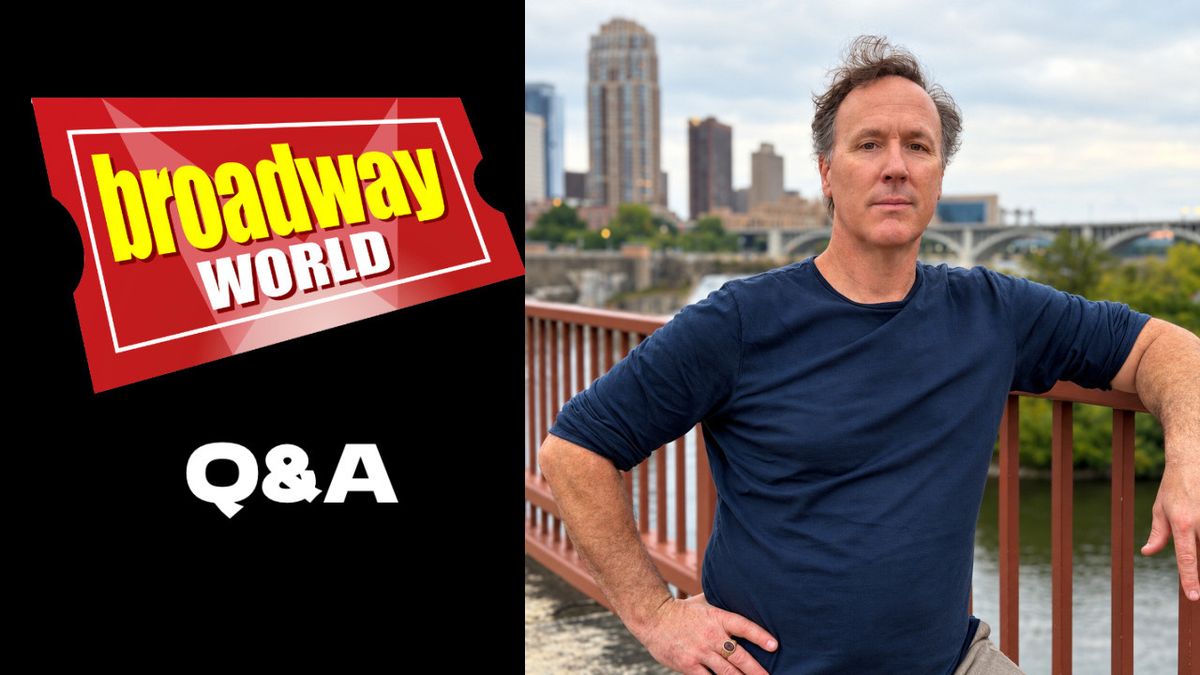
Mannakin Theater & Dance presents THE MADNESS OF LADY BRIGHT, Lanford Wilson’s poignant one-act play about loneliness, aging, and the human need for connection, reimagined through drama and dance. The production is now playing through October 25 at The Phoenix Theater in Minneapolis before moving to the iMPACt Center for Art & Dance in San Francisco November 6 through 15, 2026. Over the course of one evening, Leslie Bright, an aging drag queen living alone in a New York City rooming house, is forced through a series of encounters to confront his loneliness, isolation, and fear of growing old. In Mannakin’s staging, the play’s Boy and Girl characters are portrayed by dancers while live readers voice their dialogue offstage, embodying Leslie’s memories, fantasies, and inner life through movement.
Directing, choreographing, and starring as Leslie is Nathan Cottam, a dancer, choreographer, and director who holds an MFA in Dance from the University of Arizona and has performed with companies including the Serbian National Ballet, Oakland Ballet, and Northern Ballet Theatre. Cottam founded Mannakin in Belgrade in 2013 before establishing its home in San Francisco in 2016, and founded en Avant School, an outreach-based ballet school that served more than 500 children in East Palo Alto. His 2025 TEDx talk, “Bridging Through Dance,” explored the idea that everyone has received a ticket to the world stage. The Minneapolis production features dancers Alice Anderegg and Reka Leeaphon with live oboe and clarinet, while Lauren Settembrino and Raina Sacksteder perform the dance roles in San Francisco.
BroadwayWorld spoke with Cottam about how the Muse of Dance led him to this play, why he trusts audiences to find their own loneliness in Leslie’s, and how Wilson’s script gave him “a blanket permission slip” to surround Leslie with dance.
What first drew you to Lanford Wilson’s THE MADNESS OF LADY BRIGHT, and when did you know you wanted to direct, choreograph, and star in it yourself?
Two years ago, I produced my first dance/drama, TERPSICHORE SPEAKS!, based on the life of Tanaquil Le Clercq, the last wife of choreographer George Balanchine. It was written as a one “woman” play with the only character being the Greek Muse of Dance, Terpsichore. I cast a puckish 62-year-old man in the title role, dressed him in light drag for a costume, and found a lovely and talented dancer to portray Le Clercq. It was a perfect fit! After two runs of that production, my Terpsichore actor told me that I should look at THE MADNESS OF LADY BRIGHT. So, I suppose you could say that the Goddess of Dance, herself, commanded me to produce this show!
The first thing that drew me to this script upon reading it was the main character’s fascination with Giselle. Dance is my primary background, so when I look at a piece of theater to produce, I’m careful to choose something that has a clear path to include dance. Leslie’s obsession with Giselle was an obvious bridge, but it doesn’t end there. Leslie IS a dancer. He prides himself on his natural sense of rhythm and he relishes the many compliments he’s received about his ability to follow and move both on... and off... the dance floor.
The choice to direct, choreograph, and star in the production is partly a matter of logistics. If you’ve got a small budget, you either wait until someone writes you a big check (...yawn) or you don a trio of hats and get on with the show. I prefer the latter. It’s deeper than that, however. I identify with Leslie. Not because I’ve had an experience that objectively mirrors his, I haven’t, but as an artist. Of the many qualities that make someone an artist is a certain sense of empathy, an ability to understand how someone else feels relative to how you feel. Pair that with the ability or desire to radiate, telegraph those feelings to other people in a way that they can understand, that catches their attention and creates a thread of human connection... I’m starting to sound like a medium with a crystal ball and a lever under the table, but I really do believe that art is a primal reassurance that we are not alone. Leslie is a figure within art that reveals the destructive power of loneliness. To quote Leslie, “I’d like to do something...” about that. It’s a message that’s important to me.
How does the play’s portrayal of loneliness and isolation speak to audiences today, especially in the wake of what’s been called a modern loneliness epidemic?
This is something that I don’t know, something that I choose not to guess at with too much specificity because it hits on the very spirit of art within this show that, as director and performer, I release to the eye of the beholder. I trust that the message of loneliness will speak to audiences today, but it will speak loneliness in different manners, different languages, at various times and places, intensities. The best experiences with art leave ample room for the audience to choose their own adventure. Some people will feel something right away, I hope. Others will leave scratching their heads, I have no doubt, and one or two of those ones might carry a vague memory of this show until it hatches, fully formed, as a helpful epiphany of some kind, or at least helps them remember that they once heard some music from the ballet GISELLE.
All levity aside, I do believe that loneliness is a modern epidemic, and I don’t have to read the newspaper or click a study for proof. I can see the ripples of loneliness on the shore of my own life in a way that resonates with what Leslie experienced decades ago. Other people will feel and see their own ripples, I’m sure. Perhaps once again as a gay man, or someone else from the LGBTQ+ community, perhaps as an immigrant, a young girl ostracized on social media, some different kind of black sheep ousted by politics or the loss of faith. There are as many options as there are seats in the house.
Wilson wrote this play in the 1960s with a very specific social context for gay men in America. How did you balance honoring that history with making it feel relevant to contemporary audiences?
This is a question that I’ve spent some time pondering on my own, as well as with trusted friends. The contemporary relevance will take care of itself, for the most part. I trust modern audiences to be able to see themselves through Leslie in a way they might not have in 1964, especially San Francisco and Minneapolis audiences, perennially, as they are, on the front lines of the social landscape. I trust them to welcome this play for its universal themes represented through the life of a gay man, rather than dismiss it by fetishizing the drag elements and treating it as a curiosity.
I honor the history by partnering with Lanford Wilson. Following him, cautiously, down the path that he clearly laid out. This play wasn’t my idea, you know? I didn’t wake up and find that I had hatched an epiphany of gay life in the ’60s, or gay life, ever. What’s more, with a main character that was 40 years old six decades ago, it’s effectively set just outside of living memory, making it all the more critical to depend on the visceral wisdom that Wilson infused into the script, obliquely telling us what made Leslie Lady Bright, who Adam was, how Michael Delaney was really the knife that twisted in Leslie’s gut; what Leslie’s mother sounded like as she chided him for being what he had been since he was four years old, three years old; how she wished he had been different even before he did. The golden flakes that honor the history and social context of this play are scattered on every page. Time spent panning will reveal them to any diligent prospector.
You’ve described dance as already being “in the script” by Wilson’s own direction. Can you talk about discovering that and how it shaped your approach to this production?
It’s like the JERRY MAGUIRE line, “You had me at ‘Hello.’” This script had me at “Giselle.” She is first mentioned on the third page, when Leslie declares confidently that he “dances like Giselle,” and remains a constant presence moving forward, until Leslie declares that he IS Giselle in the final moments. So, while that was all it took to get me hooked on producing the show, dance imagery and movement themes abound. There is dancing at a party where Leslie tries to learn new steps, many references to him dancing and spinning around in his room as a child, the deep regret at his “dancing legs” being taken over by varicose veins, several references to Leslie moving well as a lover, dancing like a flower, dancing with the most grace. Dance references appear so frequently in the script that you realize it was very intentional on the part of Lanford Wilson; he used dance as a primary characterization tool for Leslie.
That intersects with my approach to this production in that it felt like a blanket permission slip from Wilson to surround Leslie with dance from curtain to curtain. When I produce a show in a way that clearly departs from the letter of how it was written, I like to ask myself if I’m likely to get a handshake or a snub from the playwright after the show. With living playwrights I’ve had it both ways! I think Lanford Wilson would be a fan of this production.
What was the process like translating Leslie’s memories and inner life into movement through the Boy and Girl characters?
Dance, as an art form, has a significant Achilles heel (how apropos that this mythical reference is so dance-ready!). Dance is not that good at telling stories. One can look at this as an inherent asset, or at least as a spur for creativity, and I do, but an honest choreographer will admit that the stereotype of audience head-scratching is there for a reason. Now, anytime you use words it’s a little bit like cheating, or at least getting a boost. In this case, the words of the script were an immeasurable aid in creating movement for Leslie’s memories and inner life. It was easier for me to build choreography with the script in hand, and it will be easier for the audience to understand and interpret the dancing because they’ll hear the words as they watch. Of course, the dialogue and choreography aren’t in a one-to-one relationship, but since they are both orbiting the thoughts and feelings of an ostensibly mad man, the audience is provided with the reference points needed to understand how their own understanding relates to Leslie’s life and experience. It’s a great luxury to have your dance steps narrated in real time.
Why did you choose to have dancers embody these roles while live readers voice the dialogue offstage, rather than having the dancers speak themselves?
This is where some of the greatest evolution took place in the development of the production. In the first place, I was thinking to do away with most of the Boy and Girl dialogue and have a male and female dancer simply act it out. However, as I became more familiar with the nuance of Wilson’s text, acting out the words, instead of hearing them, fell flat. The idea to add voices from offstage was the moment the baby-bird production left the nest as something totally unique, yet fully loyal to Wilson’s intent. I stopped seeing the dancers literally as “a boy” and “a girl,” and instead as an ensemble that loosely represents the Boy and the Girl at once, something like a Greek chorus. Blurring that line meant that I no longer needed exactly two dancers, no longer needed a “boy” and a “girl” for that matter, and enabled me to go deeper into Giselle imagery with choreography, music, costume... hair.
Two more points on this. The choreography trends towards ballet, and practically speaking, dancers from that world are often so focused on telling an entire story through dance that not many of them become “triple threats” or even “double threats.” Surely they’re out there... but difficult to find. Secondly, and more importantly, this method allows the Boy and Girl to exist solely in Leslie’s head. They aren’t really “there” in his apartment with him, after all; they are voices he hears over various flashback encounters, making it appropriate for them to be disembodied in the audience’s experience as well. As you can see, it took a few steps to get there, but refracting the Boy and Girl into their audio and visual components allows the audience to experience exciting visual images in the context of dialogue that Wilson composed with great care. It has made for a natural blending of the drama and dance worlds through a script that has all the pieces waiting to be picked up and placed just so.
Why must audiences come and see the show?
You’ve never seen anything like it! A one-act drama quite literally wrapped in a ballet. It bends the genres of theater and dance and connects them end to end, blending the unique storytelling abilities of each to create something brand new, and that is just the icing on top! The cake is Lanford Wilson’s script, still alive and relevant today, not only as a narrow window into one man’s struggle with life as a gay man in the ’60s, but as a landscape view of our society-wide struggle with loneliness in a hyper-connected world.
THE MADNESS OF LADY BRIGHT plays The Phoenix Theater, 2605 Hennepin Avenue, Minneapolis, through October 25, and iMPACt Center for Art & Dance, 1625 Bush Street, San Francisco, November 6 through 15, 2026. Running time is approximately 75 minutes. For tickets and information, visit mannakindance.org/performance.
Weekly top stories - unsubscribe anytime.
|
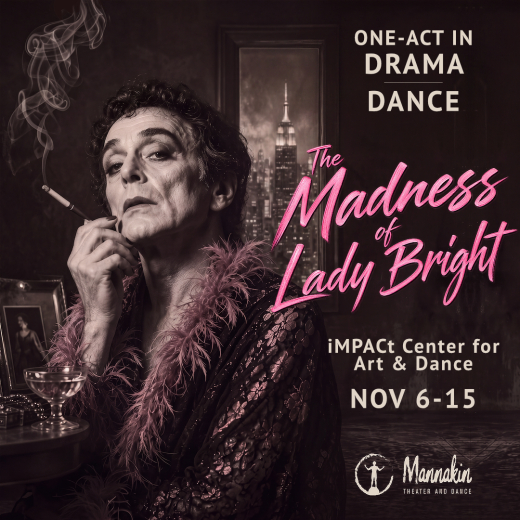
The Madness of Lady Bright Venue: iMPACt Center for Art & Dance (11/06-11/15) |

|
Gutenberg! The Musical! Hillbarn Theatre (10/08-11/01) |

|
The Secret Garden Marin Shakespeare Company’s Downtown Theatre (11/27-12/20) |
|
Hadestown Orpheum Theatre San Francisco (1/07-1/10) |

|
Exile | Banishment | Home O1C (11/15-11/15) |

|
Hamilton (Angelica Company) San Jose Center for the Performing Arts (7/07-7/18) |

|
Live At the Orinda - Beth Leavel Orinda Theatre (11/08-11/08) |

|
Catch Me if You Can San Mateo Performing Arts Center (10/22-10/25) |

|
PlayGround Twisted Holiday Festival Potrero Stage (12/04-12/11) |
|
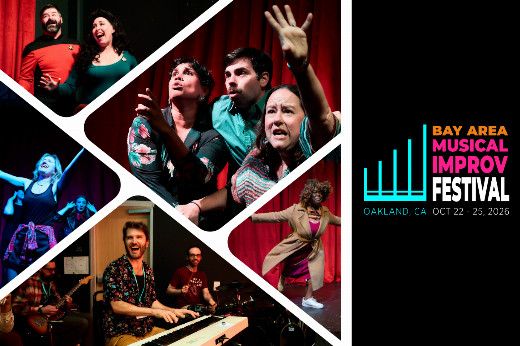
Bay Area Musical Improv Festival - Sunday 1:30PM Show All Out Comedy (10/25-10/25) |