


Review: PENNY SAUNDERS’ SHERLOCK at TPAC’s James K Polk
Penny Saunders’ Sherlock is a whimsical and nail-biting epic with some truly remarkable sound design and charismatic performances.
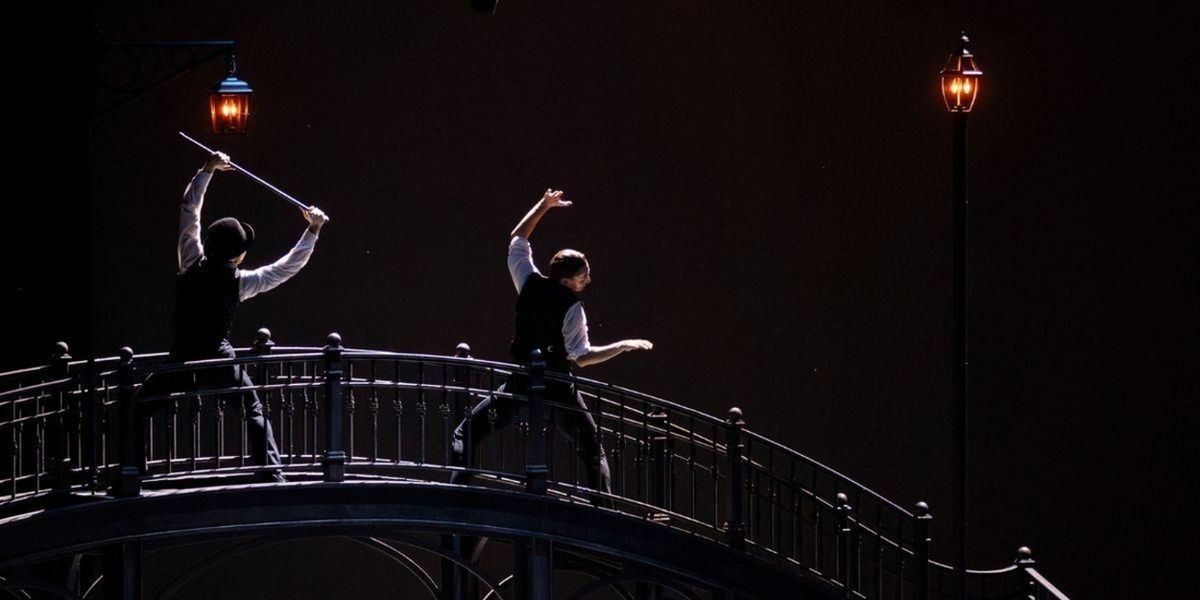
To close off its fortieth season, Nashville Ballet presents Penny Saunders’ Sherlock as part of their Attitude series. Attitude offers a collection of contemporary ballet pieces, giving audiences something untraditional to take in. Penny Saunders’ Sherlock is a whimsical and nail-biting epic with some truly remarkable sound design and charismatic performances. Maria A. Konrad’s Lumina drips in elegance as audiences are welcomed into the intimate space of Adele Bloch-Bauer. Donald Byrd’s Wake the Neighbors is simple yet effective as an emotional rollercoaster of a one-man show. Running May 1-3 at TPAC’s James K. Polk Theatre, these pieces are not ones to miss.
Kicking things off is Wake the Neighbors by Tony-nominated choreographer Donald Byrd. Out of all the pieces covered in my recent interviews for Nashville Ballet, Wake the Neighbors was the one piece that I didn’t get enough information for. I went into it as blind as possible, and it wasn’t until I had received my program that I realized it was a one-man show. The one man I witnessed onstage was James Lankford, who plays the role for the evening performances while Jorge Emilio Peña takes over for the matinee performances. Given how both dancers shared the role of Prince Siegfried in the company’s recent production of Swan Lake, I knew I was in for a treat. To simplify things for those who haven’t seen it, we witness a young man using the art of dancing to let out some frustration. Of course, there’s more to it, but you’ll have to see for yourself. The production team made the smart move of keeping everything from the clothing to the lighting so simple. That way, all eyes are on the dancer. During intermission, someone stated that they didn’t expect this dance to be so short, with a runtime of only six minutes. I replied with, “Maybe the reason it’s so short is because the neighbors finally woke up and got him to stop.” It may be a short segment, but the combination of traditional ballet and contemporary dance makes this one hard to look away from.
When I interviewed Maria A. Konrad on Lumina, I was immediately drawn to her inspiration. Initially inspired by the color gold, she discovered the world of Adele Bloch-Bauer. Adele is known for posing in portraits made by Gustav Klimt, and she was known in Austria for hosting these artists salons. That luxurious and sultry world was brought to life, with the dancers dripping in gold. Milla Wilkes-Davis and the Nashville Ballet’s wardrobe team offered exquisite costumes that just screamed “EXPENSIVE”. Just about everything demanded my attention, including Trad A Burns’s illuminating lighting design in a dark space. Even though I was far away from the stage, I felt like I was seated by the edge of the stage. That’s how intimate it all felt. It was like the dancers were about to pull me straight into their social gathering. As for the dancers themselves, they all flowed beautifully together while also getting the chance to shine (figuratively and literally) as individuals. All in all, Lumina truly shines in its world premiere.
And now, we come to the grand finale. Unlike so many other ballets, Penny Saunders’ Sherlock replies on words as much as it relies on music. Saunders not only served as the choreographer, but also the sound designer (with Daniel Clifton as the sound engineer). Using audios from Sherlock Holmes radio dramas, the dancers lip sync to their characters as they prance around onstage. Scenic Designer Andrew Boyce provided plenty of moving pieces and one singular set piece that is used to great effect. Keri Fitch and the wardrobe team certainly outdid themselves with the costumes. I was especially impressed by the flowy coat that Sherlock had to dance around in without getting completely engulfed by it. The show was staged by Pablo Piatino and Katie Crews-Linsley, who’ve somehow managed to contain the chaotic fluidity of a massive cast in a tight space.
Sherlock has no shortage of characters running around onstage. The massive ensemble cast delivered their roles flawlessly in such a chaotic environment. Speaking of flawless, Farin Taft effortlessly brought the character of Irene Adler to life (with Sarah Pierce playing the role for the matinee performances). She is just so sultry and cunning as she carefully mirrors the great detective. Since Penny Saunders wanted Adler to tell the story, her voice is provided by Lisa Zimmerman, whose delivery brings a lot of charm to the show. Marissa Stark (Lily Saito in the matinees) is gentle yet strong in the role of Mary Watson. Her little dance with Dr. Watson was really cute. Speaking of Dr. John Watson, he is brought to life by the talented Shaiya Donohue (with Michael Burfield taking his final bows with the company in the role for the matinee performances). Dr. Watson is the only one who can keep up with someone as energetic as Sherlock Holmes, and Donohue pulls that off pretty well. He is also very charming and funny in the role. In his final performance with the company, Brett Sjoblom depicts the mysterious and haunting Dr. Moriarty in all four performances. I had previously witnessed him as Von Rothbart in Swan Lake, and he certainly knows how to bring a villain to life onstage. With such menace with a hint of grace, it’s very fitting that Dr. Moriarty would be Sjoblom’s final role. And now, the man of the hour. Garrit McCabe (James Lankford in the matinees) doesn’t leave a single stone untouched as Sherlock Holmes. He will do anything from climb over furniture to slide on the floor in order to solve a case, and his humor sticks the landing. His dancing wasn’t the only thing I was impressed by; his lip syncing was on point, as were his facial expressions. Even in a sea of remarkable talents and characters, McCabe shines brightly.
Penny Saunders’ Sherlock and the rest of the Attitude series run May 1-3 at TPAC’s James K. Polk Theatre. Get your tickets now!
Prefer BroadwayWorld in Google Search?
Add us as a preferred source so our stories show up more often in Top Stories and Google’s AI answers — for you.
Sign up for all the news on the Fall season, discounts & more...
|
Giselle TPAC Polk Theater (10/02-10/04) |

|
The Night Shift Before Christmas The Circuit Playhouse (11/20-12/20) |
|
Disney's The Little Mermaid Ramsey Theatre Company (6/26-6/27) |

|
The American Revolution (in 40 Minutes or Less!) Chattanooga Theatre Centre (9/01-9/30) |
|
Stranger Sings! The Parody Musical Roxy Regional Theatre (10/23-11/01) |

|
The Best Gift: A Christmas Carol Musical Ramsey Theatre Company (12/05-12/06) |

|
Attitude Tennessee Performing Arts Center (5/07-5/09) |

|
Dial M for Murder Hendersonville Performing Arts Company (3/19-4/04) |

|
The Tempest Scenic City Shakespeare (10/02-10/23) |
|
Misery Ramsey Theatre Company (3/19-3/20) |

Reader Reviews
To post a comment, you must register and login.