




Season 2, Episode 5: Behind every summer is a community that keeps Fire Island alive. This episode explores the history of the beloved Pines Pantry through the eyes of its iconic Pantry Girls, alongside the volunteer firefighters of The Pines and Cherry Grove who protect the island from fires, hurricanes, beach erosion, and an uncertain future.
Review: CALON ARANG Questions Good and Evil
EKI Dance Company revived their Balinese-inspired musical at Graha Bhakti Budaya.
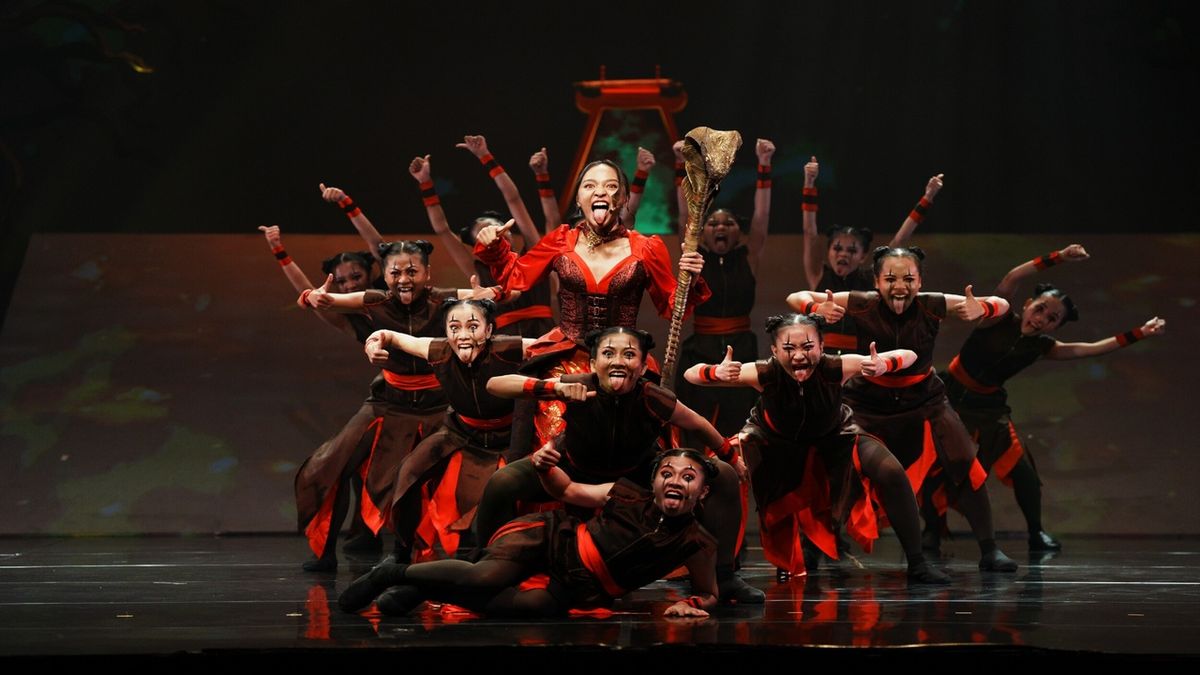
From September 17 to 20, EKI Dance Company put on CALON ARANG at Graha Bhakti Budaya to commemorate their 30th anniversary. This production – an adaptation of Balinese legend of the same name – is the third public iteration of EKI Dance Company’s CALON ARANG following two shows in 2025 at Galeri Indonesia Kaya and Teater Besar.
Ara Ajisiwi returns as the director and scriptwriter. The show’s choreography is handled by Nala Amrytha alongside Ara Ajisiwi, Yuliani Ho, and Ericha Vicky. Oni Krisnerwinto serves as the music director with Oni n Friends as the music team; the lyrics are written by Ara Ajisiwi and Titien Wattimena. Iskandar Loedin handles the art direction, with set design by Ichtiar Iskandar.
At the theater lobby, there was an exhibition of EKI Dance Company’s 30-year history. Photos of past shows lined the wall, with information about each show, showcasing the breadth of genres and themes that the troupe has previously tackled. Glamorous costume pieces were also put on display, each one bringing a strong sense of personality through intricate craftwork.
Before the show proper, there was also a medley of EKI Dance Company’s oeuvre. Played live by the music team and accompanied by archival footage, this opening act conveys an unmistakable sense of legacy and artistry that befits a dance company celebrating its thirtieth year.
In this version of the show, CALON ARANG opens with Ida Ayu Datu (Ara Ajisiwi), a young woman with a powerful talent for magic. But this gift, or this curse, has made her ostracized from her own village.
She then found sanctuary in a training ground for sorcerers run by Barada (Gabriel Harvianto). Although the two got along well in the beginning, Barada began to resent Ayu for her growing popularity and power. It all culminated in him accusing Ayu of trying to steal their order’s sacred grimoire. Once again losing the place where she belonged, Ayu ran away to a remote village, bringing her daughter and the said grimoire with her.
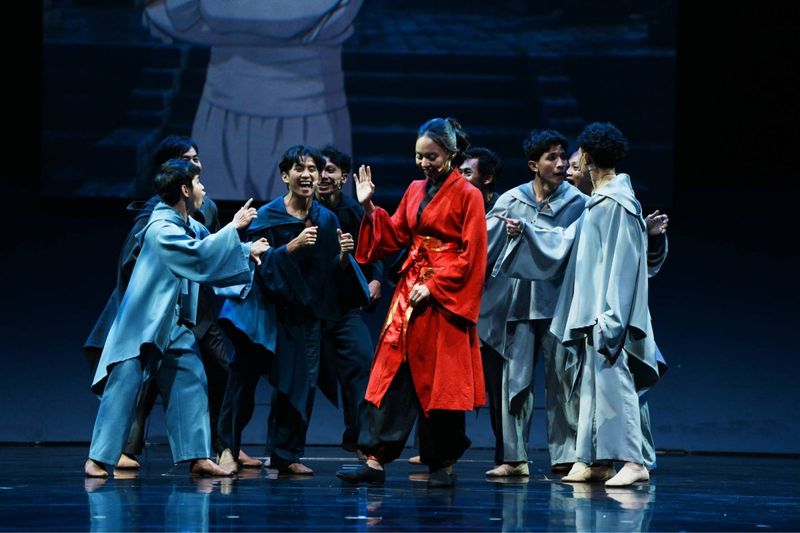
As she channeled the power of the grimoire, the goddess Durga (Sita Nuranti) appeared before her. The divine being not only bestowed an even greater magical power to Ayu, but also a message: live and die only for love.
Years passed; Dayu, now revered and feared as Calon Arang, lived with her daughter, Ratna Manggali (Nala Amrytha), and her own gaggle of followers. Due to her mother’s notoriety, and Ratna’s own budding magical powers, nobody in the village wanted to play with her.
Calon Arang tried to force the villagers to be friends with Ratna Manggali using her powers, which inevitably backfired. Still lonely and friendless, Ratna met a newcomer who introduced himself as Bahula (Gerry Gerardo). He claimed to be an admirer of Calon Arang and her mighty magical powers.
As Bahula endeared himself to Calon Arang, a romance began to blossom between him and Ratna as well. Soon enough, the two were betrothed. In the evening before their wedding, Bahula showed his true colors: he stole the grimoire and ran away, leaving a confused Ratna Manggali at the altar the next morning.
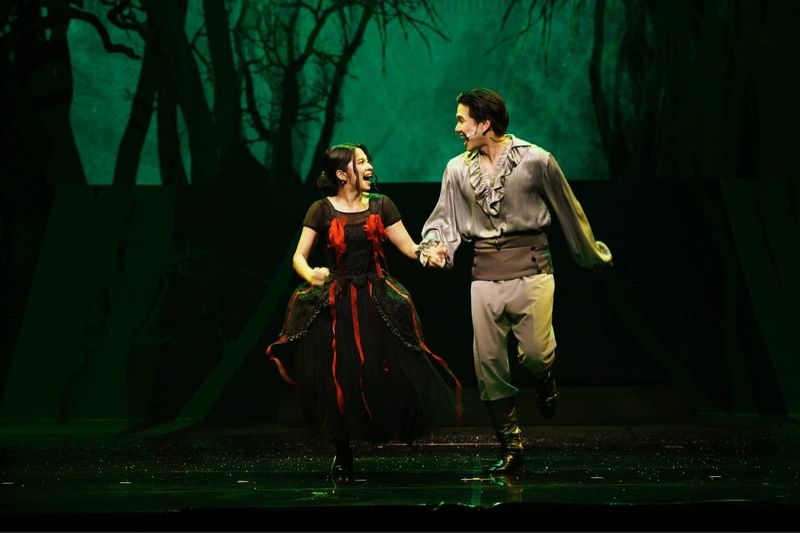
Enraged, Calon Arang went to Barada’s training ground and wreaked havoc, easily killing Barada’s pupils, including Bahula. Eventually, Barada himself came down to face her; they were about evenly matched, but a swarm of Barada’s pupils came to his support.
Ratna Manggali arrived just in time to see her mother being overpowered and slain. Barada declared that by bringing upon Calon Arang’s demise, he had brought an end to pestilence and suffering. Overtaken by grief and rage, Ratna inherited her mother’s staff and channeled her own tremendous power to exact revenge right there and then.
Conceptually, Calon Arang is a reinterpretation of a well-known legend, putting the traditionally villainous character in the hero’s seat. Musical fans might be familiar with this flavor of adaptation through works like Wicked, Twisted, or Unfortunate.
It’s an intriguing approach to the story. Calon Arang’s bond with Ratna Manggali becomes the crux of this thesis; the love Calon Arang has for her daughter easily endears her to the audience. Her friendly – and sometimes even a bit goofy – demeanor when interacting with the audience also successfully makes her feel approachable.
However, the show flips the script the other way around. The villagers are foolish, childish, and mean-spirited; Barada is ruthless and vindictive, flattening these characters in place of Calon Arang. We did get to see some consequences of Calon Arang’s actions, but these are mostly played for laughs or spectacle. It’s still an interesting and entertaining take on the folktale, but not a particularly nuanced one.
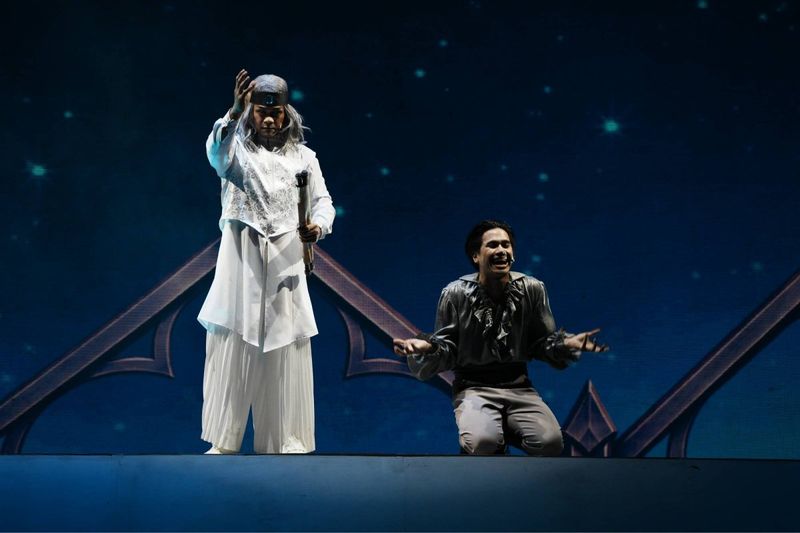
Compared to the previous versions, this iteration of CALON ARANG adds a few scenes and implements a number of changes.
Most notably, the show starts not with Calon Arang greeting the audience gleefully, but with her past as Dayu. To me, this backstory does make the dynamic between Dayu/Calon Arang and Barada more interesting and meaningful. But it creates a problem: a sense of disconnect between the past and current personality of Calon Arang. Her being a boisterous, chipper disposition feels like it comes out of nowhere, compared to the largely somber and serious backstory that ends with betrayal.
Another big change is the addition of the goddess Durga, as played by Sita Nusanti.
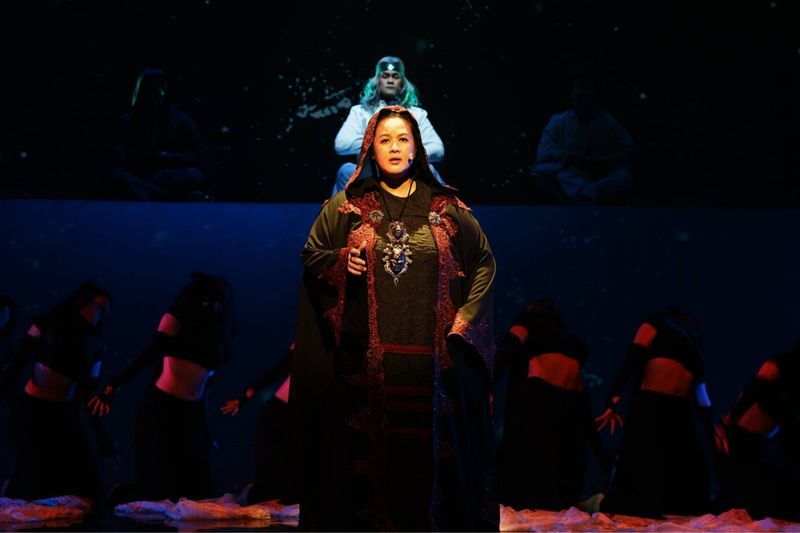
Although this character does not play a big role in the narrative, she brings tremendous thematic importance. The new song paints Calon Arang’s story as one of uncompromising love. Furthermore, Sita brings with her a truly awe-inspiring stage presence, elegant and powerful in equal measure. Even when her microphone didn’t turn on during her second song, her composure and vocal technique still enchanted the audience. Interestingly, as mentioned in the opening speech by EKI Dance Company founder Aiko Senosoenoto, Sita started her musical theater career with this very company, making her return particularly meaningful.
The other cast members also brought a slew of Great Performances. Ara Ajisiwi had the meatiest role, with emotions ranging from hopeful, joyful, maternal, and unrestrained anger. As an experienced actor, she conquers the role with ease.
Nala Amrytha’s Ratna Manggali is appropriately sweet and sympathetic, until the very end, where she explodes with grief and vengeance. Her solo song is very charming and sung beautifully, although a bit too short.
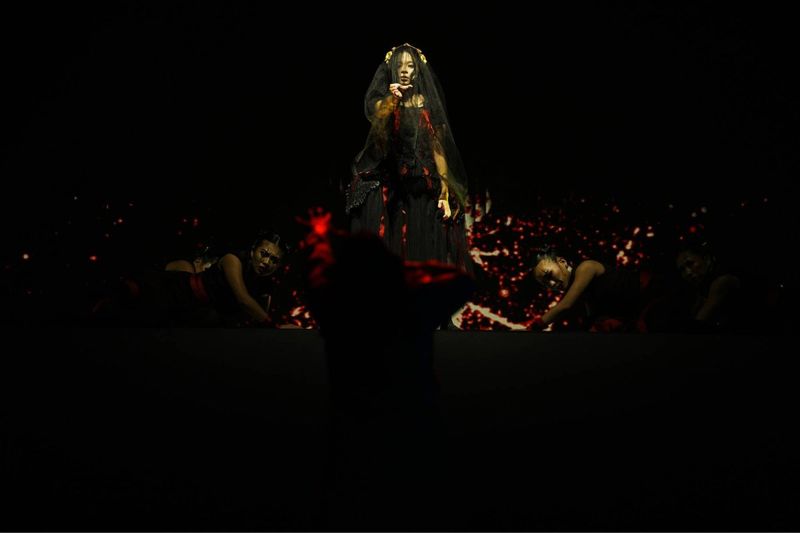
There is, however, a bit of confusion regarding her character. Ratna is portrayed as very childlike in her mannerisms, especially when she interacts with the other villagers – they play childish games like rock paper scissors and hide-and-seek. Yet, in the second act, she is about to be married to Bahula, hinting that she’s at least slightly older.
Gabriel Harvianto’s Barada is menacing and charismatic, although the role is rather a bit one-note. Gerry Gerardo played Bahula as both comedic or hateable as needed. The ensemble also brought great energy, especially during the comedic and fight scenes.
Artistic design has always been EKI Dance Company’s strong suits, alongside, of course, the sharp and energetic dance moves. And CALON ARANG is no different. The choreography is striking, particularly the hand-to-hand combat sequence. Another stand out moment was a dance number where the ensemble danced in sandboxes on stage, creating a mesmerizing particle effect.
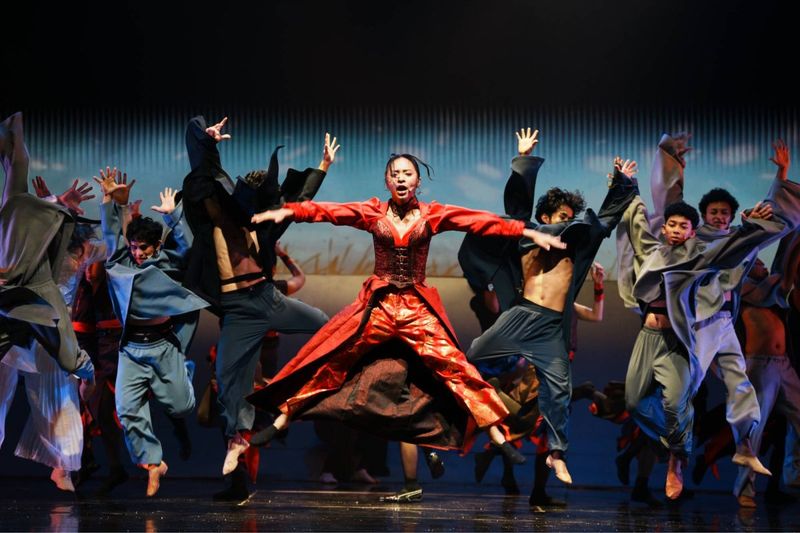
The costumes are largely well-made and full of personality, especially with Calon Arang in bold red fabric and Barada in pristine white, inspired from Rangda and Barong of the original legend. A slightly odd choice is Ratna Manggali’s costume, which is princess-like in silhouette; pretty and hints at her innocence, but inappropriate for her early scenes where she wanted to play playground games with the other villagers.
CALON ARANG also made extensive use of multimedia and prop work. For example, the opening scenes are partially told through animation on LED screens. However, the efficacy is questionable; having actual actors – instead of Ghibli-styled artificial characters – portray the villagers who shun Calon Arang might have made it more human impactful.
When this mixed media approach works particularly well, in my opinion, is in the climactic fight between Calon Arang and Barada’s pupils. Movable LED panels are used to cover pupils who got hit by Calon Arang’s attacks, then the screens depicted their grisly end. The multimedia design is credited to Harry Setiawan, Tito, and Jimmy Wijaya. The lighting design was made by Alim Jeni with Udin as assistant lighting designer.
EKI Dance Company’s CALON ARANG is an interesting retelling of the age-old legend. Although it has the elements to be an emotionally harrowing theatrical piece – particularly with the newly added scenes – it’s still comfortably a family show; it will entertain a wide range of audiences.
Certain elements might be incongruous on a deeper look, but nevertheless the show will leave you with a question: are people born wicked, or do they have wickedness thrust upon them?
More on EKI Dance Company
Broadway news in your inbox
Weekly top stories - unsubscribe anytime.
Weekly top stories - unsubscribe anytime.
Reader Reviews
To post a comment, you must register and login.