


Review: A Biographical Musical of SAYAP CINTA HABIBIE & AINUN
On 8th May, Broadwayang Production brought SAYAP CINTA HABIBIE & AINUN to the stage under the direction of Mikail Edwin Rizki, who also played Rudy Habibie.
Review by Zahira, editing by Rakaputra Paputungan.
On 8th May, Broadwayang Production brought SAYAP CINTA HABIBIE & AINUN to the stage under the direction of Mikail Edwin Rizki, who also played Rudy Habibie. Produced by Irwin Rizki with Seruni Hardiono as co-producer, the musical stars Mikail Edwin Rizki as Rudy Habibie and Dhea Seto as Ainun Besari, alongside Maudy Koesnaedi as Tuti Marini Puspowardoyo. The team from Broadway World Indonesia came to see the show, and here’s our review.
SAYAP CINTA HABIBIE & AINUN tells the story of the legendary love between B. J. Habibie (Indonesia’s third president) and Hasri Ainun Besari, following the couple from their youth until the end of their lives. As Habibie pursues his dreams of becoming an engineer and eventually dedicates himself to serving Indonesia, Ainun remains by his side with unwavering love and sincerity. Together, they endure the joys and hardships of life, from building a future abroad to returning home in service of their country, culminating in a love story that promises devotion, sacrifice, and loyalty that transcends time.
The musical wastes no time establishing its energy. It opens with an exciting ensemble number, packed with lively choreography that immediately pulls the audience into the world of the show. We are introduced to Rudy Habibie and Ainun during their younger years as their affection for one another slowly blossoms. Their courtship is met with obstacles, not necessarily dramatic ones, but rather a series of comedic interruptions and encounters with the people around them. Suitors visit Ainun’s family home, relatives and acquaintances chime in with opinions about their lives, and the musical peppers the budding romance with lighthearted humour.
As their relationship develops, Habibie and Ainun eventually choose to build a life together. Ainun follows Habibie to Germany, where he pursues his ambitions and career as an engineer. Their life abroad is portrayed as one of mutual support, with Ainun accompanying Habibie through his personal and professional growth. Throughout these sequences, the production frequently uses comedy and ensemble pieces to bridge the narrative, occasionally punctuated by charming visual touches, one of my favourite parts was the becak scene that is very simple, sweet, and endearing.
The second act shifts attention away from the couple‘s courtship and towards Habibie’s relationship with Indonesia itself. Political and social unrest forms the backdrop of the story, represented through musical numbers that allude to the nation’s turbulent circumstances. Habibie is eventually called back to Indonesia, leaving behind the life he had built in Germany.
Habibie’s political journey in Indonesia was the centre of the plot. He encounters Soeharto, who recognises his potential and invites him to play a greater role in the nation’s future. The meeting itself becomes one of the musical’s major set pieces, complete with an unexpected solo performance by Soeharto. As the political landscape changes and leadership transitions take place, Ainun continues to stand faithfully beside Habibie, supporting both his ambitions and the demands placed upon their family.

The musical’s final movements accelerate through the later years of Habibie‘s life and career. The story gradually shifts from direct action into reflection, with the family‘s experiences serving as a lens through which the audience witnesses the passage of time. Eventually, the narrative reaches its inevitable conclusion, returning to the central idea that the bond between Habibie and Ainun endures beyond the hardships and separations they faced in life. The production closes on an almost spiritual note, suggesting that love itself transcends earthly limitations and remains the lasting legacy of their story.
But somewhere along the musical, I realized that this wasn’t really a story about Habibie and Ainun.
It is, first and foremost, a story about Habibie. Ainun simply happens to be there.
That’s not necessarily a flaw. In fact, the production commits to this perspective remarkably well. We follow Habibie’s dreams, his ambitions, his career, and eventually his responsibility to the nation. Ainun is his confidante, his source of comfort, and his unwavering support system. The musical paints a portrait of a man with grand aspirations and the woman who chooses to stand by him.
The issue, perhaps, is that the title promises the audience something else.
The romance feels surprisingly brief. The courtship itself is sweet enough, though I never found myself completely invested in their story. There are tender moments and delicate words exchanged between the two, but the musical never allows those moments to breathe. Just as the audience is invited into a romantic scene, another comedic interruption barges in. Loud supporting characters, extended jokes, and recurring gags repeatedly pull the focus away from the couple.
Ironically, the romance seems to stop once Habibie and Ainun get together.
From that point onward, the musical transforms into Habibie‘s story. His education, his work, his ideals, his political journey—these become the driving force of the narrative. Ainun remains present, but mostly as a steadfast wife supporting her husband’s decisions. She sacrifices, reassures, follows, and waits. Dhea Seto portrays this version of Ainun with grace, making her believable without reducing her to a mere historical imitation. Yet I couldn‘t help but wish the script had given her more agency beyond being Habibie‘s emotional anchor.

Mikail Edwin’s portrayal of Habibie is a more complex performance. He has this accent that is a lot more prominent than anybody else’s. While this decision made him stick out as the protagonist, it also removed the period authenticity of the other actors, making them feeling less vintage. That being said, I think his commitment to playing Habibie made him manage to carry the weight of the role just enough.
Musically, the production is vibrant. The opening number bursts with energy, the ensemble’s choreography is engaging, and the costumes and hair design successfully establish the period setting. There are delightful touches throughout, from the appearance of a becak to the inclusion of songs associated with Guruh Soekarnoputra. Even a solo number by Soeharto—which I was not expecting in the slightest—turns out to be surprisingly catchy, even if its dramatic necessity remains questionable.
Perhaps that is why I walked away feeling strangely distant from the central romance. Habibie and Ainun are undoubtedly very kind to each other. Their affection is gentle, their conversations are soft, and their partnership is built on mutual respect. Yet I never found myself very swept away by their love. They look like they are in love but somehow it all feels so distant.

Speaking of the artistics, I really like the costumes and hairdos that are so convincingly vintage. They got the silhouette of the time period right, the fabrics of the dresses looked like something a woman of that time period would wear and the materials were not overtly costume-y. As for the make up, they went for a natural look without the exaggerated theater features, but refined enough to not be washed out by the lights.
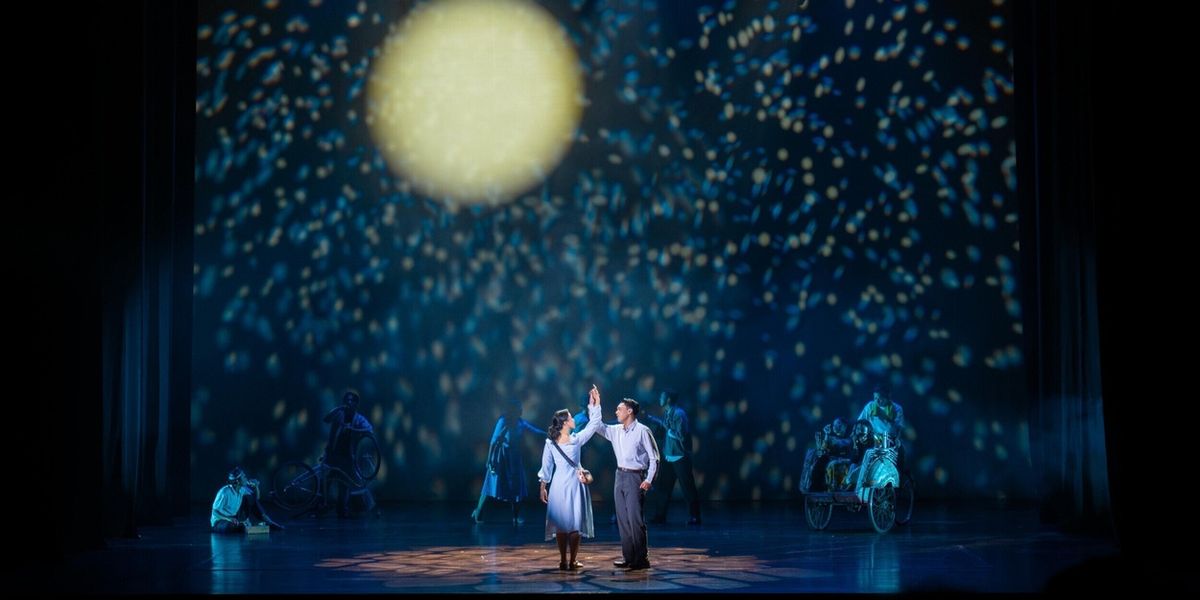
The lighting work (by Aurelius) was splendid, consisting of pale yellow, light blue, and pale green. They added so much emotion to the weight of the characters who are remembered heroically. One of my favourite lightwork was the moonlight scene, in which a contrasting round spot light shines on the black curtain, making a remarkable impression of the moon. On the other hand, certain elements of the set design seemed ineffective. There was a scene in Ainun’s house, where the stage was divided between the interior living room and the front yard. The proportions of how small the living room was incredibly different compared to the expansive front yard, considering there’s more people bunched up in the living room, creating a cramped look that is visually cluttered.
SAYAP CINTA HABIBIE & AINUN functions as a visually striking tribute to B. J Habibie’s life, work, and patriotism. Even if the romance does not completely sweep you away, the production’s choreography, catchy musical numbers, and impressive staging choices make it a worthwhile experience for anyone who appreciates a well-crafted historical biography on stage.
If you’re a fan of Indonesia’s historical figures and wanted to see a musical about their life, I think you would definitely enjoy this show’s dedication to Habibie’s legacy.
Weekly top stories - unsubscribe anytime.
Reader Reviews
To post a comment, you must register and login.