


Review: JERSEY BOYS Brings Class Act From Jersey to Jakarta
On June 27 and 28, Nawanika Production and Jakarta Art House presented JERSEY BOYS at Teater Besar, Taman Ismail Marzuki.
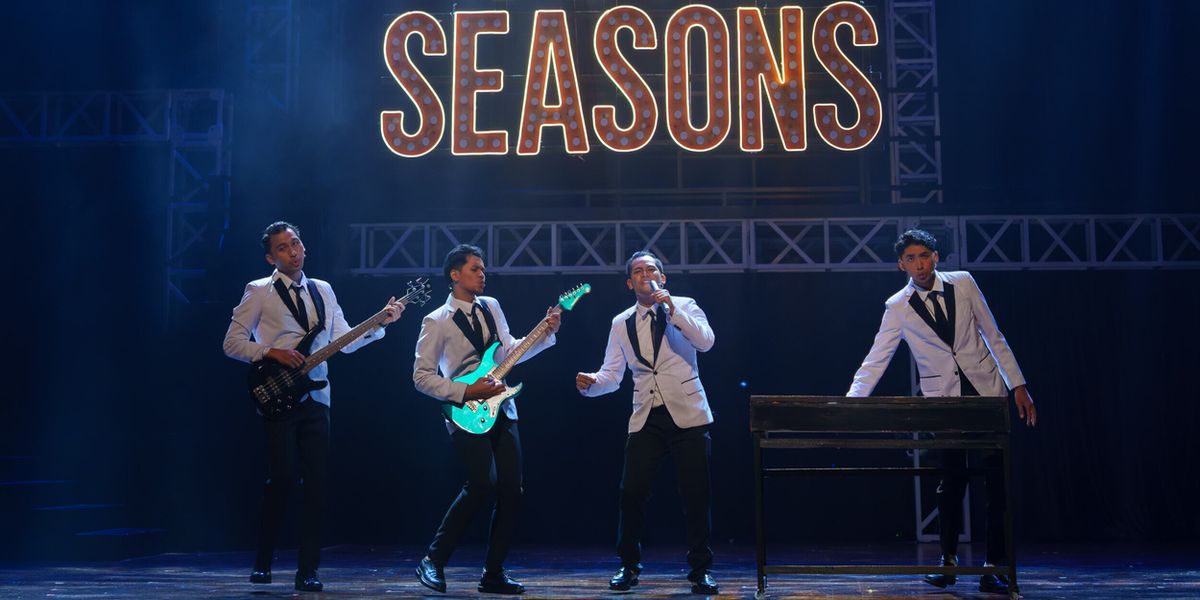
On June 27 and 28, Nawanika Production and Jakarta Art House presented JERSEY BOYS at Teater Besar, Taman Ismail Marzuki. This iconic jukebox musical retelling the story of the Four Seasons features a book by Marshall Brickman & Rick Elice, music by Bob Gaudio, and lyrics by Bob Crewe. The show’s dialogues are performed in Indonesian while the songs are kept in English.
JERSEY BOYS is the debut production of Nawanika Production, a creative initiative. The production is directed by Bran Vargas, returning to the director’s chair for the first time since 2014. The creative team also includes Raissa Putri Permana as co-director, Felita Kezia as music director, Clarissa Theophilia and Muhammad Ferdy Zein as vocal directors, Mumu Harmoun as choreographer, as well as Marcella Anya Setyawan and M. Alief Agung Alim Valerie as co-choreographers.
The story of JERSEY BOYS is told through the perspectives of the band’s four main members: Frankie Valli (Andikara), Nick Massi (Ray Paulus), Bob Gaudio (Ghatfaan Rifqi), and Tommy DeVito (Nabil Pawaka). The show opens by Tommy welcoming the audience to follow the story of the Four Seasons, immediately framing the show as a flashback, biographical story that we can sit back to observe and enjoy. It’s a smart way to set the audience’s expectations.
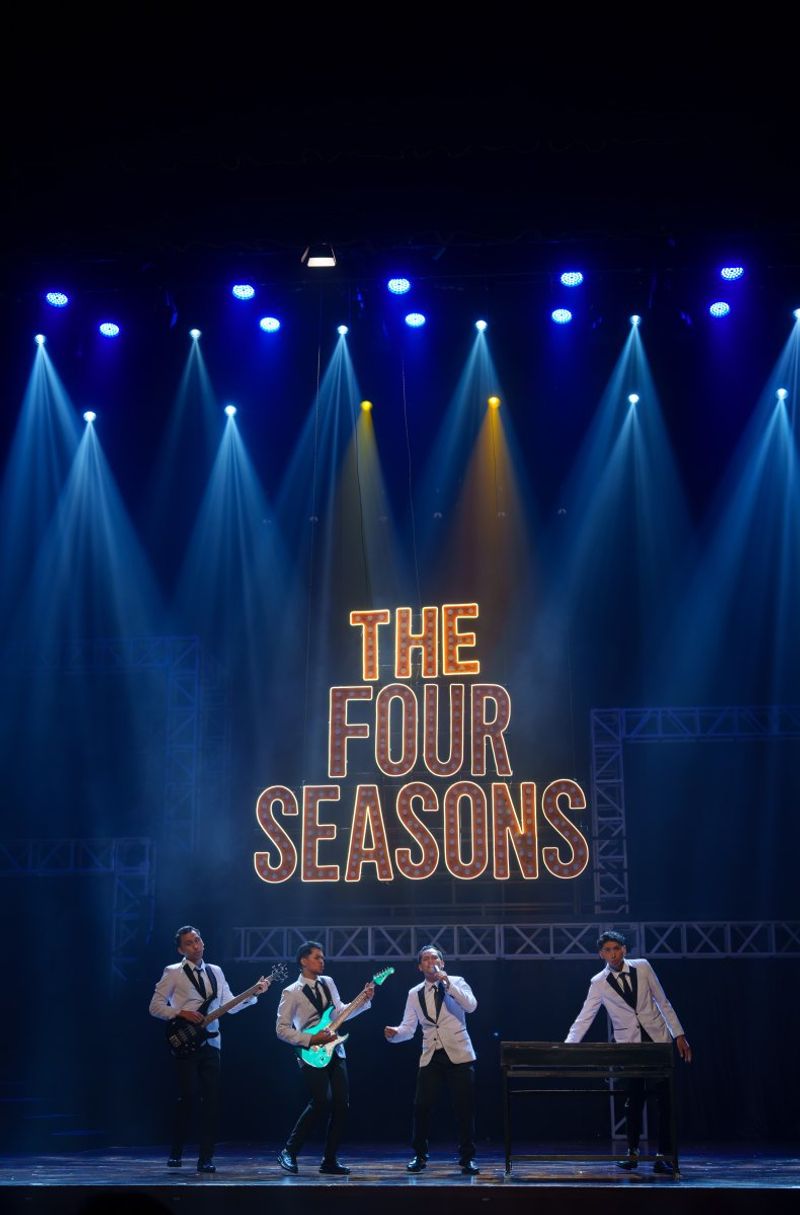
Then, as with many other biographical works about musicians, the story proper starts with the foundation of the band in Bellville, New Jersey. JERSEY BOYS wasted no time in painting the picture of a grimy, crime-laden town full of danger but also opportunities. The state itself becomes almost like another main character, becoming the motivation behind these young men’s actions to pursue their dreams, as well as the explanation behind their more questionable decisions later in life.
What follows is a series of events dramatizing the band’s rise to fame, decline, and personal conflicts. The three most prominent plot threads are the band’s struggles in making it big in the music industry, Tommy’s gambling problems that led to a massive debt the band eventually takes over, and Frankie’s tumultuous relationships with both his romantic partners and his daughter, the latter of which ended in tragedy.
JERSEY BOYS is a jukebox musical, meaning the songs are actual songs by the Four Seasons and or its members. A common challenge of jukebox musicals is that the songs can often feel forced to suit the story instead of being made bespoke to serve the narrative; JERSEY BOYS offsets this by making it a biographical musical, meaning most of the songs are diegetic and doesn’t need justification to be performed (although several songs are indeed performed as if they’re the characters’ inner feelings as in traditional musicals).
Another standout element of JERSEY BOYS is how the action never stops; the characters move in and out between songs and scenes without any blackout. This makes for a tight flow that’s easy to engage the audience members with; but, on the flipside, it provides a tremendous logistical challenge.
To face this challenge, Bran Vargas and the creative team created a multi-level set with many different playing fields. This is a stroke of genius, allowing both the actors (and the stage crews) to move between these different areas without stopping the action. Often, we see the viewpoint character narrating what happens next as he climbs a set of stairs or walks across the set, and when he arrives at the next point, the stage is already set.
The set itself is largely made of steel beams, constructed to frame the playing areas like a concert stage, evoking the image of show business that is the core of JERSEY BOYS. This neutral backdrop works great with the story that takes over different places and decades, with smaller set pieces brought in or out as needed.
So, that’s the matter of flow and pacing settled, but how were the performances?
Thankfully, they were similarly great. Each character, including the supporting characters and featured ensemble parts, has a strong personality, making for an exciting watch despite the realistic story.
First and foremost are of course the Jersey Boys themselves. Nabil Pawaka is wonderful as Tommy DeVito, smooth, suave, and just the right amount of scummy. Just like what he did to Frankie and the rest of the band, he draws us in with a magnetic charisma and charmingly sweet words. Even when he got the band in deep financial trouble, we can’t hate him too much, and that is an amazing balancing act.
Ghatfaan Rifqi as Bob Gaudio brings the youthful yet scrappy role to life. The character’s a singer-songwriter with a chip on his shoulder, mostly being known as a one-hit wonder for his rather corny single Short Shorts. Ghatfaan maneuvered the different sides of this character adeptly, selling us on the young man’s eagerness – and even desperation – to make it big. He particularly stood out during an early scene in which he negotiated his pay to be the same as Tommy and the other band members; we could see both his confidence and his vulnerability, and we wanted to root for him. Moreover, his rich, powerful voice really shined in his few solo moments.
Then there’s Ray Paulus as Nick Messi, the band’s bassist. The character prefers to stay away from the interpersonal drama most of the time, thus we didn’t get to hear his thoughts for much of the show. But what we could hear was Ray’s solid vocal performance with his delightfully deep and smooth bass tones, a preciously rare gem in modern musical theater.
Speaking of rare vocal types, none fits that description better than Frankie Valli himself as played by Andikara. It’s a tenor role with strong falsettos, another technique seldom used in modern musical theater. Therefore, it was a pleasure to hear Andikara pull off this unusual vocal technique with perfection. When the four of them sang together in songs like “Sherry”, the harmony created was a true musical delight, courtesy of the collaboration between the four actors and the vocal director, Clarissa Theophilia.
Frankie Valli also had some of the weightier emotional moments in the play which paved the way to the most drastic character growth, developing from a naive and gullible up-and-comer into a mature, tenacious artist who bears deep emotional scars. This is a surprisingly difficult role, but Andikara managed to portray the character’s journey with such conviction and honesty that it’s like he truly matured 20 years during the show’s duration.
As a side note, I appreciate that the show platformed new, exciting talents in the lead roles that I hope to see in more shows.
Of course, the story couldn’t have come to life without the plethora of supporting characters. They are, as a whole, great. The whole cast made an impression both individually and as a company, a testament to their dedication and skill under Bran’s direction. Particular stand out performances came from Agatha Pricilla as Mary Delgado (alluring and intoxicatingly compelling), Yehuda Yudi Tyasya Christian Elson as Joey Pesci (hilarious, with a personality as big as his pompadour), and Arjuna Asa as Gyp DeCarlo (as magnetic and intimidating as a mafia don should be).
A featured ensemble performance that stole the scene came from Ignatius Genta Banyu Adjie as Hal Miller. Hal Miller is one of the singers who Four Seasons sang back up for. During the scene, Banyu sang a 40-second excerpt of An Angel Cried. Considering it was a small part, one short scene out of a montage portraying the Four Seasons’ struggle to get their music produced, nobody was ready for the powerhouse vocal performance. It was a roof-raising, jaw-dropping moment that received a well-earned rapturous applause from the audience.
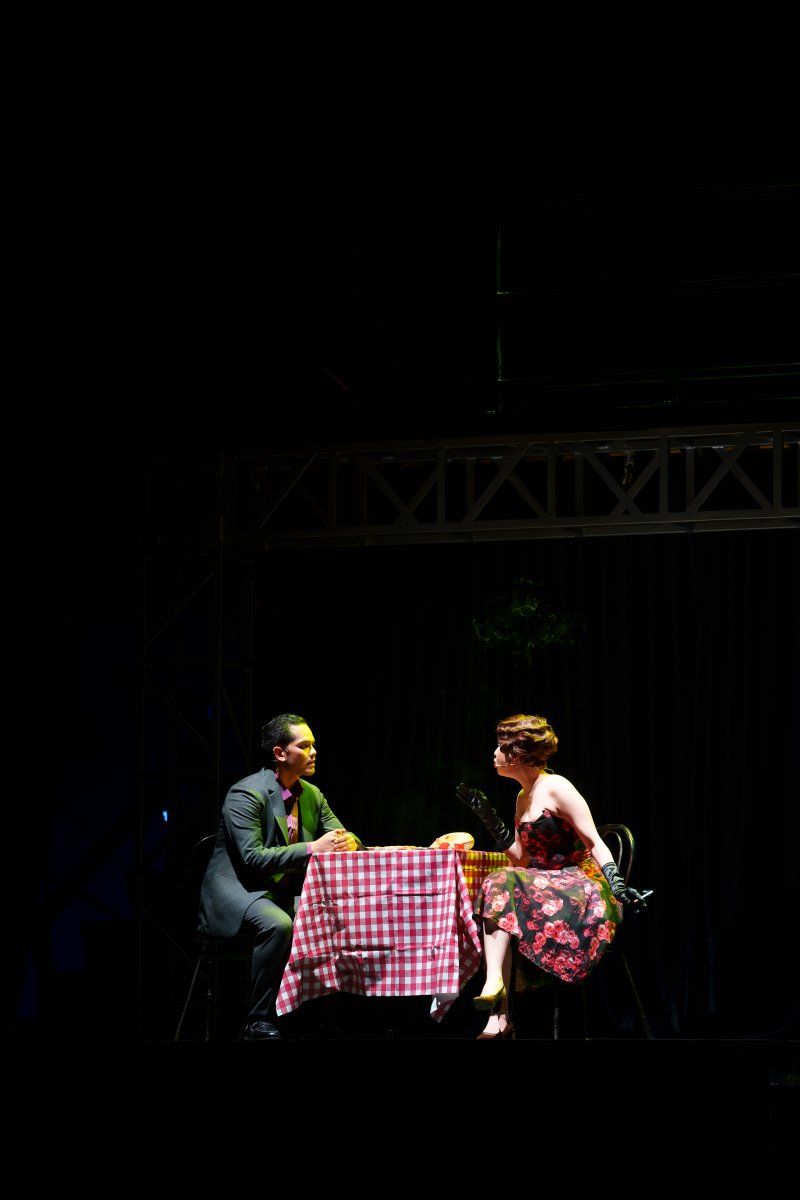
For a musical focusing on vocal performances, JERSEY BOYS thankfully had a great sound design and execution. The vocals sounded crisp, worthy of a concert or even recording; the utilization of off-stage pit made the musical numbers sound satisfyingly full and blended in immaculately. And although this is not a dance-heavy show, the choreography helped in both evoking the period setting and injecting some playful energy into the group numbers.
The Indonesian translation by Palka Kojansow worked well, for the most part. Considering the story is set in a very specific locale and time period, with a script full of references to American culture and musicians, having the dialogue set in Bahasa Indonesia actually helped in lessening the barrier to understanding the story.
Sometimes, however, the dialogue can be hard to understand; the main culprit is usually either the combination of Indonesian dialogue with foreign names and song titles, or the actor having to speak quickly while getting to their next spot. Other times, the dialogue set in the middle of a song can be drowned out by the music. But, overall, the main points of the story remain easy to grasp.
Another side note is the show has some strong language and intense moments; a more visible age rating or advisory would help interested audience members to make more an informed decision.
Overall, JERSEY BOYS is a tremendous debut for Nawanika and another quality production by Jakarta Art House. Although material might not be the most emotionally resonant, it’s a well-crafted show that’s surprisingly easy to enjoy, very competent in its technical execution, and platformed new, promising talents. It’s almost too good to be true.
Broadwayworld Indonesia was a media partner of Jersey Boys.
Prefer BroadwayWorld in Google Search?
Add us as a preferred source so our stories show up more often in Top Stories and Google’s AI answers — for you.
Sign up for all the news on the Fall season, discounts & more...


Reader Reviews
To post a comment, you must register and login.