


Review: Jakarta Movin’s SENJA TEDUH PELITA: A Laborious Spectacle
From July 3 to 12, Jakarta Movin is presenting their latest show, SENJA TEDUH PELITA at Graha Bhakti Budaya, Taman Ismail Marzuki.
Review by Nabila “Hana” Hananti, editing by Rakaputra Paputungan.
From July 3 to 12, Jakarta Movin is presenting their latest show, SENJA TEDUH PELITA at Graha Bhakti Budaya, Taman Ismail Marzuki. This show is a jukebox musical featuring the songs of Maliq and the Essentials, a popular band known for their jazz, soul, and pop discography.
Uniquely, SENJA TEDUH PELITA has double casting, with the role of Arah either played by Alf Elijah Beloved Sigarlaki or Daria Lakshmi Algamar; the co-starring role of Kala is then played, respectively, by either Xanrea Abigail Tabythaputri or Cliochi Junio Eigo. This review is based on the opening show on the afternoon of Friday, July 3, with Alf as Arah.
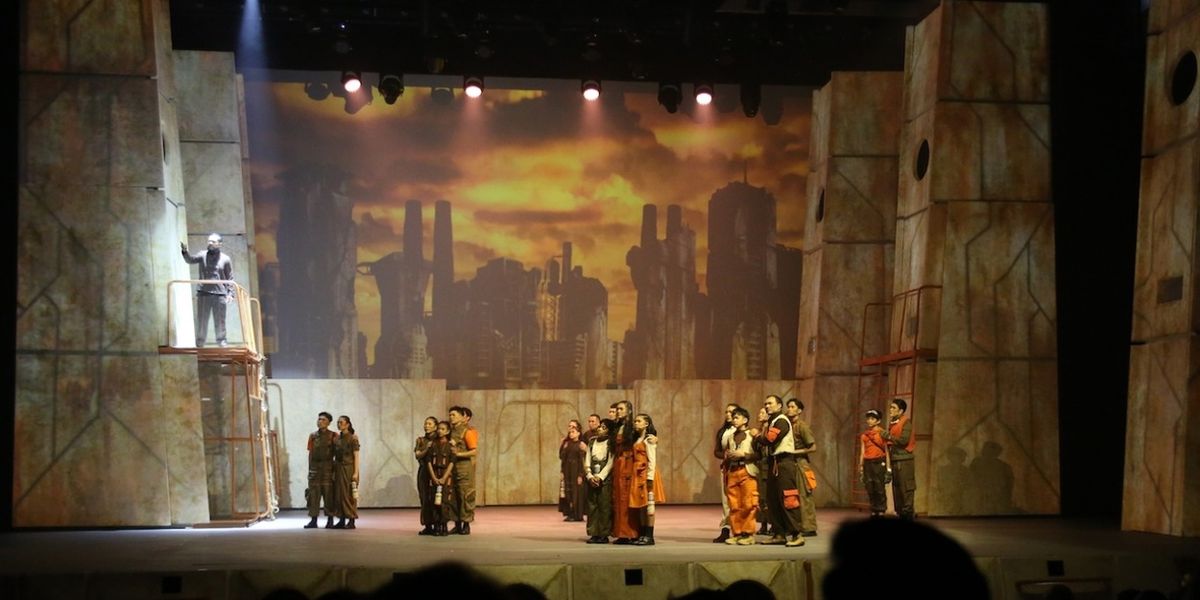
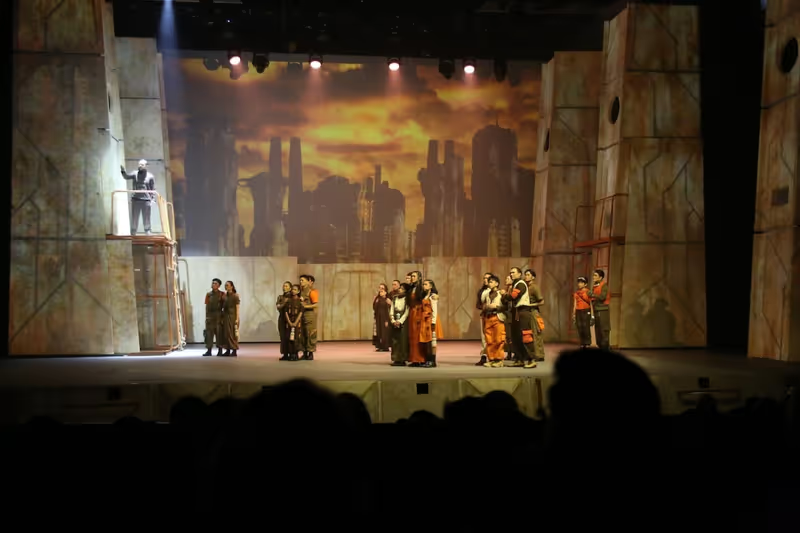
Set in a post-apocalyptic world where human greed and endless crises have caused civilization to collapse and all adults to vanish, children are left as humanity's sole survivors. In a dying city, a resourceful group of kids—Arah (the navigator, played by Alf Elijah Beloved Sigarlaki), Hara (the botanist, Emily Olivia), Palu (the builder, Nayaka Maleakhi Tomasouw), Volta (the electrician, Sahlendra Syarief), Raga (the strong all-rounder, Nadindra Gynta), and Lagu (the musician, Annabella Farizky)—struggle to survive while building a new home and waiting for their parents to return from a mission. Their status quo changes when Arah receives a mysterious message from her mother, prompting her to launch a rescue mission. Joined by newcomers Kala (the historian, Xandrea Tabythaputri) and Langit (the astrologer, Mavisha Reakana), who reveal that the parents are at a place called Aurora, the group sets out. However, an ideological rift forms: Kala warns that the adults' actions must be stopped to avoid repeating the cycle of destruction, while a defensive Arah strongly believes their parents are working for the greater good.
Their journey takes a dramatic turn when a massive storm destroys their raft, stranding them in a surprisingly pristine, untouched bay they name Teluk Pelita. There, they meet Binbin (Jecky Rizhan Sianturi), a child who can communicate with animals, completing their ultimate survival team known as "Pasukan Pelita" (The Pelita Squad). In this lush new environment, the exceptionally skilled children successfully build the sustainable, ideal life their parents had always envisioned. This newfound paradise eventually leads into a major dilemma for the group: when Arah urges Pasukan Pelita to press on with the dangerous search for their parents in Aurora, a massive debate erupts over whether they should risk everything to leave, or simply stay and enjoy the safe, sustainable world they have created for themselves.
As seen from the official synopsis above, the story of SENJA TEDUH PELITA is fantastical and ambitious. Nuya Susantono is credited as the sole writer behind SENJA TEDUH PELITA, while also taking the mantle of director and producer.
In the big picture, this is an interesting way to reinterpret the songs of Maliq and the Essentials, which are traditionally seen as romantic songs.
But this very ambition might be its biggest oversight.
A story should make logical sense. That does not mean that a story can only be good when it is realistic, there are countless stories that have heavy fantastical elements, and the audience believes in the logic of the fantasy that the writer created. Events should follow one another, with clear cause-and-effect.
As a whole, the script of SENJA TEDUH PELITA feels like a collection of plot points. There were minimal amounts of character-heavy actions, and there was nothing that interconnected the different plot points naturally. Any problem was resolved simply because the characters say it was resolved, instead of through them logically and coherently working on a solution. At a certain point, it felt simply like an amalgamation of different plot points that were haphazardly put together, and that made it nonsensical.
Some plot points within the play immediately collapse when one chooses to dwell on them a bit longer. One example is the way Arah’s mother waits for Arah & his friends to arrive in the detention center before breaking out, although she has had the ability to leave the prison far before. For another, there’s Kala, a child who decides to travel alone to follow Arah & his friends who had left the island to continue searching for their parents, despite knowing the tremendous risks.
In addition to these illogical decisions and questionable actions, there was a lack of intention given towards the characters.
The main characters of Senja Teduh Pelita were Arah and his friends. In the synopsis, they were dubbed the “Pasukan Pelita” (Starlight Team), but the kids (yes, even Arah himself) were significantly underdeveloped. While the show attempts to introduce these ensemble of kids and try to give them all identities, most of the kids all existed and acted as a collective. Unfortunately, the lack of their own individual personality, goal, and motivation made them forgettable.
This also applies to the adults within the story. We only find out the name of Arah’s parents nearing the end of the story, when the villain was asking for their identity. To me, this only seems to show the lack of consideration for these characters’ roles within the play. The only thing important about them was their name and their purpose: as a plot device that delivers sentences. The relationship between Arah and his parents too were almost nonexistent. The lack of development also means a lack of emotional depth in their relationship, and that reduces the impact inflicted upon the audience (when, spoiler alert, one of the parents died) by the end of the show.
Additionally, despite the many characters on the stage, there was also a significant lack of chemistry happening between them.
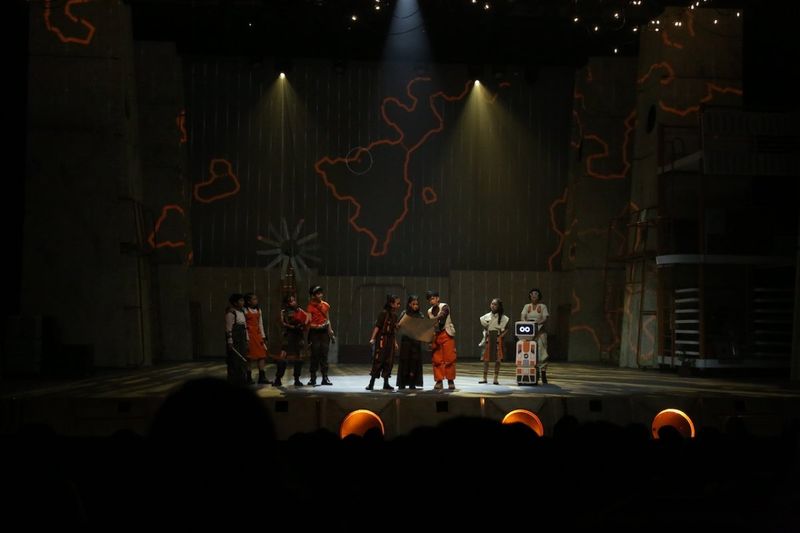
Another writing issue I would like to discuss is the lack of purpose in having these characters be kids—these kids did not act at all like kids. There would be no difference in the actions happening within the story if some of these characters were aged up; I would even say that some of the actions taken would’ve made more sense if they were older (such as Kala’s decision to travel alone to find the others who left Teluk Pelita to find their parents). There was no purpose or consequence in having these kids be so young—they just are—and I think that’s a very fatal storytelling flaw.
There was no attempt to convey any semblance of childishness within the story, courtesy of the characters having little personality in the first place. This was unfortunate, as kids can impact a story in a way that still preserves their identity as kids. When the kids sing a song about longing for their parents, it is not shown the how and the why they miss them. Rather, the kids were all doing alright, living in their own functioning collaborative society without the adults. It could have made for a more powerful moment if we understood why they longed for their parents.
The uses of Maliq & D’essentials’ songs were also largely straightforward. Noticeably, it had led to a forced romance in which children were singing their poetic romantic song as-is. The show did not explore and utilize Maliq & D’essentials’ discography, for example through symbolisms and allusions, which I consider a missed opportunity.
As she also acted as the director of Senja Teduh Pelita, there’s a bit of an uncertainty with me whether the main issue of this show was the direction or the writing. I believe that Nuya Susantono had a good intention in bringing forward a strong dystopian concept, but a strong concept does not always translate to a creative execution.
Courtesy of her directing, the storyline was conveyed coherently. However, it was not conveyed as engagingly. The musical numbers of this show were splendid spectacles and full of spirit, but the same couldn't be said about the moments without music.
From the beginning, Senja Teduh Pelita set a fantastical tone. It was wholly ethereal and full of otherworldly energy, brought on by the music and the colorful lighting. The arrival of the cast in the non-conventional costumes and eccentric makeup also established the circumstances and situation the people within the story were in.
However, this attention to detail seemed to be misplaced when they decided to add a sound effect to the safety briefing prior to the show’s starting. This effect adds to the immersion, certainly, but it also reduces the intelligibility of the content. While the environment was atmospheric, the accessibility was lost.
Some of the song lyrics were also lost, even unintelligible, perhaps due to being performed without optimal musical theatre technique. It was still, incredibly, a feast to the ears, but it was often hard to comprehend. And for a story that already had weak writing, emotion alone isn’t enough.
My critiques about the writing existed because the cast and crew had brought such a spectacular performance to this show. Jakarta Movin had earned their reputation over the years. SENJA TEDUH PELITA was a professional production with multiple highly competent people involved within it. It was a visual feast and an audiophile’s daydream. My favourite part of this show was the artistic decision that evokes childlike wonder, such as the use of puppetry within the show. Everything was done strategically, delivering a high-quality professional production. Unfortunately, it collapsed under its own weight because the foundation – i.e. the writing – itself wasn’t strong enough. Thus, the show simply became a laborious spectacle with some emotional moments injected here and there.
As a whole, Senja Teduh Pelita was a gorgeous production that felt more like a recital than a show (and I’ve seen recitals that told a better story). I think producers nowadays should consider investing more in script development. If weak writing could inspire such great artistic decisions, then imagine what would’ve happened if the writing was better? It would certainly leave more of an impression on the audience. And perhaps then, the audience could go home inspired by the values of the show.
Sign up for all the news on the Fall season, discounts & more...

Reader Reviews
To post a comment, you must register and login.