

Review: DIE WEISSE ROSE at Theaterhaus Stuttgart
A deeply moving musical about courage, conscience and the enduring power of resistance
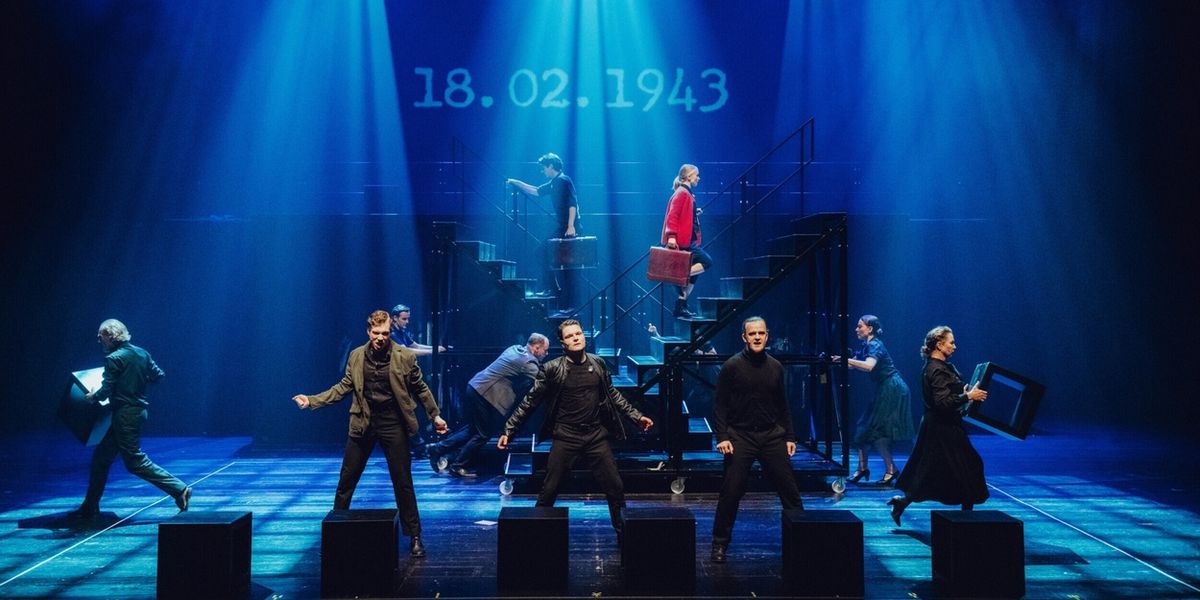
The multi-award-winning German musical „Die Weisse Rose“ (The White Rose) is a powerful, courageous and deeply affecting work of remembrance that speaks to contemporary audiences with striking immediacy. Rather than relegating history to the past, it encourages new generations to engage with the enduring value of freedom and the extraordinary power of individual courage.
Husband-and-wife team Vera Bolten and Alex Melcher have created a contemporary musical of exceptional artistic ambition. Bolten, who penned both the book and lyrics, also directs the production, while Melcher—alongside contributing to the lyrics—has composed a richly textured, dramatically driven score. Every creative element feels seamlessly interconnected, resulting in a production shaped by a singular artistic vision.
The narrative unfolds with remarkable assurance. As the audience follows Hans and Sophie Scholl's transformation from enthusiastic members of the Hitler Youth into increasingly reflective young adults who ultimately sacrifice their lives in defiance of the Nazi regime, brief yet harrowing interrogation scenes repeatedly interrupt the chronology. These glimpses ahead foreshadow the inevitable consequences of the White Rose's leaflet campaign, casting an inescapable shadow over everything that precedes it.
The musical also gives equal dramatic weight to the other historical members of the White Rose resistance movement. Their stories are woven naturally into the narrative, presenting each of them not simply as resistance fighters, but as recognisable young people filled with hopes, fears, ambitions and deeply human emotions. Their families, friendships and romantic relationships become just as important as the painstaking reconstruction of how isolated doubts gradually evolved into one of the boldest acts of resistance in German history. Their leaflet campaign at Munich University has since become an enduring international symbol of freedom and moral conviction.
Bolten shapes this wealth of historical material into an exceptionally cohesive and emotionally resonant book. Combining coming-of-age drama, historical tragedy and the mounting tension of a political thriller, „Die Weisse Rose“ generates a dramatic momentum that rarely loosens its grip. Whether encountering these events for the first time outside the classroom or bringing personal or family connections to the legacy of the Second World War, audiences are unlikely to remain emotionally detached.
Melcher, meanwhile, has found exactly the right musical language to propel the story while illuminating the emotional journeys of its protagonists. His score extends well beyond conventional musical numbers, employing an intricately woven underscore that enriches the spoken scenes through recurring motifs and subtle thematic development.
Most importantly, Melcher never loses sight of the fact that this is, above all, a story about young people. However extraordinary their historical legacy, they remain instantly recognisable through their friendships, insecurities, dreams and fleeting moments of happiness. Even amid overwhelming darkness, they continue to celebrate youth, companionship and hope, and the music reflects that emotional complexity with remarkable finesse.
The score moves effortlessly between elegant waltz influences, luminous melodies recalling Amélie, relentless staccato passages underscoring the ever-present threat of the Gestapo, driving rock-inflected sequences fuelled by anger at systemic injustice, solemn chorale-inspired harmonies that embody hope, and heart-rending string writing accompanying those devastating moments in which profound despair slowly gives way to acceptance of an unavoidable fate.
The lyrics prove equally compelling. By incorporating authentic diary entries, letters and poems written by members of the White Rose alongside newly written material, the songs establish a powerful dialogue between historical testimony and contemporary musical theatre. Rich in philosophical reflection and emotional nuance, they provide profound insight into the characters' inner lives while expressing ideas that continue to resonate long after the final curtain. They reward repeated listening, revealing fresh layers of meaning with every encounter—a quality fortunately preserved on the superb cast recording released by the creative team.
Visually, the production is every bit as accomplished. Jens Hahn's animated illustrations serve not merely as scenic backdrops but as emotional landscapes, blending tangible locations with abstract states of mind. Inspired by Sophie Scholl's own artwork, they first appear with Sophie seated alone at centre stage, enveloped by darkness as her imaginative sketches gently illuminate the world around her. Creativity itself becomes an act of quiet resistance—the first spark of individuality capable of igniting a far greater movement.
Andreas Hönig's lighting design reinforces this symbolism with impressive subtlety. Carefully sculpted shafts of light puncture the surrounding darkness, creating striking visual metaphors without ever feeling overstated. At pivotal moments, Hönig floods the stage with blinding brightness, dissolving the traditional boundary between performers and audience. During Gauleiter Paul Giesler's notorious address at Munich University, the lecture hall expands beyond the stage to engulf the entire auditorium. For a few unsettling minutes, the audience ceases to be passive observers, becoming silent witnesses—reluctant accomplices and quietly outraged opponents of Nazi ideology. The distance between history and the present moment suddenly disappears.
Elsewhere, deep crimson washes and isolated pools of pale light isolate the imprisoned members of the White Rose as they await interrogation and certain death, standing in stark opposition to the fanatical "Blood Judge." His grotesquely theatrical show trial initially appears almost exaggerated, yet its disturbing power lies precisely in the knowledge that history unfolded exactly this way. The production becomes a sobering reminder that Europe was, until relatively recently, governed by an ideology whose arbitrary brutality and moral bankruptcy now seem almost incomprehensible. More importantly, it illustrates how alarmingly quickly democratic societies can slide backwards—a thought that inevitably resonates against today's political landscape in Germany.
Yet Bolten's production never leaves the audience in despair. If history demonstrates how swiftly darkness can overtake a society, it also suggests that courage, compassion and resilience possess the power to reverse that course. Change rarely happens all at once, but it can begin with a single courageous decision. It is this sense of cautious optimism that emerges from the seamless interplay between Bolten's direction, Melcher's score, Hahn's visual world and Hönig's evocative lighting.
Sven Raff's sound design, complemented by Marcin Weber's meticulous audio engineering, proves equally memorable. Long stretches of almost unbearable silence alternate with moments of overwhelming sonic intensity, allowing sound itself to become an essential storytelling device. From the opening seconds, the audience is plunged into the production through the deafening roar of aircraft engines interwoven with Nazi propaganda broadcasts. The atmosphere is established immediately: one of such overwhelming tension that the proverbial pin could have been heard dropping throughout the performance.
The closing moments bring that same sonic motif full circle. Once again, aircraft thunder overhead, but this time they herald liberation rather than oppression. What begins with Nazi bombers foreshadowing war concludes with Allied aircraft scattering leaflets inspired by those of the White Rose, transforming the production's opening image of terror into one of hope. It is an elegant piece of dramatic symmetry that provides the evening with a deeply satisfying emotional resolution.
Marcus Bendel's set consists of a raised playing area connected by two movable staircases, creating multiple physical and narrative levels that allow scenes to transition with cinematic fluidity. Combined with the staircases themselves, the structure effortlessly accommodates an astonishing range of locations without interrupting the flow of the storytelling.
Projection surfaces incorporated into the gauze and upper stage display Hahn's illustrations alongside Dustin Staeger's understated yet highly effective video design. Projected dates, locations, historical propaganda footage and harrowing images from the war front provide invaluable historical context, helping audiences navigate the chronology without ever disrupting the production's dramatic momentum.
The seven-piece orchestra remains visible throughout, becoming an integral part of the theatrical experience rather than an accompaniment hidden from view. Under the musical supervision of Marc Tritschler, the musicians perform Melcher's score with tremendous precision, emotional intelligence and stylistic versatility, always serving the drama rather than overpowering it. Musical director Johannes Still leads the ensemble with quiet authority, while Astrid Naegele's cello and Ariane Volm's violin provide many of the evening's most emotionally devastating moments. Andreas Kurth on drums and Oliver Poschmann on bass inject the score's rock-inspired passages with irresistible energy, while Johannes Weik and Patrick Sühl on guitars bind the musical's remarkably varied influences into one cohesive sonic identity.
Bolten's direction, supported by Ana Wybkea Gutschke, revolves around roughly a dozen black cubes that form the production's central scenic language. Constantly shifted, stacked, separated and reconfigured, these deceptively simple elements transform effortlessly into Munich University, the Scholl family home, student lodgings, the English Garden, railway compartments, the clandestine printing press, prison cells and even a military field hospital. Yet they serve a purpose beyond naturalism. They become physical expressions of emotional states, inner journeys and acts of resistance, creating a theatrical space where psychological landscapes and historical reality coexist.
Bart de Clercq's choreography operates according to the same principle. Rather than illustrating the action, his movement vocabulary externalises emotions that the characters themselves cannot always articulate. Elements of expressive dance merge with ballet and Viennese waltz, while flowing contemporary movement repeatedly gives way to abrupt, almost violent passages inspired by ensemble work and hip-hop. Every choreographic choice reinforces what is spoken and sung, amplifying the emotional undercurrents rather than distracting from them. The result is a succession of visually arresting tableaux in which movement itself becomes a powerful narrative force.
Franziska Wüst's period costumes, complemented by Maja Storbeck's understated hair and make-up design, demonstrate the same attention to detail. Against a predominantly black visual palette, carefully placed accents of colour distinguish individual characters while quietly underscoring their humanity. Small costume adjustments also make rapid role changes immediately comprehensible, allowing performers to inhabit multiple historical figures without causing confusion. Every department contributes another symbolic layer to the production, enriching its thematic complexity without ever sacrificing clarity. None of these choices feel ornamental; each serves the storytelling. The production's many awards therefore feel not merely justified but entirely inevitable.
Ultimately, however, a production of such emotional and historical weight depends above all on the strength of its cast. These performers must recreate one of Germany's darkest chapters night after night, navigating extraordinary emotional extremes while ensuring that iconic historical figures never lose their essential humanity. They are tasked not simply with portraying symbols of resistance, but with bringing to life a group of young people whose hopes, fears and ideals remain startlingly recognisable today.
One of the production's greatest achievements lies in the ensemble's collective presence. Hardly any of the eleven performers leave the stage throughout the evening. Whether occupying the foreground, silently observing events from the margins or becoming part of the anonymous crowd, every actor remains fully invested in the unfolding narrative. Beyond their named historical roles, they also embody bystanders, supporters, sceptics and opponents, creating a living social landscape that constantly surrounds the protagonists. Every appearance, however brief, is firmly rooted in historical reality.
As Fritz Hartnagel, Louis Dietrich delivers a performance of quiet warmth and understated sensitivity. His portrayal of Sophie's fiancé, serving on the front lines, introduces moments of tenderness that provide welcome emotional contrast to the surrounding tragedy. The chemistry between the two performers feels entirely convincing, while the exchange of letters lends the story a fragile romantic intimacy. Dietrich depicts the psychological burden of war with admirable restraint, allowing his character's suffering to emerge gradually rather than forcing it upon the audience.
Claudia Dilay Hauf brings profound emotional authenticity to Magdalena Scholl, presenting her as the family's unwavering emotional anchor. Living under the constant fear of losing her courageous children, Magdalena oscillates between despair, resilience and unconditional love. Hauf navigates these emotional extremes with remarkable control, creating several of the evening's most affecting dramatic scenes without ever lapsing into sentimentality.
As Traute Lafrenz, Tamara Köhn radiates intelligence, courage and youthful determination. Her Traute is spirited without becoming reckless, quietly reinforcing Hans Scholl's convictions while emerging as an indispensable member of the White Rose in her own right.
As Inge Scholl, the family's eldest daughter, Juliette Lapouthe emerges as a compassionate, thoughtful voice of reason and faith, offering Sophie and Hans—as well as their parents—the emotional anchor and sense of familial stability they so desperately need.
Julius Störmer gives Willi Graf an affecting vulnerability. His Willi is a reserved outsider struggling with the emotional wounds left by war and the depression that threatens to consume him. Within the White Rose, however, he discovers both purpose and belonging. Störmer charts that transformation with admirable subtlety, making Willi's quiet resolve all the more moving.
As Christoph Probst, Albert Gaßmann delivers one of the evening's most understated performances. A devoted father whom the other members intentionally try to shield from the movement's most dangerous activities because of his family responsibilities, Probst nevertheless finds himself unable to ignore his conscience. Torn between his love for his children, concern for his gravely ill wife and his moral convictions, he becomes one of the production's most tragic figures. Gaßmann fills the role with vulnerability, quiet dignity and an understated defiance that lingers long after his scenes have ended.
Daniel Berger shoulders the considerable task of portraying several of the production's principal antagonists, and excels in every one of them. As the Gestapo investigator, he becomes an omnipresent force, drifting through the narrative like an inescapable shadow. Constantly watchful, relentlessly driven and, at times, chillingly persuasive in his calculated displays of false compassion, he embodies the psychological terror of the regime far more effectively than overt brutality alone ever could. Berger wisely avoids reducing the character to a conventional villain, instead presenting him as an ever-present menace whose influence extends across virtually every stage of the story.
His portrayal of Gauleiter Paul Giesler proves equally unsettling. Beneath towering swastika banners, Berger recreates the infamous speech delivered at Munich University with unnerving conviction. It is one of the production's most uncomfortable sequences, regularly provoking audible boos and palpable outrage from the audience. More importantly, the scene demonstrates that opposition to National Socialist ideology had already begun to emerge before the White Rose itself became active. The first sparks of resistance were already flickering beneath the surface of German society.
Berger's third major role, Roland Freisler, is perhaps the evening's most disturbing creation. His portrayal of the notorious President of the People's Court captures both the grotesque theatricality and fanatical cruelty of the sham trials with frightening precision. The performance never slips into caricature. Instead, Berger confronts the audience with the terrifying reality of a judicial system transformed into an instrument of ideological fanaticism.
As Alexander Schmorell, Adam Demetz embodies the most outspoken and uncompromising member of the White Rose. He conveys Schmorell's internal conflict between the country of his birth and the nation he regarded as his homeland with conviction and emotional clarity. Demetz's restless energy becomes the catalyst for a compelling dynamic alongside Albert Gaßmann, Julius Störmer and Jonathan Guth, giving tangible form to a friendship built not only on personal affection but on a shared moral purpose that ultimately transcends each of their individual lives.
Jonathan Guth delivers a richly layered interpretation of Hans Scholl. He is simultaneously a dreamer, a poet, a devoted brother, a proud son and a young man forced to suppress the way he truly loves. Guth carefully balances Hans' unwavering moral courage with the fear that inevitably accompanies every decision he makes. Rather than presenting him as an untouchable hero, he portrays a young man still in the process of becoming himself—a boy whose intellectual and emotional awakening is cut tragically short. That tension between youthful vulnerability and extraordinary conviction lends Hans' fate profound emotional weight, making his sacrifice all the more heartbreaking because it comes just as his life is truly beginning.
Friederike Zeidler's Sophie Scholl undergoes an equally compelling evolution. Her journey towards resistance begins with art and imagination before gradually expanding into intellectual independence and, ultimately, an unshakeable moral conviction. Zeidler portrays Sophie as a profoundly compassionate young woman who moves through the world with open eyes and unwavering empathy. Every rumour she hears, every letter arriving from the front and every personal tragedy she encounters deepens her resolve until youthful curiosity gives way to absolute conviction.
As Sophie's commitment to the White Rose becomes central to her identity, Zeidler charts that transformation with extraordinary emotional intelligence. She confronts fear not with recklessness but with conscious determination, presenting Sophie as perhaps the bravest member of the group precisely because she fully understands the consequences of her actions. She chooses courage despite them. It is an exceptional character study that honours Sophie's legacy without ever reducing her to an untouchable historical icon.
The evening's most accomplished dramatic performance, however, belongs to Martin Planz in the dual roles of Robert Scholl and Professor Kurt Huber. His acting possesses an effortless humanity that immediately draws the audience towards him. As Robert Scholl, his gentle Swabian dialect and understated warmth create a father whose authenticity feels completely unforced. What might easily have slipped into caricature instead becomes one of the production's most emotionally truthful portrayals.
Through Planz's interpretation, the origins of freedom, compassion and independent thought become strikingly tangible. These values are shown to arise not from grand ideological manifestos or larger-than-life heroes, but from ordinary people whose quiet moral integrity shapes those around them. Rejecting the theatrical excess often associated with musical theatre, Planz creates two very different men united by the same ethical convictions. Both are fathers deeply concerned for their families; both fight for identical ideals through different means; and both ultimately dedicate themselves to securing a safer future for those they love.
Fear, vulnerability and emotional devastation surface naturally throughout both portrayals without ever compromising their dignity. As a result, Robert Scholl's return from imprisonment, Kurt Huber's interrogation and, above all, Huber's final letter to his family become some of the production's most devastating moments, leaving much of the audience visibly moved.
Maintaining such a consistently high standard throughout a touring production is no small achievement. The outstanding swing ensemble—Christian Bock, Alexander von Hugo, Michaela Thurner, Nikko Forteza, Wolfram Föppl and Lutz Thase—ensures that every demanding principal role can be covered without compromising the production's remarkable artistic quality.
Formularbeginn
Formularende
In collaboration with every creative department, Vera Bolten and Alex Melcher have crafted a work of extraordinary theatrical and historical significance. "Die Weisse Rose" is far more than a musical retelling of one of Germany's defining acts of resistance; it is a living work of remembrance whose emotional impact lingers long after the curtain falls. Through the unique possibilities of musical theatre, it not only preserves the memory of these events but also makes them accessible to new generations, encouraging a deeper understanding of both history and personal responsibility.
What distinguishes the production even further is Bolten's commitment beyond the performance itself. Introductory talks, post-show discussions and opportunities for audiences to engage directly with the themes demonstrate that the project extends far beyond the stage. They reflect a genuine desire not simply to recount history, but to foster meaningful dialogue about its relevance today.
The production's central message resonates with striking clarity. Courage is not reserved for extraordinary individuals; it exists, at least in potential, within all of us. The members of the White Rose were not born as heroes. They were ordinary young people who chose to act when confronted with extraordinary injustice.
In an age in which democratic values can no longer be taken for granted, "Die Weisse Rose" serves as both a memorial and a call to vigilance. It reminds us that freedom, humanity and civil courage must be defended anew by every generation, and that silence has consequences every bit as real as action.
Few contemporary musicals combine artistic excellence with such profound moral purpose. "Die Weisse Rose" succeeds as compelling drama, as meticulously crafted musical theatre and as an act of cultural remembrance of exceptional power. It is a production that deserves the widest possible audience—and one that everyone should experience at least once.
Erhalten Sie Broadway-News auf WhatsApp
Erhalten Sie aktuelle Nachrichten, exklusive Berichte und Theaterupdates direkt in der App.

Weekly top stories - unsubscribe anytime.
|
Der grosse Mark Twain-Abend Die Humoristen (1/01-12/31) PHOTOS |

|
Mein Freund Arthur Maschinenhaus Kulturbrauerei Berlin (1/23-1/23) |
|
DER HERZOG & ICH - Das Theatermacher-Musical von Titus Hoffmann & Christoph Zirngibl Staatstheater Meiningen (12/05-6/22) |
|
Lempicka (EEA) Staatstheater Regensburg (5/29-7/28) |

|
Der Zauberlehrling (The Sorcerer's Apprentice) theater in medias res (1/01-12/31) VIDEOS CAST |

Reader Reviews
To post a comment, you must register and login.