


REVIEW: The Festival d'Avignon Presents THE LAST HAMLET By Ben Duke
As an aesthetic object, the production remains caught between irony and sincerity.
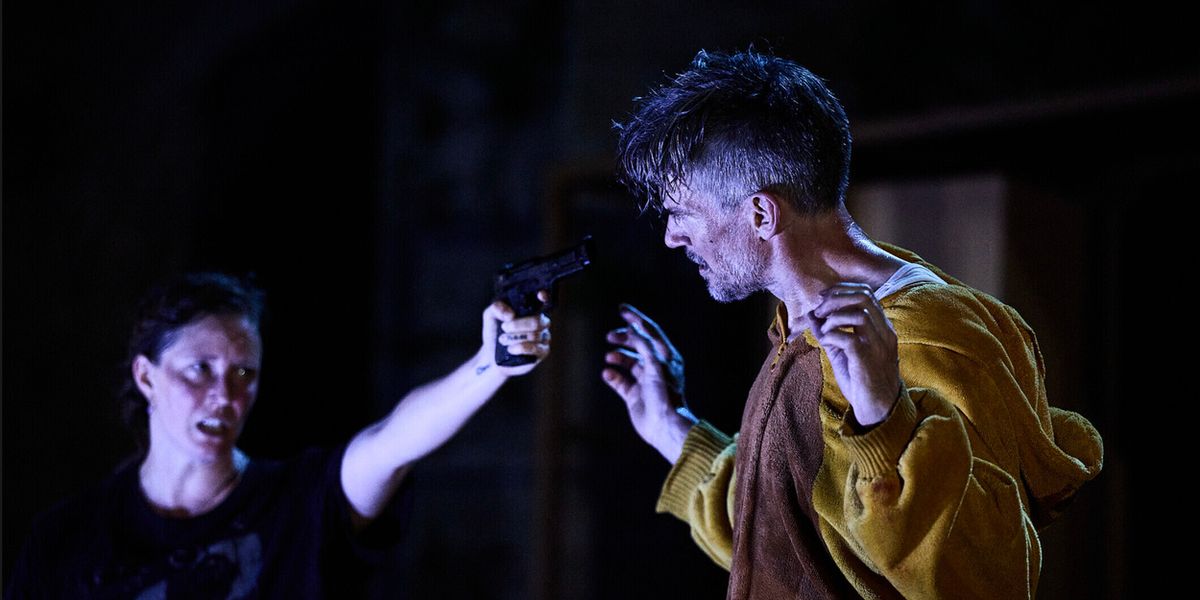
In a BBC interview, famed director Katie Mitchell calls for fewer productions of Hamlet. She is tired of attending plays about “misogynistic, angry, depressed men.” I respect any artist defining the boundaries of what interests them. Yet Mitchell’s critique feels strangely shallow, the academic equivalent of an edgy social media post. Really, that is all Hamlet boils down to? Agreeing with me from the stage of the Festival d’Avignon’s Cloître des Célestins is the Dane himself. In Ben Duke’s The Last Hamlet, the Prince of Denmark, confronted with Mitchell’s scathing critique and the subsequent withdrawal of subsidies for productions of Shakespeare’s masterpiece, attempts to reinvent his own play.
Hamlet enters the stage flabbergasted by Mitchell’s criticism, which is broadcast into the space through a small radio. The work’s central set piece, designed by Soutra Gilmour, is a small movable wall constructed from cardboard boxes. Within these boxes, Hamlet reveals his characters: Ophelia appears as an otter; Gertrude as a large goose; and, unexpectedly, Claudius emerges as a snake. He was not supposed to be there. In the guise of a one-person performance, Hamlet invites audience members to read simplified versions of Shakespeare’s text. Then, one audience member is brought onto the stage. We discover that he is Miguel Altunaga, a performer, and one of the three members of the ensemble, who has been planted among the spectators. With this revelation, the stuffed animals, audience participation, and familiar conflicts of Shakespeare’s tragedy become part of a broader postmodern examination of the play itself.
The production’s reinvention contains several expected departures. The ordinary citizens of modern-day Denmark (which is to say, England) are bewildered by Hamlet’s relentless soliloquizing. There are references to The Lion King, as Hamlet appears in a Simba onesie and his father crosses the stage with a lion’s skull for a head. The production also moves into dance and music. Singer Anna B Savage performs mournful folk songs, while, at several moments, the layers of irony dissolve entirely as Altunaga, Duke, and Hanna Shepherd execute intricate choreographic sequences. Shepherd’s final solo is a genuinely affecting and visually remarkable illusion, as her movements appear accelerated, almost as if she were performing in fast-forward. As Ophelia, she has endured not the “slings and arrows of outrageous fortune,” but rather the wounds inflicted by Hamlet himself, and finally confronts him.
The production’s central questions are familiar but necessary: Is Hamlet depressed, or is he grieving? Is he violent and misogynistic, or are those traits produced by his circumstances? What responsibility does he have to transcend his own historical moment? What histories did he share with the people around him? The Last Hamlet moves between Shakespeare’s era and the present day, sometimes with bruised sincerity, sometimes with dismissive irony. As elements of the play become archetypes, the production attempts to reencounter them as contemporary shocks. His father is dead; his mother has married his uncle. Anyone can recognize the trauma embedded in this situation. In Duke’s retelling, Hamlet has impregnated Ophelia and accompanies her to obtain an abortion. As he looks at the ultrasound, he quietly begins, “To be or not to—” “Shut the fuck up!” Ophelia interrupts. The moment is not about him.
I found myself somewhat disheartened by the production’s abandonment of its initial simplicity. The stuffed animals and audience interaction suggested a theatrical language capable of producing a genuinely imaginative examination of Hamlet. Instead, the work’s meta-theatrical rules are broken but never fully discarded, leading into a funhouse-mirror reinvention of Shakespeare’s tragedy. The result produces more dynamic staging: Jackie Shemesh’s lighting design and Will Duke’s inventive video work transform the cardboard wall into a constantly shifting visual landscape. Yet, by the end, The Last Hamlet offers no direct answer to Katie Mitchell’s provocation. Rather than interrogating whether Hamlet remains relevant, it turns toward a counterfactual reconstruction of the adolescent relationship between Hamlet and Ophelia.
As an aesthetic object, the production remains caught between irony and sincerity. As an adaptation, it is suspended between iconoclasm and reverence. The Last Hamlet is most compelling when it allows these contradictions to coexist.
Photo Credit: Christophe Raynaud de Lage
Prefer BroadwayWorld in Google Search?
Add us as a preferred source so our stories show up more often in Top Stories and Google’s AI answers — for you.
Recevez l'actualité de Broadway sur WhatsApp
Recevez les dernières mises à jour, les nouvelles de dernière minute et une couverture exclusive directement dans l’application.

Sign up for all the news on the Fall season, discounts & more...
|
ART RADIANT - BELLEVUE (4/10-4/10) |
|
SIMON NOENS - SIMON NOENS DERNIERES DATES AVANT L OLYMPIA THEATRE DAUDET (5/21-5/21) |
|
|
VOYAGE VOYAGES L'INTERVALLE (1/14-1/14) |
|
|
RENVERSANTE THEATRE DES MATHURINS (9/15-12/15) |
|
|
MODE D''EMPLOI POUR METTEUR EN SCENE ... TH DU ROND POINT - SALLE ROLAND TOPOR (11/21-11/27) |

|
ABBA GOLD THE CONCERT SHOW - ABBA GOLD LE LAPS - PARC DES EXPOSITIONS (3/12-3/12) |
|
|
MERCI DE VOTRE COLLABORATION TH DU ROND POINT-SALLE RENAUD BARRAULT (11/04-11/14) |
|
|
LE CHAT DU RABBIN - CONTE MUSICAL SALLE GAVEAU (11/08-11/08) |
|
|
LES BEAUX THEATRE DES MATHURINS (9/16-10/07) |
|
|
LE BOURGEOIS GENTILHOMME L'OLYMPIA (1/24-1/24) |
