


REVIEW: The Festival d'Avignon Presents CASTING LEAR By Andrea Jiménez
There is unmistakable care between them, and perhaps, if only for an instant, the possibility of genuine healing.
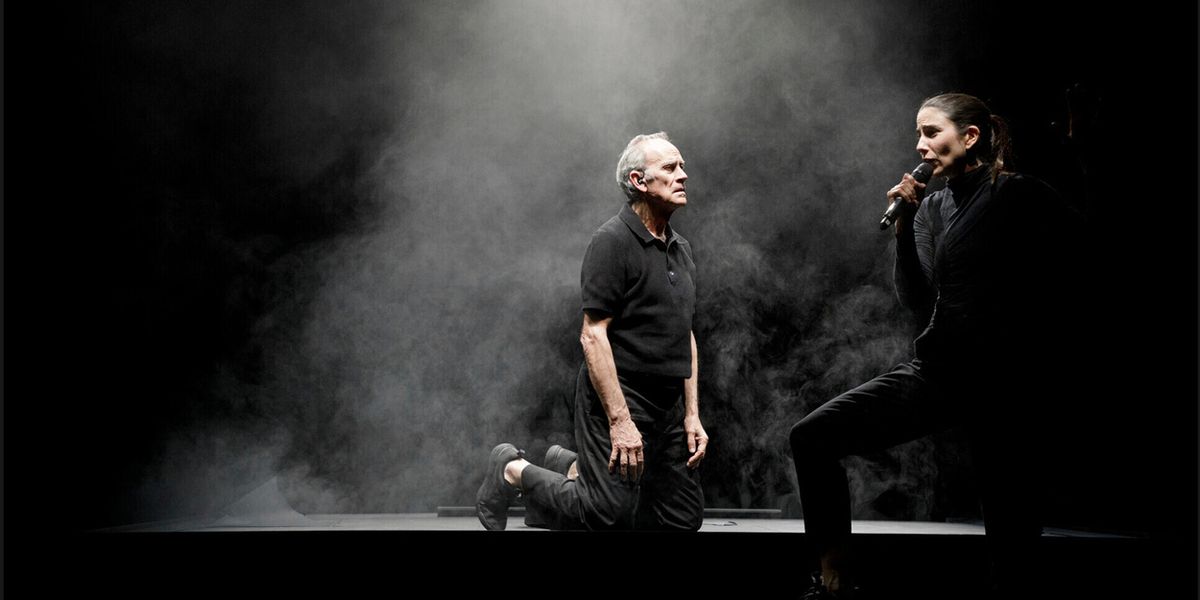
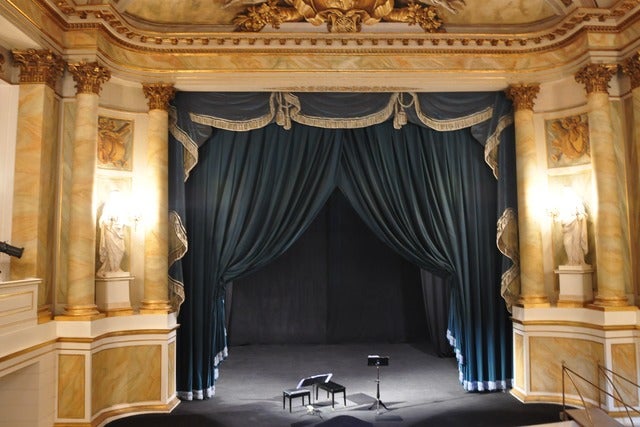
What better way to close out the Festival d'Avignon than with a love letter to the theatre? At the conclusion of Casting Lear, now performing at the Opéra Grand Avignon as part of the Festival, creator and performer André Jiménez makes an impassioned case for the art form. Reflecting on the performance she has just offered the audience, she asks: What has this accomplished? What can theatre offer us? What power does it possess? Although dedicating her life to the stage has brought immense hardship, she has no regrets. As the evening makes clear, however, she is still searching for closure.
Jiménez uses Shakespeare's great tragedy to examine the fractured relationship between herself and her own father. She distills King Lear down to a central pair: Lear and Cordelia. Jiménez always plays Cordelia, while each performance introduces a different actor as Lear. That actor arrives without having seen the production or knowing what he is about to undertake. His lines are fed to him by Matthieu Luro, who circles the stage with the composed efficiency of a CEO's assistant, while Jiménez directs him through the performance. For this evening's performance, Lear was played by Éric Ruf, the distinguished Comédie-Française actor whose production of Le Soulier de Satin captivated audiences in the Cour d'Honneur last year.
At the heart of the work is Jiménez's own disinheritance. Her father, who owned a tennis club in Spain, cut ties with her after she told him she intended to pursue a career in theatre. Over the course of ninety minutes, Jiménez moves swiftly through Shakespeare's tragedy, weaving it together with her own biography and uncovering unexpected points of convergence. She does not simply interpret Lear. She recognizes him. Where critics and scholars have long debated the motives behind Lear's rejection of Cordelia, Jiménez understands that some fathers simply behave this way because she has lived it herself.
Yet Shakespeare ultimately refuses to provide the resolution she longs for. When she and Ruf reach the reconciliation between Lear and Cordelia, Jiménez tears through the scene searching for emotional satisfaction, only to come up empty. Cordelia's unconditional forgiveness rings hollow against Lear's belated, self-absorbed remorse. In a moment of startling self-awareness, she cries out to the audience, "I am trying to solve my own family struggles using Shakespeare," prompting one audience member to quietly murmur, "Ooh là là." The theatre erupted in laughter. I found myself wishing Shakespeare could grant Jiménez the catharsis she seeks. But Shakespeare did not write therapeutic models. His tragedies illuminate human suffering; they rarely resolve it.
Drawing on her training in clown with Jacques Lecoq, Jiménez embraces the play's layered meta-theatrical structure with remarkable agility. She constantly finds opportunities for surprise and humor while taking exceptional care of Ruf throughout the performance. He is dream casting as Lear. His gentle eyes and understated warmth make his eruptions of royal fury all the more unsettling. His entrances are punctuated by Judit Colomer's stark monochromatic lighting and Lucas Ariel's score, which oscillates between thunderous, reverberating soundscapes and moments of quiet delicacy.
Within the production's playful framework, Ruf proves wonderfully game. During Lear's descent into madness, he wanders into the audience and, following Jiménez's instructions, settles into the lap of Festival director Tiago Rodrigues before extending his hand for a kiss. Smiling, Rodrigues obliges. Ruf is clearly committed to realizing Jiménez's vision, yet this is not the tightly controlled environment of the Comédie-Française. Unexpected moments inevitably arise, and when they do, Jiménez deftly absorbs them, preserving both the rhythm and emotional momentum of the evening.
Ultimately, Casting Lear becomes everything Lear is not. It is honest, vulnerable, forgiving, and deeply self-reflective. Although she briefly plays the fool, Jiménez harbors no illusions. Theatre is not life. It cannot repair the wounds left by family. But it may offer something adjacent to healing.
Throughout the performance, Jiménez repeatedly references the email (yes, the email) in which her father disowned her. It sounds devastating. Yet rather than reading it aloud herself, she places a copy into Ruf's hands at the performance's conclusion and asks him to read it silently. He does. He neither gasps nor recoils, but his expression subtly changes, making clear that its contents are painful. How could someone reject so coldly the woman whom everyone in the audience had grown to admire over the preceding ninety minutes?
When Ruf finishes reading, he embraces Jiménez. It is a staged moment, but no less genuine for that. Whatever fiction has carried us through the evening dissolves in that embrace. There is unmistakable care between them, and perhaps, if only for an instant, the possibility of genuine healing. That is the remarkable power of theatre.
Photo Credit: Vanessa Rabade
Recevez l'actualité de Broadway sur WhatsApp
Recevez les dernières mises à jour, les nouvelles de dernière minute et une couverture exclusive directement dans l’application.

Sign up for all the news on the Fall season, discounts & more...

|
LE PETIT PRINCE - CONTE MUSICAL SALLE GAVEAU (1/24-1/24) |
|
LES CHAMBRES CLOSES TH DU ROND POINT - SALLE ROLAND TOPOR (9/22-9/27) |
|
|
RADIO LIVE : LE JOUR D''APRES TH DU ROND POINT-SALLE RENAUD BARRAULT (5/27-5/29) |
|
NOVECENTO THEATRE DES MATHURINS (9/17-12/17) |
|
RADIO LIVE : VIVANTES TH DU ROND POINT-SALLE RENAUD BARRAULT (5/28-5/30) |
|
|
LE GOÛT DE LA FRAMBOISE THEATRE DES BELIERS PARISIENS (8/29-11/01) |
|
|
MATCH D''IMPRO THEATRALE - LYON VS SUISSE - MATCH D''IMPROVISATION THEATRALE LE TRANSBORDEUR (1/31-1/31) |
|
|
LES PLUS BELLES COMEDIES MUSICALES THEATRE SEBASTOPOL (10/18-10/18) |
|
|
FLASHDANCE - THE MUSICAL - FLASHDANCE Le Grand Rex (4/11-4/11) |

|
LYNDA LEMAY & JEAN- FELIX LALANNE THEATRE SEBASTOPOL (11/09-11/09) |
