


Review: THE WINTER'S TALE at Chicago Shakespeare Theater
Shakespeare's most magical tale runs through December 12th.
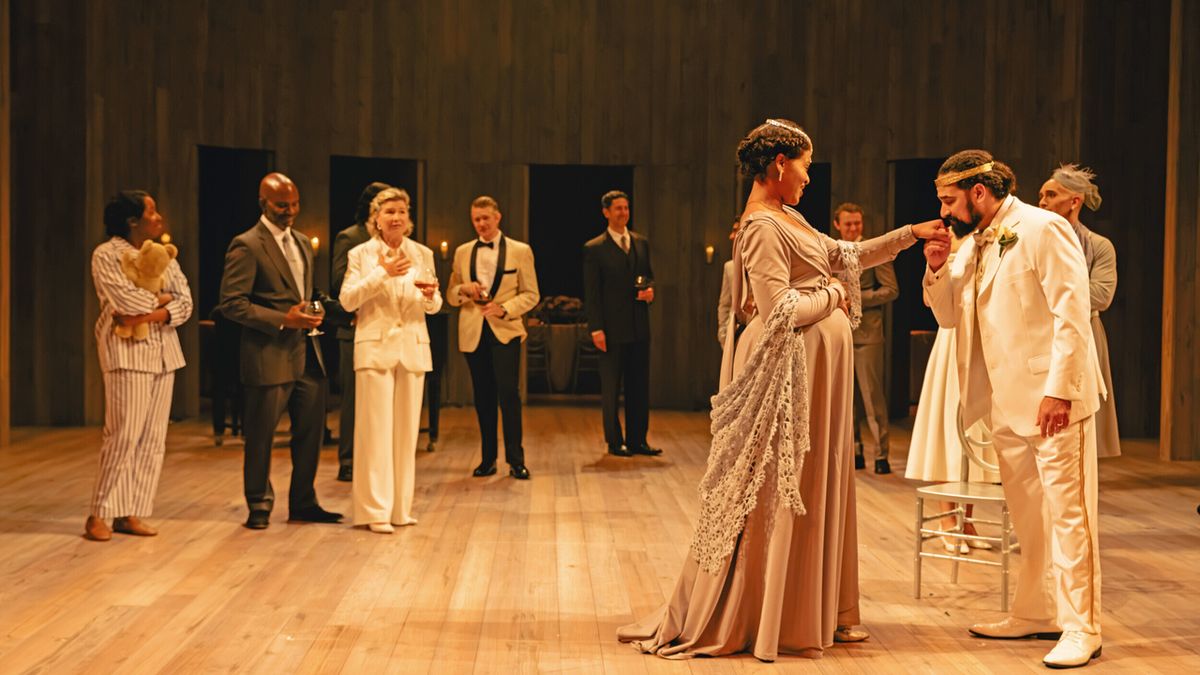
“A sad tale’s best for winter,” declares Prince Mamillus early in William Shakespeare’s The Winter’s Tale. But as the nights get longer and the days get colder, theater audiences would no doubt rather be drawn to the warmth of a love story, the thrill of an adventure, the fun of frivolity. Fortunately, Chicago Shakespeare Theater’s The Winter’s Tale—now playing and soon to run in repertory with the even wilder Midsummer Night’s Dream—provides audiences with an emotional, uplifting, and even redemptive story sure to thaw frozen hearts and provide a much needed escape to a fabulously wild world of color and music. The show runs through December 12, 2027, at CST’s Jentes Family Courtyard Theater.
The Winter’s Tale initially feels like an odd choice for “holiday” programming of a sort when so many Chicago theaters are returning to tried and true classics to pull in crowds during the harshest months of the year. The Winter’s Tale isn’t one of the more widely read and studied of Shakespeare’s texts, and those who have heard of it often reduce it to the most infamous stage direction in dramatic literature: “Exit, pursued by a bear.”
The Winter’s Tale is often referred to by scholars as one of Shakespeare’s “problem” plays, those plays that don’t fit neatly into categories of “comedy” or “drama” or “history.” In fact, The Winter’s Tale can almost feel like two separate plays linked by an intermission. In the first half, King Leontes of Sicilia (Demetrios Troy) welcomes his old friend King Polixenes of Bohemia (Chiké Johnson) for an evening of hospitality and celebration. Over the course of the evening, though, Leontes becomes convinced that Polixenes has been having a torrid affair with his pregnant wife Hermione (Jessica Dean Turner) and that the child she bears is not his own. Leontes rains down his wrath on his loved ones, pursuing Polixenes until he sails back home in shame, forcing his weakened wife to stand public trial, and casting his own child Perdita (Felicia Oduh) off into the wilderness.
A sad tale indeed.
But what makes The Winter’s Tale so captivating despite (or because of) its oddities is its skillful transformation of pain and heartbreak into reunion and joy in its second half. This requires incredibly deft work on the part of both actors and their director, and artistic director Edward Hall once again demonstrates his expertise in navigating him and his crew through the complexities of Shakespeare’s most challenging texts while providing audiences with the entertainment and fun they have come to expect from the institution. Hall instructs his cast to stay true to their world and all its pain that has been thrust upon them. Monologues that other actors may play up through histrionics or melodrama are instead handled with care and understatement that allows the emotional beats to land all the more forcefully.
Take, for example, the scene in which Hermione stands trial for her accused treason. At the lowest moment of her character’s arc, Turner turns Hermione into a powerful symbol of feminine defiance and devotion to truth. In fact, her strength in this scene allows Hermione to haunt the remainder of the play, an unseen presence whose impact can still be felt in her kingdom even a generation later. Her performance is beautifully complemented by Troy’s Leontes, a man hunted by doubts and plagued by jealousy. Whereas Hermione is strong and defiant, Leontes is weak and uncertain. Troy’s brilliance in the role is his ability to slide effortlessly from seething rage in one scene to crippling self-loathing in the next. His king is a tyrant who fears that betrayal lies behind every corner, that every flatterer is a backstabber in disguise. It’s fitting that his kingdom evokes a cold, tomblike prison while he wears a crisp gold-fringed uniform that wouldn’t be out of place at a shah’s palace (costumes and set design both by Michael Pavelka, whose devotion to the production’s eccentricities is immediately palpable and excellently executed). We see early on that distrust and anxiety have permeated Sicilia, and it feels as though it will take no small miracle to reach hoary winter’s end.
No doubt it is jarring to fly from the dark frigidity of Sicilia to the bright rolling fields of Bohemia in the play’s second half, an hour and some change that gives the audience the humor and reconciliation that they so desperately crave. If the Sicilians are gray and somber, the Bohemians are technicolored and full of life, perhaps best represented in the performances of Kevin Gudahl and Dan Haller as an old shepherd and his son, respectively. Both actors prove themselves to be wonderfully fun Shakespearean clowns, but it’s Haller in particular who earns the biggest laughs of the show with his whole-hearted devotion to the play’s silliest bits. Sean Fortunato is a close runner-up, though, as the thieving rogue Autolycus, who bears more than a passing resemblance to the musician Slash. Audiences at the opening performance found Fortunato’s charisma to be undeniable, even if the punk aesthetic feels out of place from all that comes before and after it (including the cloying singing sheep—but I digress). As Florizel, a young prince smitten with Perdita despite her uncertain parentage, Esteban Ortiz-Villacorta projects all the qualities that Leontes seems to lack. Ortiz-Villacorta’s Florizel is full of love and life, a young man who–unlike others in power–sees no difference between different classes of people and believes that love conquers all trials.
As raucously fun as the play’s second half can be, it bears the challenge of providing a suitably happy ending to a play that opens with destructive pain and deceit. The play’s final, magical moments have stumped scholars and performers since the scene was first written, though you wouldn't realize it from seeing Hall and his cast’s skillful execution. It’s difficult to write about this concluding scene without spoiling it for the uninitiated, but Oduh, Troy, and Turner have such a magnetic, exhilarating reunion that I still feel a chill run down my spine just thinking about it. Much like a broken vase glued back together, the actors’ performances emphasize that healing doesn't necessarily mean that the damage can be undone. Given all that comes before it, the finale ends on a bittersweet note, but it’s one that is all the richer for having been forged through tragedy.
Perhaps The Winter’s Tale affects audiences so deeply right now because of its warnings as well as its unapologetic fun. A kingdom built on distrust and jealousy cannot stand. A tyrant who sees enemies around every corner risks bringing his kingdom down around him while also crushing his subjects. And yet Edward Hall’s Winter’s Tale insists upon the invigorating bonds of community and the (at times literally) transformational power of love.
Now that’s a tale best for winter.

Weekly top stories - unsubscribe anytime.

|
Adirondack Chair Circle Steppenwolf's Ensemble Theater (10/22-12/06) |

|
Love Story: A Tribute to Taylor Swift Raue Center For The Arts (11/07-11/07) |

|
Million Dollar Quartet Stolp Island Theatre (10/07-1/03) |

|
Rotary Rocks The Raue: James Garner's Tribute to Johnny Cash Raue Center For The Arts (10/24-10/24) |

|
The Christmas Carol Paramount Theatre (11/11-1/03) |

|
Topdog/Underdog Steppenwolf's Downstairs Theater (9/17-11/01) |

|
Blond Ambition: A Tribute to Madonna Raue Center For The Arts (11/07-11/07) |
|
Memphis The Musical Studebaker Theater at the Fine Arts Building (10/24-10/25) |
|
When We Were Young and Unafraid Greenhouse Theater Center (11/12-11/29) |
|
Women and Expectations by Mamzelle Amandine & Julie Morel Private Home in Logan Square (11/01-11/01) |
Reader Reviews
To post a comment, you must register and login.