


Review: BEST LINE WINS at Contemporary American Theater Festival
Perhaps Not Strictly Factual, But Funny and Fun
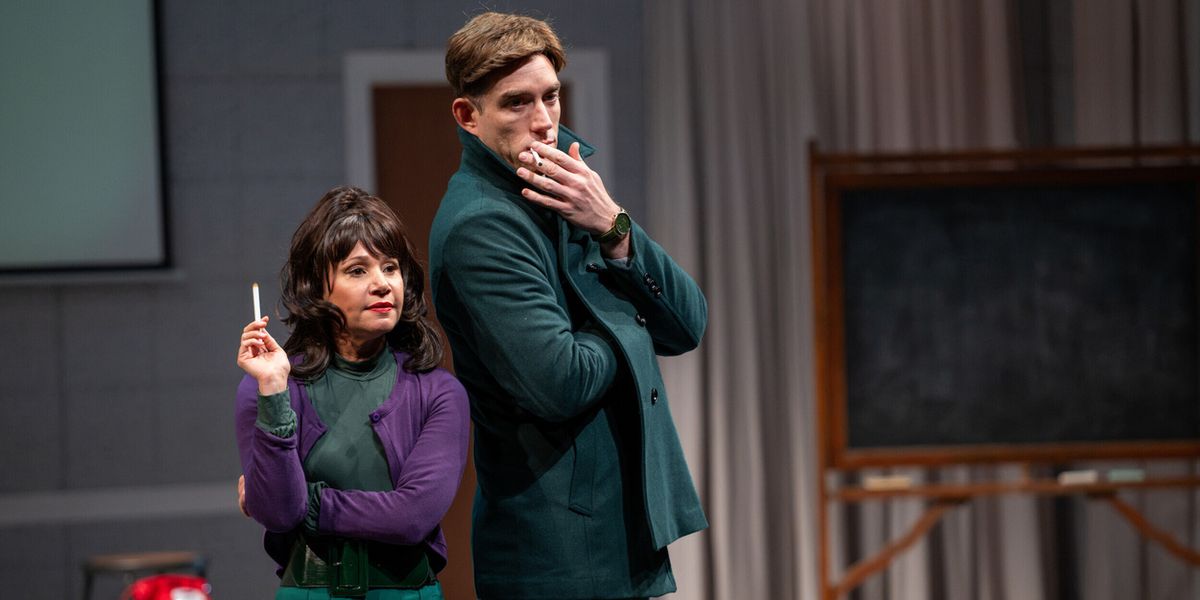
Comedians Mike Nichols and Elaine May got their start in the 1960s in Chicago. As a child and teenager growing up in the 1960s in a part of the Midwest that wasn’t Chicago, however, I had no way of attending a live performance of theirs. But I sure knew their comedy records. I owned at least two of them, and could recite you some of their routines pretty much verbatim. So naturally I was looking forward to Best Line Wins, in production at the Contemporary American Theater Festival, a show whose subtitle promised “Inspired by the Improvised Lives of Elaine May & Mike Nichols.” I’m not sure that the experience was exactly what I came for, but it was fun and it was interesting.
And what did I come for, exactly? (Other than to write a review?) I guess I came for that very experience of Nichols and May I was never lucky enough to enjoy live in the 60s. This show never promises to be exactly that. For one thing, there were, as I understand it, no permissions to use original material (though there is a nonverbal quote from N&M’s “Teenagers” sketch). I knew going in that Beth Kander’s script wouldn’t contain actual N&M dialogue either. What I may not have been as prepared for was that Kander’s not being allowed to hew too close to these facts would drive her to resort to what one might call standard biopic tactics.
The silver screen may be the place where the biopic style was invented, but this show demonstrates that its elements work on the stage as well. (If, after Jersey Boys and Beautiful and their ilk, we needed any convincing.) Basically, you take one or more well-known persons, especially persons in the entertainment business, and take some publicly-known information about them to flesh out the standard biopic tale. That tale runs: creative geniuses burn bright, burn out, fall apart (jointly or singly, depending on the show’s focus), then come back together eventually for unprecedented triumph. Facts inconvenient to the template will be ignored, and gaps in the record can be supplemented with wholehearted inventions.
In the case of Nichols and May, the facts are that they came out of a troupe that would eventually come to be known as Second City, but were very good at improv, so they took their act on the road and eventually to Broadway, also making three hit original record albums. Total time elapsed: about four years. After that, they split: not so much on account of creative differences or a ruptured friendship as because they had different kinds of artistic aspirations. They went on to have very good but mostly separate careers in various other aspects of stage and screen, collaborating from time to time (May mostly writing, Nichols mostly directing). The collaborations didn’t reconstruct “Nichols and May,” and did not amount to a continuous partnership. But the two were definitely invited into each other’s creative lives at various times. Nichols died in 2014, and May is still with us. (I finally got to see her live in 2018 on Broadway playing a feisty old lady declining into senility, in The Waverly Gallery.)
In Kander’s hands, this factual history is not ignored, but it still comes out a lot like the biopic template, i.e. a story of geniuses who couldn’t make their creativity work together, but were never as good separately (much is made of May’s unusual failure with Ishtar), until they came back together (presented almost in the manner movies use to show characters falling cutely in love again). In short, a rather different trajectory than the facts suggest.
Either that kind of thing bothers you or it doesn’t. There’s no legal requirement that a playwright faithfully follow the facts wherever they lead. (If you insist on that, you should probably steer clear of Shakespeare’s history plays too.)
What Kander’s flexibility with the facts here buys you is some kind of simulacrum of the Nichols/May style in the first half, where May is instructing Nichols on how to be funny in improv and laying down the rules for the relationship they’re going to have, and there are a lot of good laughs there. For instance:
ELAINE
.... Hey. Ask me the secret to comedy.
MIKE
What’s the secret to—
ELAINE
Timing.
MIKE
Ha. That’s good.
The second half is funny too, but not mostly in a rim-shot kind of way. Nichols is alive to the attractions of Hollywood, while May is not as impressed. From her perspective, “Los Angeles is where culture goes to die.” From his, it’s where real money is to be made. And there is also tension because he’s trying to revive a three-day affair they had. She lets him have it, albeit with a joke:
ELAINE
Let’s talk about something else. How’s your girlfriend of the week?
MIKE
Come on. You know I married Patricia. She’s not my girlfriend. She’s my wife.
ELAINE
Well I’m sure it’ll be a wonderful first marriage.
The dramatic point of the second “act” is telling how they break up as a comedy team, and then how they get back together. His triumphal procession through Hollywood is rendered as superficial and unsatisfactory (which to this critic, who loved most of Nichols’ movies but his earlier ones best of all, is admittedly a difficult sell), and May’s own turn toward movies is rendered with a skepticism about Hollywood’s sexism that is no doubt justified, but still feels rote and by-the-numbers as an account of a career. Yet the play attempts to make us feel that these two supposedly unsatisfactory careers will grow more fruitful when the two of them, in effect, kiss and make up. Though this seems wrong to me as a matter of history because it doesn’t seem as if there was all that much of a breach, it does end up dramatically convincing in the play. Kander gives them the right lines to bring about the reconciliation, tart and snappy, but driven by the characters’ mutual creative need. Hence the audience will walk out happy, because, though it isn’t profound to say it, happy characters make for happy audiences. And I too am guilty as charged, your honor.
Elaine May is portrayed here by Lori Vega, and Mike Nichols by Riley Shanahan. They each adequately look the part, Vega petite, pretty and dark, Shanahan tall and amiable, awkward in his hair (as was Nichols, condemned by a juvenile case of alopecia to wear a wig). They don’t sound overwhelmingly like the voices those albums had graven in my mind (not New Yorky enough), but they are fine for delivering Kander’s witty lines.
The show might have worked even better in a better space; the Frank Center at Shepherd University is broad and shallow, though set back rather far from the audience, not an ideal stage for a two-hander play like this one. And the acoustics aren’t ideal either; lines can get lost there. I noted, for instance, that at the performance I attended, not-terribly-loud ambient noises like coughs managed to drown out three different iterations of what was effectively the same joke (about May’s low opinion of Nichols’ performance in a student production of Strindberg’s Miss Julie). I doubt the audience ever got to hear enough of that joke to understand it. But the venue didn’t usually overwhelm the show.
The stage is well-decked. The set by Michael Raiford must shuttle us through many times and places, with pieces that move around rapidly, all the time anchored visually by a centrally-placed lipstick-red telephone, while the backdrop provides a variety of spots for projections. The projections are vital to this show, to exhibit various markers of time and place (projections by Mona Kasra, lighting by Jeanette Oi-Suk Yew). One always knows when and where the characters are, and comes away with a strong sense of the physical and emotional environments and the times that shaped them.
There’s some fairly heavy stuff in this year’s incarnation of the Contemporary American Theater Festival; in this context, the comic relief provided by this play is definitely welcome.
Best Line Wins: a Play Inspired by the Improvised Lives of Elaine May & Mike Nichols, by Beth Kander, directed by Jessica Kubzansky, presented by the Contemporary American Theater Festival through August 2. Tickets $45-$75 at 681-240-CATF (2283). Adult language and situations.
Production photo by Seth Freeman.
Sign up for all the news on the Fall season, discounts & more...


|
La Sylphide Maryland Hall (10/16-10/18) |
|
Mama, I'm A Big Girl Now! Baltimore Center Stage (10/02-10/04) |

|
The Score Shakespeare Theatre Company (9/11-10/25) |
|
Toby''s Dinner Theatre Presents: Summer - The Donna Summer Musical Toby's Dinner Theatre Columbia (8/28-11/01) |
|
SIX (Boleyn Tour) France-Merrick Performing Arts Center (10/25-11/01) |
|
The Rocky Horror Show Iron Crow Theatre (10/16-11/07) |
|
Appropriate Maryland Ensemble Theatre (4/02-4/25) |
|
Jazz Night McDaniel College (12/03-12/03) |
|
The Crater Sisters' Christmas Special Maryland Ensemble Theatre (11/20-12/20) |

|
Student African Drum Ensembles McDaniel College (12/01-12/01) |

Reader Reviews
To post a comment, you must register and login.