

Spooky Season on Stage: Three Musical Villains Share Their Secrets
The art of being bad, as told by Jake Shears, Claybourne Elder, and Ali Louis Bourzgui.
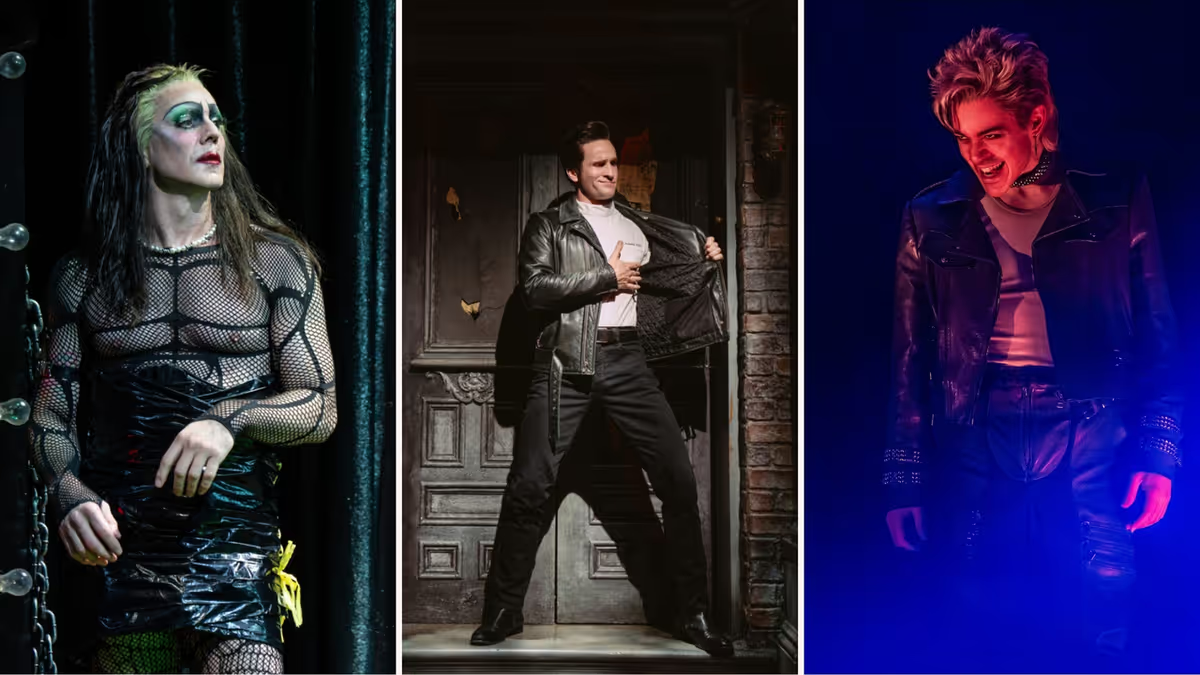
In case you haven’t noticed: horror is big business on (and off) Broadway these days! Along with plays like Paranormal Activity and Stranger Things: The First Shadow, musical theatre is getting in on the trend too, with both revivals and new titles alike that pair big thrills with those big, belted notes.
To celebrate spooky season, I spent a little time talking with three of the actors who spend every week making audiences terrified of (and maybe a little in love with) musical theater’s biggest baddies on stages right now.
“It’s a Really Juicy Dichotomy”
Stepping into the heels and corset of The Rocky Horror Show’s Dr. Frank-N-Furter is an intimidating feat for anyone. But for Jake Shears, it’s just a new twist on an energy he’s been embracing for a long time.
“I get to really use my frontman skills,” the Scissor Sisters vocalist says. “Portions of this show really do feel like a rock concert, and I love tuning into the audience. I really do plug in with them, as if we’re at a concert, and that comes very naturally!”
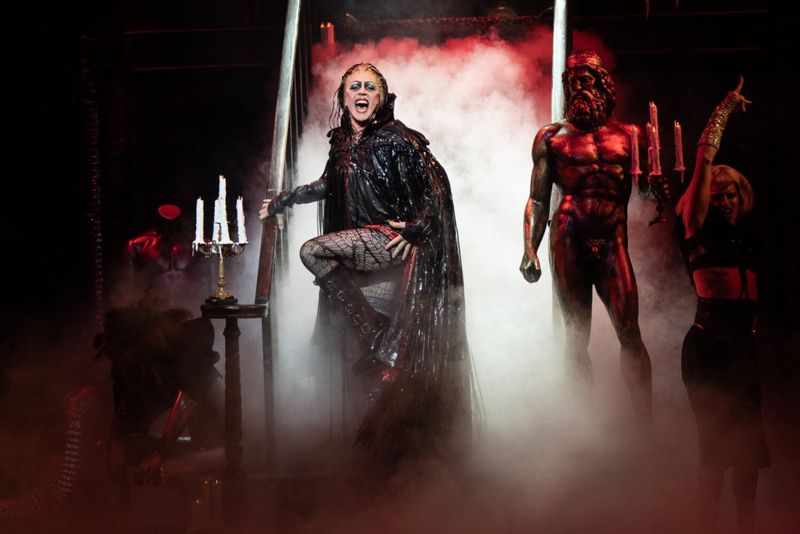
Frank-N-Furter is, without doubt, the most instantly-recognizable Rocky Horror character, permeated into pop culture for decades. It’s his character that most embodies the show’s sideways satire. He’s to be feared, but not necessarily for his non-conformity; in fact, that’s a big part of his appeal.
“Frank wants to live a life of absolute pleasure at any cost, which is his downfall,” says Shears. “If there is any kind of lesson in this show, it’s be who you want to be, and do what you want to do, and seek pleasure – as long as you don’t hurt anybody. And that’s where it goes really wrong for Frank. And he’s kind of a narcissist – he does not like when anyone gets in the way!”
“Frank-N-Furter is proper queer mythology,” he adds. “What’s so appealing about him is that he’s this symbol of absolute freedom. And yet, he’s also a truly dastardly murderer. And yet, we love him so much! So that’s a really juicy dichotomy, to play someone incredibly charming and yet so, so scary at the same time.”
That dichotomy is on display in two of Shears’s favorite moments to perform. On the twisted, violent side, there’s the “death of Eddie” sequence.
“I think a lot about Michael Alig and [the movie] Party Monster, that party host that everyone wants to hang out with and loves, but he’s actually a killer,” he explains. “There are all the good times in Act One, and then this stillness in the theater because something really scary and horrible has happened. I just love the mood change, feeling the air in the room change really fast.”
He also loves “I’m Going Home,” Frank’s big 11-o’clock-number, for similar reasons: the dawning realizations and the feeling of slowing down and getting (somewhat) serious amidst the brash campiness.
“I feel like my version of Frank realizes what he’s done, something irreparable, and that moment is just one of my favorite songs of all time,” Shears says. “I love getting to sing that — another still moment in a pretty chaotic show!”
Getting those different moments right means sliding back and forth between unabashed camp, rockstar gravitas, and being scary when the moment demands.
“It’s moving the dials every day to get that balance right,” he reflects. “For a while, my Frank was almost like a really proud homemaker on too many diet pills! Before every show, you kind of go to the performance ‘dials’ and tweak them and see what works. You just want to listen to what feels right. I love playing on stage and surprising my cast mates, and living and changing.”
A longtime Rocky Horror fan, Shears understands why the show – and Frank-N-Furter – has endured the way it has, earning new fans with each new generation to encounter it.
“It’s the contradictions in the character. Frank really is this symbol to many people, of freedom. As a twelve-year-old, seeing Tim Curry for the first time sort of cracked me open. Rocky Horror was like a message in a bottle from my future, like ‘so many things are possible.’ And I think Frank represents that possibility for so many people.”
“I think it’s really interesting that Rocky Horror can still ruffle feathers! That is a sign of a great piece of art; it can still shock and appall people for all sorts of different reasons. Multiple things can be true about one thing. To someone like me, who grew up on it and is in love with it, it’s just a perfect thing. But I do love that it doesn’t come without its problems. But what doesn’t?”
“They’re Ready to Be Scared Tonight”
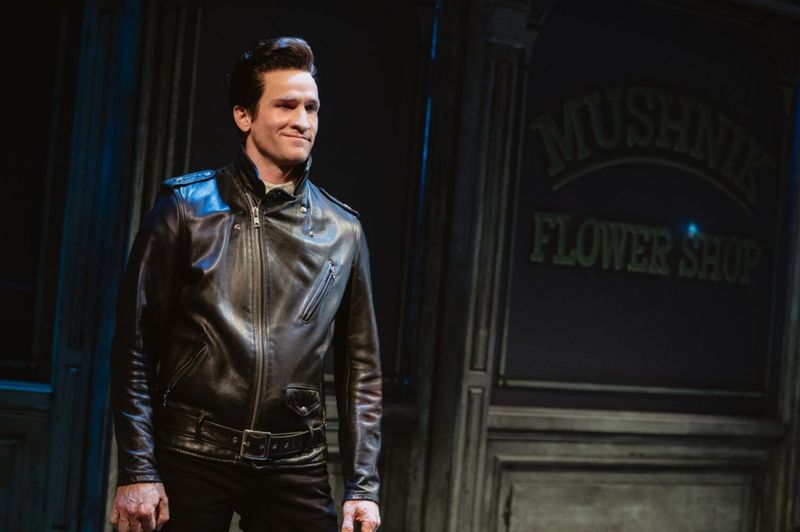
“Getting to play a villain is like stepping into the shoes of your own worst nightmare, and it can feel very daunting, the responsibility of being the bad guy and making sure the audience doesn’t like you. I think as actors we’re kind of trained to make them all love you, and you really have to let that go,” says Claybourne Elder, currently starring as the demented dentist Orin in the off-Broadway Little Shop of Horrors.
Countless actors have played Orin in the 40-plus years since Little Shop debuted, and Elder puts his stamp on the role as he embraces every part of the character: comic relief, all-too-human monster, and even a touch of the mythological.
“In this Faustian tale that is Little Shop, I think Orin is — until the plant shows up — the strong, rich, powerful force that people have to adhere to in order to get what they want. And then Seymour is like, oh my gosh, I’ve just been given the power to vanquish Achilles, and he feels like it’s the right thing to do. But of course, what he doesn’t know is that he’s actually feeding the ultimate bad guy.”
Little Shop is the goofiest of all the horror-tinged shows playing now, and for Elder, that poses its own kind of challenge. He grounds his Orin with, among other ideas, the thought that much of his wicked behavior is driven by a complicated, abusive relationship with the mother he mentions in his villain song “Dentist!”. Performing Orin is a fine line to walk, earning big laughs and horrified gasps alike.
“[That balance] is something you have to be constantly checking in with,” he reflects. “Every night, I have to ask myself, ‘Do I believe this?’ There are definitely a lot of jokes and goofy things that have made the audience laugh that I’ve cut back on because I go offstage, and I think, ‘Yeah, but do you believe that?’ But yeah, there is a part of you that’s like, ‘Oh, they’re ready to be scared tonight!’”
A lot also relies on Elder’s dynamic with his Seymours and Audreys (of which there have been several during his run), as well as with each audience. One of his favorite scenes, the confrontation between Seymour and Orin, is particularly fun to play, and he changes things up frequently — though always “within the rules of the game”!
“As long as they’re willing to play — and all of them are — it’s just so much fun!” he says.
Ultimately, Elder sees Orin as bridging that gap between the unreality of the fantastical and the grittier, real fears beneath. “I think one of the most evil things in the writing is that you have this dentist, and he’s very funny and you’re laughing at him, and then he hits Audrey, and all of a sudden, it’s real, an actual monster.”
“You Have to Make Him Undeniable”
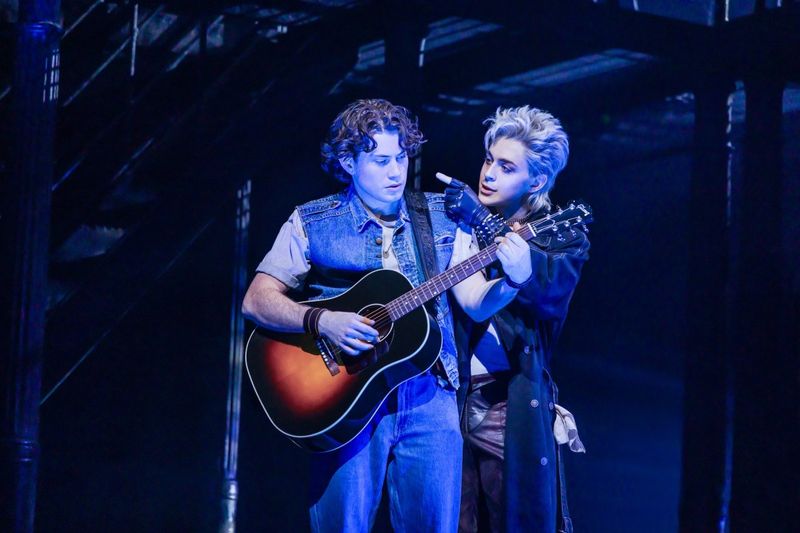
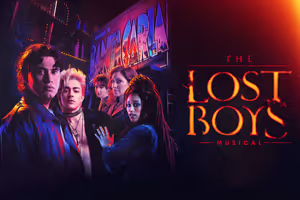
Historically, vampires haven’t been a hit – commercially or critically – in theatre. The Lost Boys aims to change that, earning four Tony Awards this year, including for breakout star Ali Louis Bourzgui, who plays David, the magnetic leader of a vampire rock band.
Intriguingly, for a show featuring musician vampires, the vamps’ only musical moments are either diegetic or singing with or to other characters; there’s no private musical introspection. For Bourzgui, that structural choice is hugely important.
“I think it’s the ticket,” he says. “There were times where we tried things that leaned into David singing or saying something that brought us a little too into his world, and you could just feel the whole thing start to crack. It is so useful for the vampires’ songs to be about other people. It creates an ambiguity that keeps them scary and unknown. And in our show, the vampires are almost more of a tool to look at humanity — a filter for our human characters to look at themselves and at the choices around them — so us not saying much about ourselves keeps us in that role.”
Bourzgui’s fascination with villains goes back to reading Shakespeare, with those three-dimensional villains with a touch of the tragic.
“You almost want to root for them, when you can tell they have a heart, they have a good intention and they’re almost doing something genuine and empathetic, but there’s that one disconnect that sends them down a bad path. It’s fun to explore, as an actor, thinking you’re doing something good; you have to believe you’re the hero. Playing someone who’s reaching for a goal but doing it in all the wrong ways, it’s such a good challenge.”
Like the other horror-tinged shows running now, The Lost Boys requires Bourzgui to balance the scary with the alluring and the downright campy.
“It’s great that we’re in the theater, because there’s already an understanding from the audience that things are going to be heightened,” he says. “Some nights, I make David super nuanced and small, but sometimes I can feel the energy of the theater being more like, ‘Actually, you need to make this bigger!’ You have to go all in playing it, or the audience is going to sense that and be uncomfortable. I’ve just made some bold choices with this guy; you have to make him undeniable.”
He cites the eerie, seductive “Time to Kill” sequence as a personal favorite example of navigating that, crediting director Michael Arden with helping find the right tone.
“The first time we did that scene, we played it very tongue-in-cheek,” he recalls. “We were teaching [LJ Benet’s Michael] guitar, but being super evil about it. And [Arden] was quick to say … the audience already does the work and knows we’re vampires, so what we have to do up there is just genuinely be cool and ‘nice.’ With that scene, the push-and-pull of the tension changes every night. But it’s always so interesting because you can really feel the alchemy of acting — there’s so much happening subtextually.”
“David acts as a perfect example of a person right in the middle of the cycle of abuse,” Bourzgui continues. “His father figure, Max, was highly abusive to him; I personally think his biological father was also abusive. He’s tried to make his own life and his own family, but he just ends up doing the same thing Max was doing to him by forcing other people into this way of living. And he’s blind to how he’s continuing that cycle; he eventually realizes it at the end of the show. He’s grateful to pass and let go of everything.”
There’s no shortage of social and historical metaphors in The Lost Boys, and Bourzgui also sees parallels with the era’s generational strife and the cycles that continue today.
“The ‘80s were a time when people decided to liberate themselves, discovering what freedom means in every lane of life. But at the same time, in leaving the boxes that had already been set up, people started to create their own boxes that now our generation is boxed into!” he reflects. “It’s this cycle of always needing to set up some kind of control. I see David as kind of a warning; just because you’ve created a world that you want to live in doesn’t mean you’ve made the right choice.”
For Bourzgui, the appeal of villains is more than just being “fun” to watch or play; it connects with the deeply, painfully human aspects that make theater so powerful.
“I think it’s interesting to watch a person who’s not perfect, to watch someone have to deal with really big moral choices and for us to see what happens when you choose ‘wrong’ things,” he says. “We can see someone make a wrong choice on stage and see how it affects everyone around them, and I think it further drives us to make the opposite choice. It connects us deeper to our moral compass and makes us think about how we affect others.
"Theatre is such a great way to practice our empathy muscle, to look at people and get our brains and hearts to connect the dots to ourselves and other people. You can look at all the good people and learn something from that, but it’s also good to watch a villain and feel what that does to your heart. It’s really cathartic to leave the theater and learn something from a villain!”
Breaking Broadway alerts by text
Get the biggest stories sent straight to your phone.
Weekly top stories - unsubscribe anytime.