Student Blog: The Shared Stage
Anyone who's shared a conversation with me this summer has heard me ramble about my fascination with audiences.

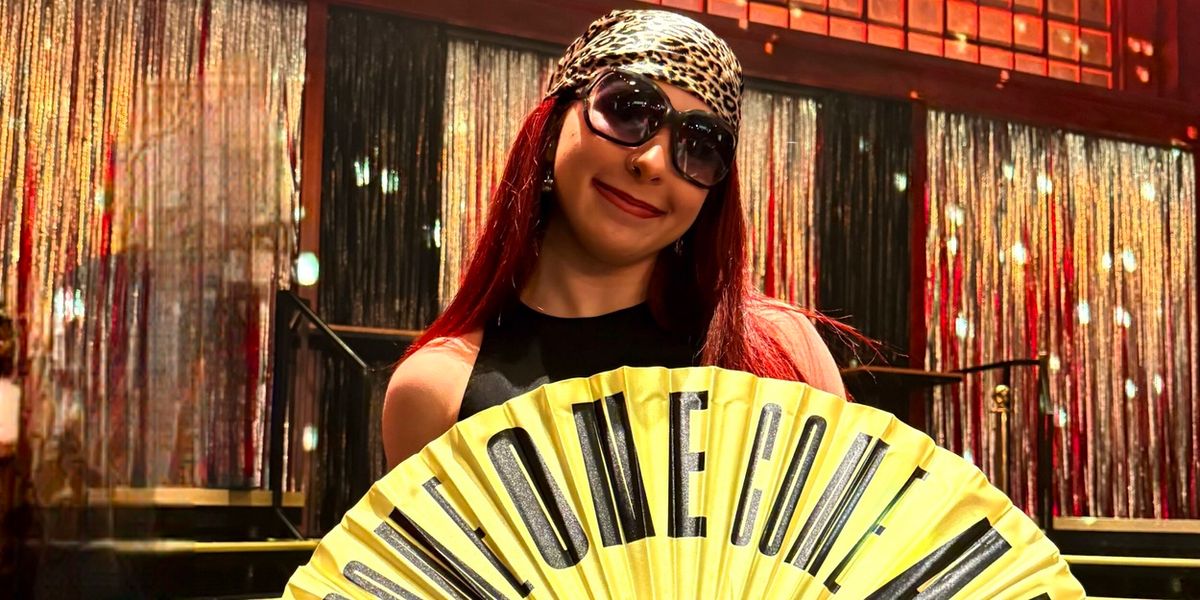
Anyone who's shared a conversation with me this summer has heard me ramble about my fascination with audiences. At this point, it's become my favorite theater rabbit hole. Marketing has always made me curious about why people experience the exact same event so differently, and theater has become one of my favorite places to look for those answers. It's prompted my curiosity not just for the performance itself, but for the patron experiencing it. Somewhere between spending my summer inside theaters, I started noticing the same pattern across productions with completely different stories and creative approaches. More and more, the audience felt like part of the artistic experience rather than the people observing it. That observation has followed me into every theater since.
For much of modern theater, the audience has occupied a compelling contradiction. Every performance depends on it, yet our attention has almost always been directed elsewhere. We dim the lights, arrange the room around a single focal point, and teach audiences the etiquette of disappearing. The ideal spectator quietly laughs, quietly cries, applauds, and then returns home. Hundreds of people gather in one room, yet watch as though they're completely alone. The audience has always been essential to the event, but rarely part of what we consciously notice.
Lately, many productions have begun to challenge that convention. In an art form that has traditionally treated the stage and the audience as two distinctly separate worlds, more productions seem interested in dissolving that boundary. Audience members are invited onto the stage, performers weave through the aisles, scenes unfold around spectators instead of solely in front of them, and audiences are occasionally asked to move through a performance rather than remain rooted to a single seat. Working firsthand on an immersive Off-Broadway production this summer has given me a unique perspective on these choices, but what has fascinated me most is recognizing similar patterns in productions that aren't considered immersive at all. It feels as though immersive theater has expanded the way many productions think about the audience, and this season especially, I've found myself noticing that influence across an incredible range of work on and off Broadway.
Breaking convention doesn't necessarily mean getting rid of boundaries. If anything, it changes where those boundaries exist. We all arrive at the theater carrying our own expectations of what it means to be an audience. For some, stepping into the world of a production is part of the thrill. For others, the experience depends on remaining an observer. At what point does an audience feel immersed rather than intruded upon? How do you create intimacy without assuming everyone defines it the same way? Those questions don't have one answer, which is exactly why they feel so relevant right now. Every production seems to draw those lines a little differently. Productions are experimenting with audience expectations and, in many ways, redefining what it means to go to the theater in the first place. Questions of proximity, participation, and the relationship between performer and audience no longer feel confined to immersive theater. They seem to be shaping the broader language of contemporary theater, where the goal no longer appears to be immersion for immersion's sake, but the audience's experience of being an audience. You're becoming increasingly aware of the people experiencing art alongside you, and that alone changes the feeling of the entire room.
The more I noticed this pattern, the more it began to feel like theater was responding to something much larger. We spend so much of our lives moving toward experiences that are increasingly individual, increasingly personalized, and increasingly our own. Nearly every corner of modern entertainment competes to know us a little better, promising recommendations built around our habits, preferences, and past behavior. Theater asks us to move in the exact opposite direction. It reminds us that an experience doesn't lose its meaning because it's shared. If anything, it gains something more valuable. Every audience changes a performance in ways that can't be rehearsed or replicated, and every performance leaves behind a room that briefly experienced the same story together while each person carried away something entirely their own. Perhaps that's part of why this moment in theater feels so exciting to me. For years, conversations about the future of entertainment have centered around technology and finding new ways to meet people where they are. Theater, however, seems to be leaning further into the one thing that has always made it distinct: the fact that every performance exists because a room full of people experiences it together. Increasingly, it feels like productions are treating that shared experience as something with creative potential rather than the condition under which a performance takes place. Community is not just what theater creates anymore. It is becoming part of what theater creates with. Across productions with wildly different plotlines, aesthetics, voices, and visions, I keep encountering artists who seem just as interested in designing the audience's relationship with one another as they are in designing the world onstage.
Theater has always been described as a communal art form, but perhaps we've underestimated what that really means. Community isn't just the condition that makes live performance possible. It feels more and more like something artists are choosing to explore with the same care they devote to story, movement, or design. That feels like a meaningful evolution, not because it makes theater more immersive, but because it expands what live performance can actually be. Many of today's productions aren't just asking audiences to experience art. They're asking them to notice the experience of sharing it. The future of theater belongs to the shared stage.
Sign up for all the news on the Fall season, discounts & more...
.jpg?format=auto&width=300)