


Review: SPRINGWOOD, Hampstead Theatre
Richard Nelson's play chronicles George VI's 1939 visit to the USA

At one point, in June 1939, the UK-US ‘Special Relationship’ was defined by the King eating hotdogs on the president’s lawn. King George VI and the future Queen Mother may not have persuaded President Franklin D. Roosevelt to promise Britain his allegiance in the forthcoming war in Europe, but their state visit – the first for a British monarch in the US – provided a model of transatlantic friendship to be mimicked for decades to come.
This play – based on the film Hyde Park on Hudson, but with a tighter focus on the state visit as opposed to Roosevelt’s broader life – briefly hit headlines in February when Stanley Tucci, originally slated to make his London directing debut on the show, pulled out due to a scheduling conflict. Writer Richard Nelson stepped into his directorial shoes, and has conjured up a tightly focused portrait of two families at a crossroads.
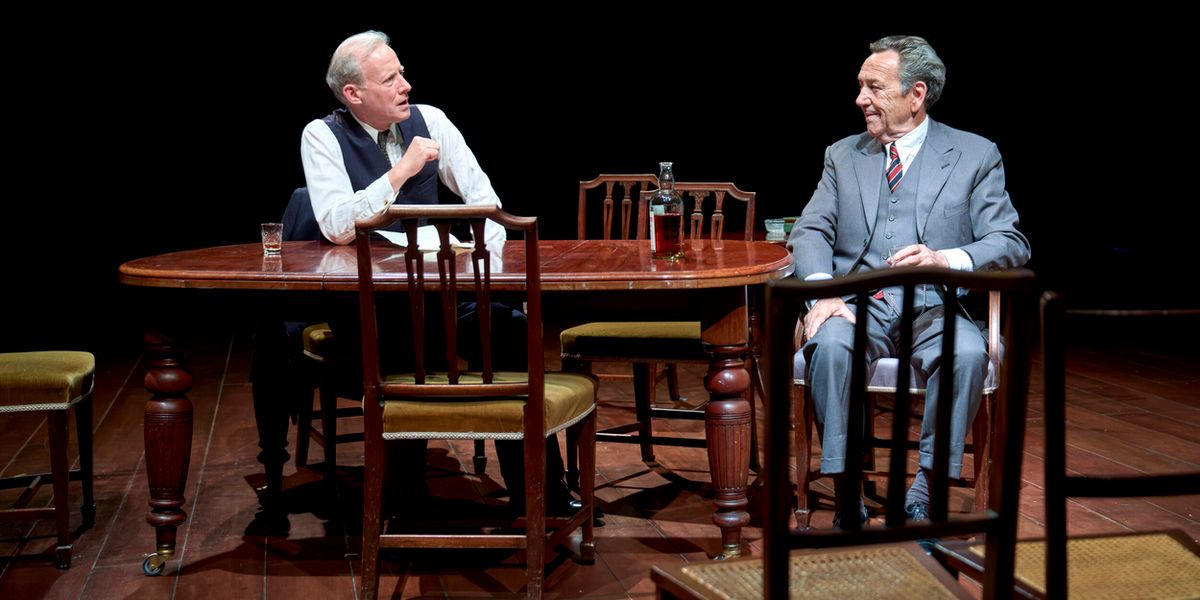
Nelson’s vision of the Roosevelt family’s Springwood estate in upstate New York is an intimate one, with the thrust staging inserting us directly into their living room. Abruptly dimmed lights and soaring musical cues give the feel of transitions between episodes of a sitcom, as each scene reveals a new tidbit about these powerful people and their reassuringly pedestrian problems. Here, the focus is on the Roosevelts’ complicated open marriage, and on the royal couple (Andrew Havill and Rebecca Night) as their bewildered houseguests, desperate not to misread a social cue.
%20and%20Rebecca%20Night%20(Elizabeth)_Springwood_credit%20Manuel%20Harlan.jpg?format=auto&width=800)
Photo credit: Manuel Harlan
This approach is possibly a little too domestic to really say anything profound about what it means to be British, or to be American, or for one to interact with the other. The King (known as ‘Bertie’) and his wife Elizabeth fall into stereotype, drinking tea and struggling under the burden of duties they never asked for. The matter of Bertie’s brother, the former Edward VIII, and his friendliness with Hitler is brought up but never explored quite as much as one might expect.
Meanwhile, Eleanor Roosevelt – so celebrated for her shrewdness, and played with a dry world-weariness by Jemma Redgrave – points out the American tendency for directness and distrust of English snobbery, all well-trodden ground. Anything that might offer a more nuanced perspective on the topic of Brits in America, like the occasional reference to the disdain of Irish and other European immigrants towards the royal family, is quickly glossed over.
Where Springwood does excel, however, is in the small stuff. There’s a running gag about the walls at Springwood being thin, and sometimes we feel like witnesses to an awkward family gathering, where everyone is a little more exposed than they would like. This play is less interested in global politics than it is in the mortifying feeling of being asked to “tell me about yourself”, or in the uneasy bonhomie that emerges between the women surrounding the president (including his wife, mother and timid new mistress).
_Springwood_077_credit%20Manuel%20Harlan.jpg?format=auto&width=800)
Photo credit: Manuel Harlan
At the centre of this deeply human drama is Robert Lindsay as FDR, in a performance that balances strength and vulnerability – you never quite know what is a genuine overture of friendship and what is a political game. When Bertie and FDR do move towards friendship, it is their shared experience of disability that bonds them – the King has his famous speech impediment, and the president partially hides his polio from the public – rather than any great ideological union.
For an audience in 2026, as the Special Relationship splinters amid ongoing conflict in Iran, there is an element of cosy nostalgia here for a simpler approach to diplomacy. It might feel wrong for such major political alliances to be formed via unspoken glances in drawing rooms, but that kind of transaction does make for excellent fodder for family drama.
Springwood plays at the Hampstead Theatre until 25 July
Photo credits: Manuel Harlan
Prefer BroadwayWorld in Google Search?
Add us as a preferred source so our stories show up more often in Top Stories and Google’s AI answers — for you.
Sign up for all the news on the Fall season, discounts & more...
.jpg?format=auto&width=300)






Reader Reviews
To post a comment, you must register and login.