


Review: MILLION DOLLAR QUARTET, The Arts At Marble Arch
The rock 'n roll musical replaces Burlesque at The Arts.
 Elvis Presley is sitting at the piano, his jacket and mouth slightly ajar, his hands over the keys and his eyes looking up at rockabilly legend Carl Perkins holding a guitar. On either side of Perkins are Johnny Cash and Jerry Lee Lewis. Teenage dancer Marilyn Evans is sitting on the piano in a dark wool dress; in his article, Bob Johnson euphemistically referred to her as Presley’s “house guest”. Taken on 4 December 1956, the photograph used for Johnson’s story — often later cropped to exclude Evans — was given a memorable caption: “Million Dollar Quartet”.
The monochrome snap by George Pierce (as well as the tape of that afternoon’s recording) are the inspiration for Colin Escott and Floyd Mutrux’s 2006 collaboration which, in a sense, may be the ultimate jukebox musical: every song here — not least the Perkins’ “Blue Suede Shoes” popularised by Presley, Lewis’ rollicking “Great Balls of Fire” and Cash’s solemn “Folsom Prison Blues” — will have featured on Wurlitzers of the day.
Directed by Jonathan O'Boyle, this production comes from Barn Theatre Cirencester where it was first staged in 2022, revived for a summer run and now transfers to the capital with its full Barn company before heading off on a national tour. It arrives as a hastily arranged replacement for the troubled Burlesque that is doing its own circuit of the UK after cancelling what was meant to be its opening run.
Million Dollar Quartet is not the only show currently trading on the theory that a flat image can carry a whole evening's drama. Anna Ziegler's Photograph 51 built an entire play around a single X-ray diffraction pattern which let Watson and Crick claim the double helix while Rosalind Franklin, who took it, went uncredited. Sondheim and Lapine went further still with Sunday in the Park with George, reverse-engineering an entire made-up existence for every dot in Seurat's La Grande Jatte until the cast physically assembles into the canvas onstage. London was due to see this again next year with Ariana Grande and Jonathan Bailey, before that revival collapsed this month when both leads withdrew and later the producers pulled the plug. While Ziegler questioned whose story an image erases, and Sondheim interrogated what a painting withholds, MDQ asks us only to watch how the bare bones of this historical encounter become the basis for this largely fictional event.
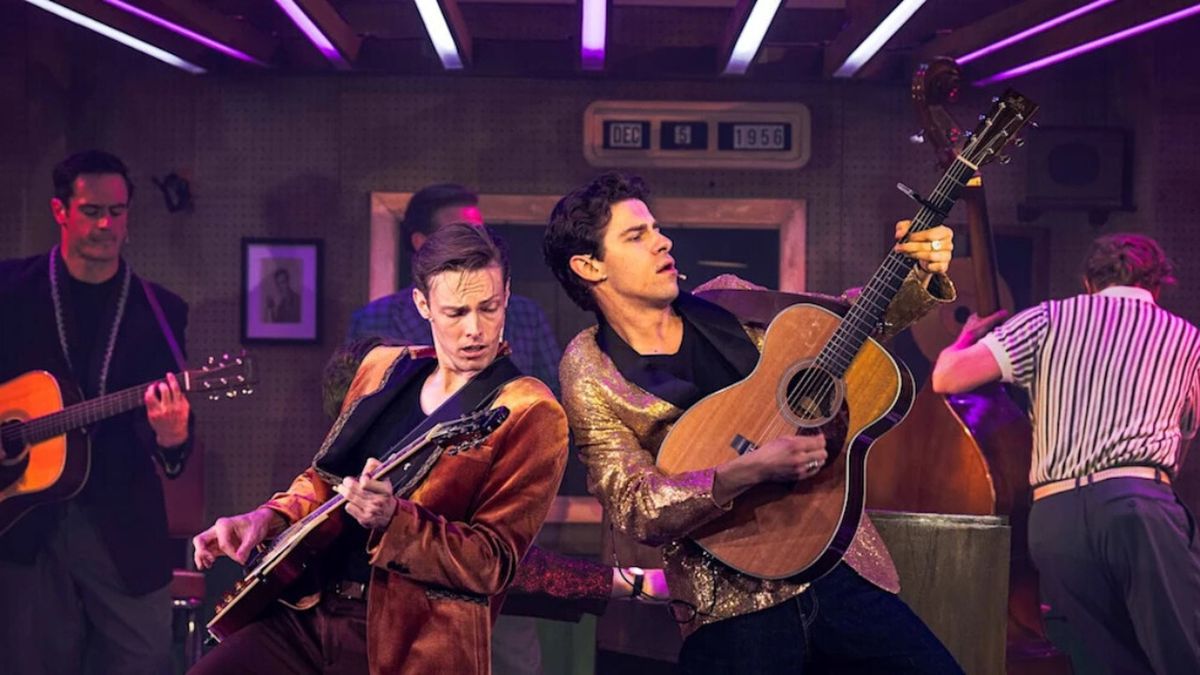
Having already played them in front of a paying audience for over two months this summer, it is no surprise that the actors confidently evoke their characters. Darren Day is the marquee name here and, with his permasmile and borrowed accent, he does a fine job as Sam Phillips, the owner of Sun Studios (a converted auto repair shop) and the Sun Records label. He was forced to sell Presley’s contract to RCA to keep the lights on and desperately wants to keep hold of his remaining stars. Meanwhile, RCA have made him an offer that could see him working alongside Elvis again, albeit at the cost of shutting down his own label. Day impresses as the charismatic boss at the crossroads of his own career watching his charges move on with theirs.
Connor Payne’s Elvis could have been a pastiche of the King but, in O’Boyle’s hands, is a gentle and humble rendition of the performer — no shaky legs, no pelvis thrusts — aware of his stardom but still wanting to keep in touch with his roots. As Johnny Cash, Christopher Erasmus is cooler than a barrel of cucumbers, his deep baritone voice a world away from the tough-guy outlaw persona his songs suggested. Joe Bence has the bad luck to be stuck with the best and worst character: his hyperactive Jerry Lee Lewis adds real pep to the proceedings when he’s not demanding constant attention. And, while there’s no Evans, Jenay Naima plays Presley’s girlfriend Dyanne, an invented character who takes her own turn at the mic.
Of the 23 songs here, only three were actually sung on the date in question: "Brown Eyed Handsome Man", "Down by the Riverside" and "Peace in the Valley" which are all presented as ensemble numbers. Perkins gets "Who Do You Love?" and "See You Later, Alligator", Cash rolls out "Folsom Prison Blues" and "I Walk the Line", Presley coasts through "Hound Dog" and "Memories Are Made of This", Lewis blasts “Great Balls of Fire" and "Whole Lotta Shakin' Goin' On" (two songs he hadn’t yet written on that day) and Dyanne takes focus on a smouldering "Fever" and a rowdy "I Hear You Knockin'". Even the deepest cuts hit hard in these capable hands.
Seventy years on, the picture is likely in a newspaper archive, the young musicians have all become legends and the piano still belongs to Sam Phillips’ estate after a failed attempt to auction it off for a seven-figure sum. The Sun Records owner only switched the tape on because he doubted he'd ever get these four in one room again. Escott, Mutrux and now O'Boyle have spent two decades proving he was half right: he never did get them back, but he never really let them leave either.
Million Dollar Quartet continues at The Arts At Marble Arch until 6 December.
Photo credit: Alex Tabrizi
Sign up for all the news on the Summer season, discounts & more...
.jpg?format=auto&width=300)
.jpg?format=auto&width=365)




Reader Reviews
To post a comment, you must register and login.