


Review: THE TURN OF THE SCREW, Arcola Theatre
Henry James gothic classic gets a partially successful revamp

You see, it’s disorientating when you start unexpectedly mid-narrative.
With a BANG!
And, a three star reveal.
In a blackout.
Okay, enough meta. It’s not unusual, nor is it necessarily a misstep, to chop and change conventional timelines - Christopher Nolan has made a career of it after all - but horror is such a specific genre that you tamper with its beats at your peril.
There are three reasons for that. Horror (enjoying a renaissance in cinemas) draws its power from the slow accretion of detail, the rising sense of fear and disbelief that fills one’s gorge as the terror mounts.
Secondly, there is a comfort in tracking the clichés as they build, their familiarity acting as a comfort blanket, reassuring us that we’ve been down this road before and it’s make-believe (at least for us). You absolutely do not want to have thoughts about Epstein Island bubbling up in what is, essentially, a good old yarn, a piece of hokum.
Thirdly, horror is never far away from comedy or, at least, laughter (often deliberately so) sometimes the result of a raised eyebrow here and there and sometimes as a reaction to the genuinely distressing feelings it engenders. What do you do when Tim Curry’s face shows up in that storm drain? Most scream, but some laugh at Pennywise the Clown.
%20Alex%20Brenner.jpg?format=auto&width=800)
Writer, Morgan Lloyd Malcolm and director, Nicky Allpress, have one of the most well-known and most adapted ghost stories of all on their hands and they would have wasted the opportunity had they simply gone through the narrative, familiar as it would be to many in the audience. It would also raise the question of why do such a thing in 2026, some 128 years after Henry James published the story in episodic format, the story containing much more than its surface.
So we start with a jump scare (they arrive somewhat randomly over the next two hours) and The Governess, overwrought and under pressure from a man who appears to be cross-examining her - or preparing her for such an ordeal, by calling upon little or no emotional intelligence in his coaching. We then go back in time to discover how she ended up in this traumatic conversation, and that conversation scene returns too often as a parallel timeline, inevitably breaking up the carefully crafted tension.
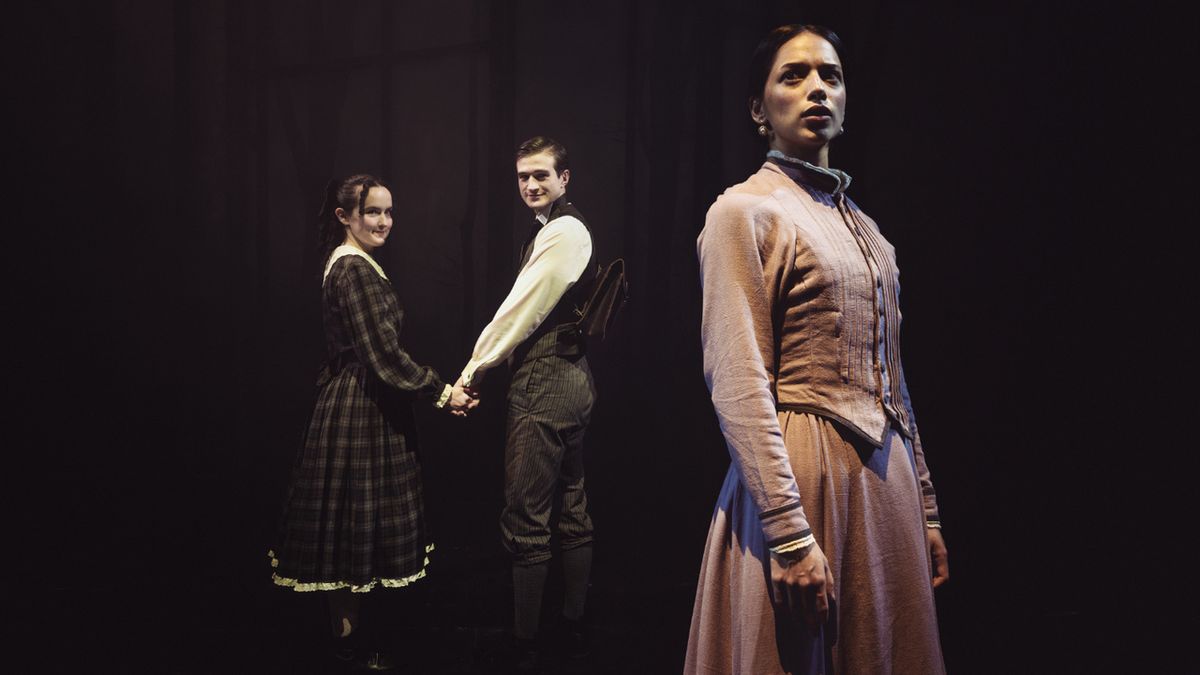
Amy Tara is our young governess, quick to smile, eager to please, but insecure and easily manipulated by The Master, an very oily Jim Fish. Their initial meeting (or meetings plural, as it’s not difficult to discern what men like him did with women like her then - and now) sends her to Bly. That's a bleak country house in Essex, a sprawling property run by Mrs Grose, the evasive housekeeper and populated by two lonely children, Miles and Flora. She soon finds out that governesses and servants appear to enjoy the same life expectancy as a Spinal Tap drummer and that everyone appears to have taken a vow of omerta. She's half-terrified and half-intrigued but she needs the job.
Soon we’re in Scooby Doo territory with unexplained whistles and things that go bump in the night, but Tara is very good on portraying distress, if a little relentlessly so and it's not difficult to believe in her. She knows something is wrong but, as we see in the jolting jumps forward to the cross-examination timeline, she is being gaslit into disbelieving her own memory. Of course, in a play full of apparitions, he may be just inside The Governess's head and she's gaslighting herself. More likely, she's a woman in distress who is not believed. Another then and now moment.
Katy Slater is gruesomely unsympathetic as Mrs Grose, whom you feel could resolve all the mysteries were she to fess up, but a lifelong commitment to The (now absent) Master and Victorian class deference seals her lips.
Toby Benyon (on professional debut) and Kathleen McAuley-Irvine (a recent LAMDA graduate) are revelations doubling as the schoolboy Miles / dead servant Quint and the schoolgirl Flora / drowned governess Miss Jessel. The Arcola can be an unforgiving space for actors, its intimate playing space and hard brick surfaces offering no margin for error in gesture, movement or diction. Both are eerily convincing when playing children old before their time, suffering PTSD long before it had a label and catching that stare that sits halfway between innocence and malevolence. You see exactly what motivates The Governess to rescue them and salve her Saviour Complex, but you also see how they might actually be possessed by Quint and Jessel.
Many of the tale’s famous ambiguities are left open, but everyone will find their own explanations for each characters’ often inexplicable actions. In that context, the adaptation is intellectually nourishing. But there’s a quid pro quo to pay for the subversion of the genre’s norms, one I felt to be a little too much for what came back in return.
The Turn Of The Screw at the Atcola Theatre until 10 October
Photo images: Alex Brenner
Prefer BroadwayWorld in Google Search?
Add us as a preferred source so our stories show up more often in Top Stories and Google’s AI answers — for you.
Sign up for all the news on the Summer season, discounts & more...

.jpg?format=auto&width=365)





Reader Reviews
To post a comment, you must register and login.