


Review: MAYBE HAPPY ENDING at National Theatre
Maybe Happy Ending runs through October 11, 2026, at the National Theatre.
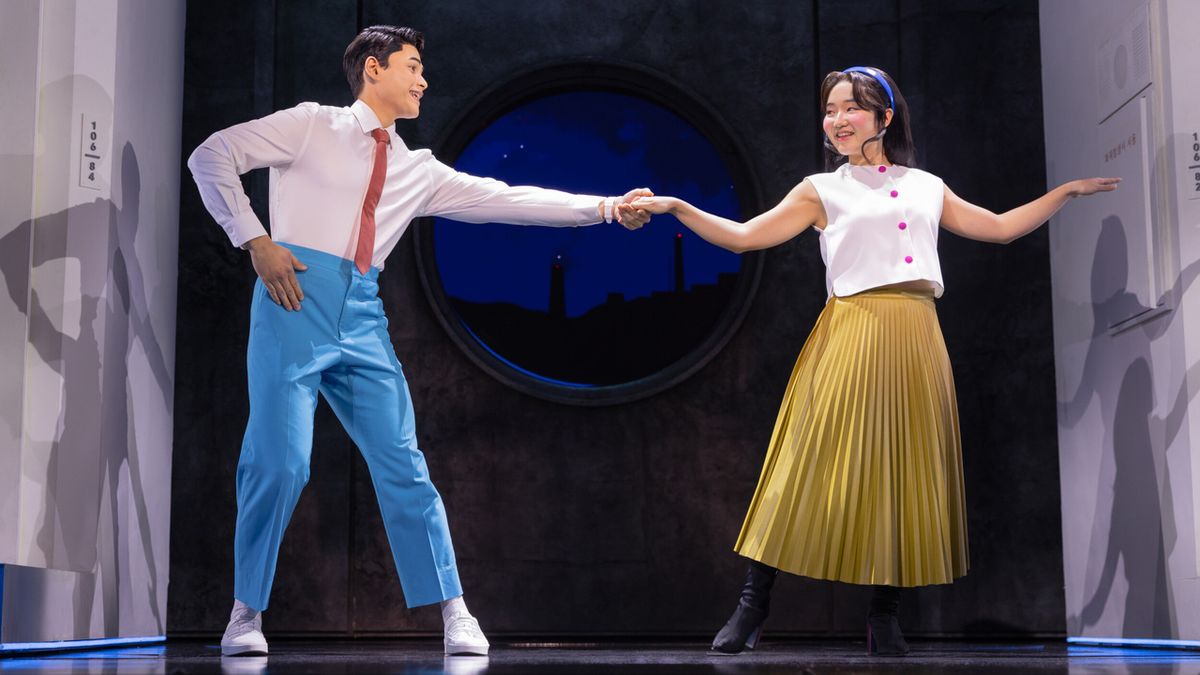
Bittersweet poignancy permeates underneath and amidst the charismatic and subversive musical that is Maybe Happy Ending ---now playing at The National Theatre. This totally involving musical is suffused with numerous creative, surprising twists and subplots by insightful writers Will Aronson and Hue Park.
The surface plot strand portrays two helper bots (robot-like helper bot# 3 is Oliver , who feels superior to helper bot robot #5 –Claire). These two helper bot robots are dealing with issues of being retired to robot retirement , trying to hold onto erased memories, and trying to understand their relationships with their former owners. Ostensibly “human” qualities of guilt , breaking through to connection, unpredictability, and love are interspersed throughout the arc of this musical.
Writers Will Aronson and Hue Park write with an air of wit and open possibilities, under the award-winning direction of Michael Arden (so brilliantly at the helm of the musicals Parade and The Lost Boys).
Composer Will Aronson creates emotional, memorable music that careens from the depths of pleasant, empathetic solos and tender duets to explosive and technically thrilling flourishes and climaxes. Henry Mancini and Burt Bacharach have been cited as musical influences on this mesmerizing pop-Broadway score, but I also detected the influence of the team of Tom Jones and Harvey Schmidt ---especially in the romantic and poignant moments (the poignancy of The Fantasticks came into my thoughts ---).
Steven Huynh as Oliver delivers an acting tour-de-force as well as singing ballads and duets with equal facility. Huynh’s robotic movements are precisely rendered, and his face is a veritable panoply of joy, angst, and befuddlement. His portrayal is alternately witty and dramatic. Mr. Huynh’s vocal chops are dexterous and full of vigor.
“The World Within My Room” shows Oliver delightfully enjoying his room as he talks to his beloved plant HwaBoon and as he clutches his beloved Jazz magazine as it slides down his state -of -the-art mail chute.
Claire Kwon as Claire is very engaging; Ms. Kwon’s -style of acting is the epitome of an inquisitive character with a bit of a commanding attitude that often “saves the day” in the technological, romantic, and humorous exploits of this charming and quirky musical. Ms. Kwon thrills with her expansive vocal range in her solos— the beguiling “How to Be Not Alone” and the devastating “What I Learned From People.”
As James, Juneso, and Others----James Seol is disarming and versatile.
As the crooner Gil Brentley, Francisco Javier González offsets the immediate action/narrative by his charismatic vocal delivery.
The use of jazz, crooning, and a mid-century aesthetic is a major metaphor for the musical. The musical is actually quite subversive in that the authors eschew any conventional wrap-ups; all conventional expectations are upended, and the audience is left to ponder outcomes for themselves. There is a palpable tension between freedom and discipline/regimentation/schedules throughout this unique musical.
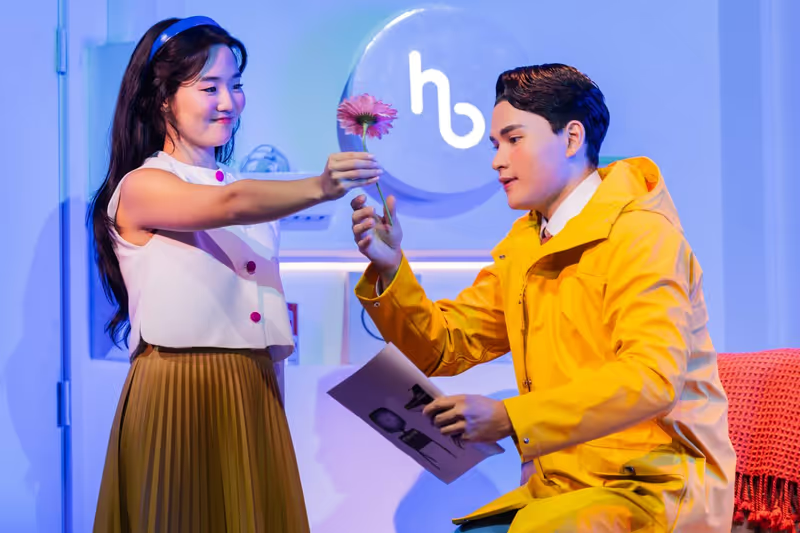
of Maybe Happy Ending.
Photo by Evan Zimmerman for MurphyMade.
A major theme of the musical is the theme of erasure --- –are memories and compulsions truly erasable and, if they are not, what is the purpose of our messy memories? Is it better to break out of our conditioning and get hurt and/or to accept our own realities with gratitude? Through the mirror of the technology of microchips and algorithms, potential human emotions are explored.
Music director and conductor Josh Tatsuo Cullen beautifully and sensitively leads a very enthralling orchestra. Orchestrations by Will Aronson are variegated and full of musical appeal. Music coordinator Kimberlee Wertz has obviously fulfilled all duties well as the music is presented and showcased in the best logistical manner.
The pulsating and rhythmic “Hitting the Road—Part 1, 2 and 3” vibrate with the joys of discovery and freedom.
“The Rainy Day We Met” is an immersive musical experience as Oliver and Claire pretend to be humans meeting for the first time (Oliver and Claire must pretend to be human as robot helpers are not allowed to be in public). As they sing, an absolutely depth-filled, fluid and vibrating scenic projection creates a rainy New York Cityscape.
The haunting and often elusive pursuit of “Chasing Fireflies”(except for one –caught in a jar) was presented via a simply enchanting and awe-inducing enveloping of glimmers of light interspersed with twinkling luminescent fireflies that were spread across the rafters of the stage. The full orchestra appeared onstage as the lights grew and gasps of awe came from the audience.
This breathtaking scene naturally led into the moving duet “Never Fly Away” The moving music to “never fly away” eventually gives way to the releasing of the firefly for one must accept reality and let go.
The tear-inducing and reflective duet “Maybe Happy Ending” is the hook and namesake of this musical . Composer Will Aronson and lyricists Aronson and Hue Park have outdone themselves in this meditation on life. Indeed, a realization occurs that reality must be accepted and a completely total storybook “Happy Ending” may not be possible---the message is that one must live in gratitude for the moment, the memories we might retain and a tentative, quite possible “Maybe Happy Ending.”
Scenic design by Dane Laffrey is highly functional and helps to propel the action, but it is also, concurrently, highly intricate, and compelling in its own right. Video design by George Reeve is constantly surprising with elucidations of fireflies, algorithm/computer parts, human helper bot owners magnified, and so forth-- all encased around the top, the sides, and the bottom of the stage space.
The furniture, separate rooms and cubicles all glide one and off (rotating turntable, automated sliding platforms) very fluidly, making it easy to transition from one moment to the next. Translucent green light and blue light encloses the various articles of furniture and so forth.
Scenic depth is envisioned as depth is shown in enlargement of three grid -like boxes or encasements overlapping one another.
Scenic highlights include a rainy day in New York City, a sexy motel room that is very much a hilarious unknown to these robotic explorers, a ferry dock, and an exploration into a lush forest replete with a starlit sky of fireflies. A retro look is shown in the musical with bullet-like lamps, classic records, pillows, and so forth.
Lighting design by Ben Stanton is stunning with green and blue illuminating lights, shafts of overhead light, and focused lighting on a blue and a pink-hued bedroom.
Costumes by Clint Ramos are replete with plaids, and pastel blue and pink shades.
Is the story a tale of exploring the possibilities of the unknown amidst the prejudices of the unknown? ---helper bots are forbidden to travel in public on their own or to touch. (Harsher shades of the Spielberg film Minority Report came into my head as well as the Orwellian feel of 1984, as this musical has some bleak implications at times------).
The firefly scene is a cautionary tale of learning to let go and explore while still being, concurrently, able to grasp the cautionary tale of learning to accept the realities of your situation while still reaching out to make connections and to explore possibilities.
A dystopian and isolated society under siege by complete automation does not grant respect so people must reach out and “re charge” what they can of their dignity and compassion for others .
These innovative musical advances the potential of the theatrical art form --akin to such groundbreaking works as Sunday in the Park with George and Operation Mincemeat.
This musical has an appeal to youth and new generations due to the timely themes that anticipate AI—yet it is also a very thorough exploration of themes that will apply to older demographics.
Like all great works of art (as you would see in much of Shakespeare, Bergman, and Sondheim), the music and content of this musical often explores the fragile, transitory nature of time and the need to embrace the moment.
For a musical that will leave you free of any preconceptions, and that will invigorate your mind and senses ---do not miss this musical---as we all hope for a Maybe Happy Ending.
Running Time: One hour and forty minutes with no intermission.
Maybe Happy Ending runs through October 11, 2026, at The National Theatre located at 1321 Pennsylvania Avenue, NW, Washington, DC, 20004.
Lead photo credit- L- R: Claire Kwon and Steven Huynh in the North American Tour of Maybe Happy Ending.
Photo by Matthew Murphy and Evan Zimmerman.


Sign up for all the news on the Fall season, discounts & more...

|
Frida...A Self Portrait Shakespeare Theatre Company Klein Theatre (10/08-11/08) |

|
Mr. Burns: A Post-Electric Play Clarice Smith Performing Arts Center (10/09-10/18) |
|
The Score Shakespeare Theatre Company (9/11-10/25) |
|
The Second-Best School Shooting NextStop Theatre (9/17-10/11) |

|
Coming to America: An Immigrant Cabaret ExPats Theatre (9/30-10/18) |

|
Monsters of the Villa Diodati Creative Cauldron (10/08-11/01) |

|
Some Like It Hot Bernard Family Theatre, Olney Theatre Center (9/18-11/08) |

|
Stonewall's Bust The Writers Center (10/09-10/25) |

|
A Christmas Carol – 2026 Ford's Theatre (11/19-12/31) |
|
Measure for Measure Folger Shakespeare Library (9/22-11/01) |

Reader Reviews
To post a comment, you must register and login.