

Review: Despite Stellar Cast, Met's ONEGIN Revival Refuses to Fly in Warner’s Misbegotten Production
Grigorian as Tatiana can’t fight through director’s bad choices, conductor’s flaccid baton, though ably abetted by de Barbeyrac’s Lenski and Tsymbalyuk’s Gremin
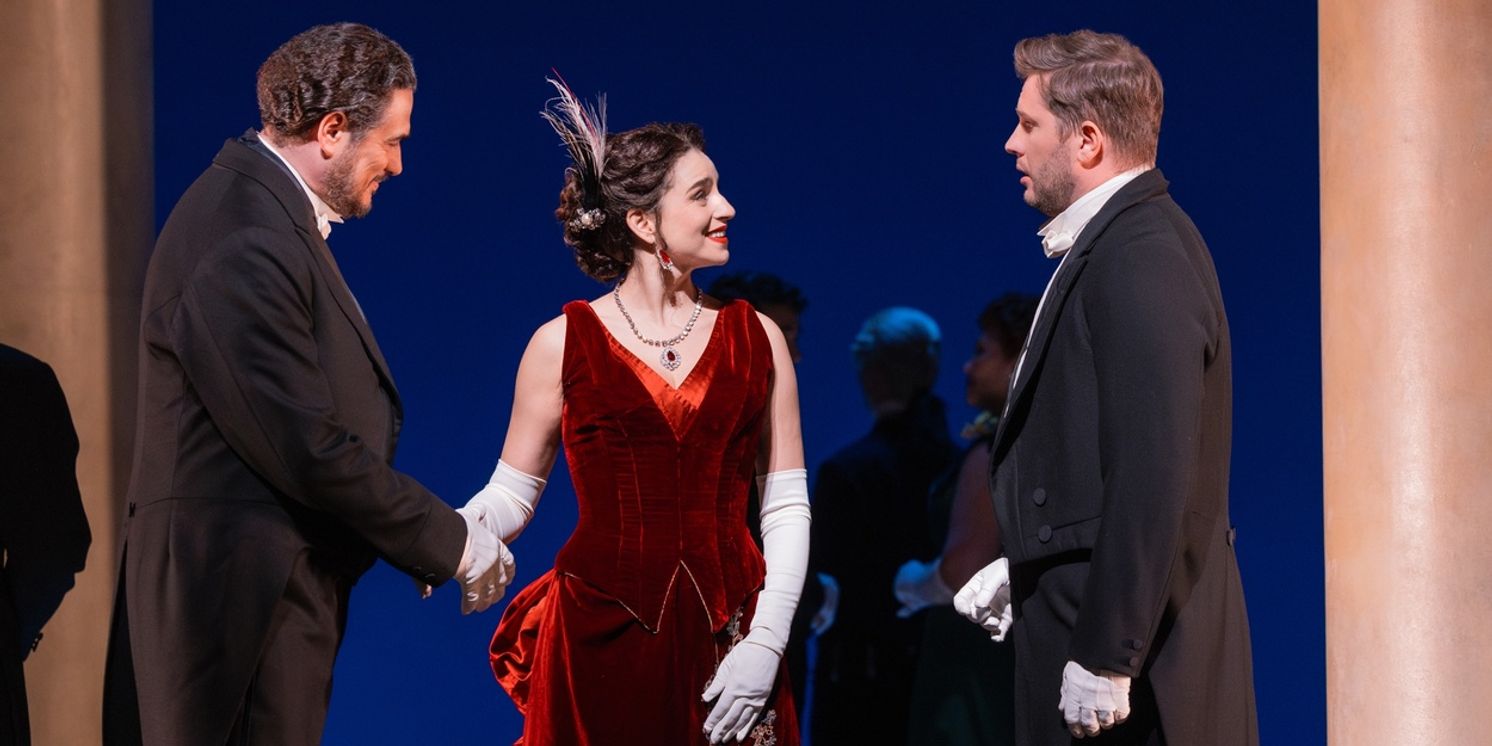
In the Met’s much-anticipated revival of Tchaikovsky’s EUGENE ONEGIN--the Met's lobby was rocking before the performance--almost anything that could go wrong, in fact, did, at Monday night’s premiere. And even though revivals are notorious for their short rehearsal periods, what was wrong here was not from that.
How something that can look good on paper turn into a frequently dull night at the Met is the definition of directorial misconduct. In size and scale, Deborah Warner’s conceit was wrong, sending some of her singers into the lion’s den without protection. And while Paula Williams is credited as director of the revival, I’m not sure there was anything she could have done to save it, though the performance did improve as it drew to an end.
To have the opera’s famously glorious Letter Scene staged in what could have passed for Yankee Stadium (Tom Pye’s unhelpful design, ditto Jean Kalman’s lighting), with a makeshift bed that you wouldn’t offer to the most unwelcome guest, showed that the director had no understanding of the opera. Was Tatiana writing her love letter to Onegin? It didn’t seem like she had much to say to him from the action on stage. (That’s not what’s written in the libretto by Tchaikovsky and Shilovsky, by the way.)
There was no sign of the lust Tatyana felt for Onegin—even if she was supposed to be too young to understand that’s what it, clearly, was. You didn’t feel it from the orchestra either; Timur Zangiev made a disappointing house debut, with an opera that appears to be something of a calling card for him. The thrust in the score was missing for much of the time in this rendition.
Asmik Grigorian knows how to sing this music to great effect—I heard her do it in concert not long ago—but there were so many obstacles put in her way that it was impossible to pull it off. (And it’s not as if this is her first time in an odd production: I saw her as a blonde Turandot set in Mao’s China.) She couldn’t go off on her own and do the Tatiana that might have made more sense, even though she’s a star—and she definitely is—and at another time could have been more take-charge.
It didn’t help, of course, that her Onegin (baritone Iurii Samoilov) didn’t seem properly world-weary, or compelling enough to make her forget everything else in her life, despite his attractive vocal instrument. He made up for it in the final duet with Tatiana.
The poet Lenski is a scene stealer of a role and French tenor Stanislas de Barbeyac did his best to prove it. Whether as the unjustly overwrought lover in the big party scene or waiting for what will surely be his death in the duel that he thrust upon Onegin, he impressed. In the short but crucial role of Prince Gremin, who has married Tatiana and made a grande dame of her, bass-baritone Alexander Tsymbalyuk did some of the night’s best singing.
Other notable contributions came from Maris Barakova as Tatyana’s coquettish sister, Olga; Larissa Diadkova as Filippyevna (Nanny); and Elena Zaremba’s Madame Larina. The Met chorus under Tilman Michael did some fine work, though they sometimes seemed a bit out of sync with the orchestra.
EUGENE ONEGIN will be the Met repertoire through May 16. For more information and tickets, please see the company's website.
Caption: (from left) Alexander Tsymbalyuk (Gremin), Asmik Grigorian (Tatiana), Iurii Samoilov (Onegin)
Credit: Evan Zimmerman/Met Opera
Reader Reviews
Videos