

In several of my recent reviews, I have made the point that it is borderline impossible to mount a production of any play with social or political elements in Washington, DC without drawing comparison to current events. Arena Stage's production of Eric Bentley's 1972 play "Are You Now or Have You Ever Been?" which dramatizes several hearings held by the House Un-American Activities Committee (HUAC) a few miles from where those hearings took place, and will run through the upcoming election season, is clearly intended to remind audiences of the enduring relevance of its themes of political persecution and the enduring need to defend the freedoms of speech, association, and assembly. The text of the play, directed by Anna D. Shapiro, is taken from actual transcripts of HUAC hearings, in which numerous left-wing writers, actors, musicians, and others were pressed about their political associations. The play jumps backward and forwards to various dates in the late 1940s and early 1950s, the highpoint of the HUAC hearings and the Hollywood Blacklist, in which those denounced as Communists to the committee found themselves unable to work for many years. The title is taken from the question frequently posed at these hearings: "Are you now or have you ever been a member of the Communist Party?"
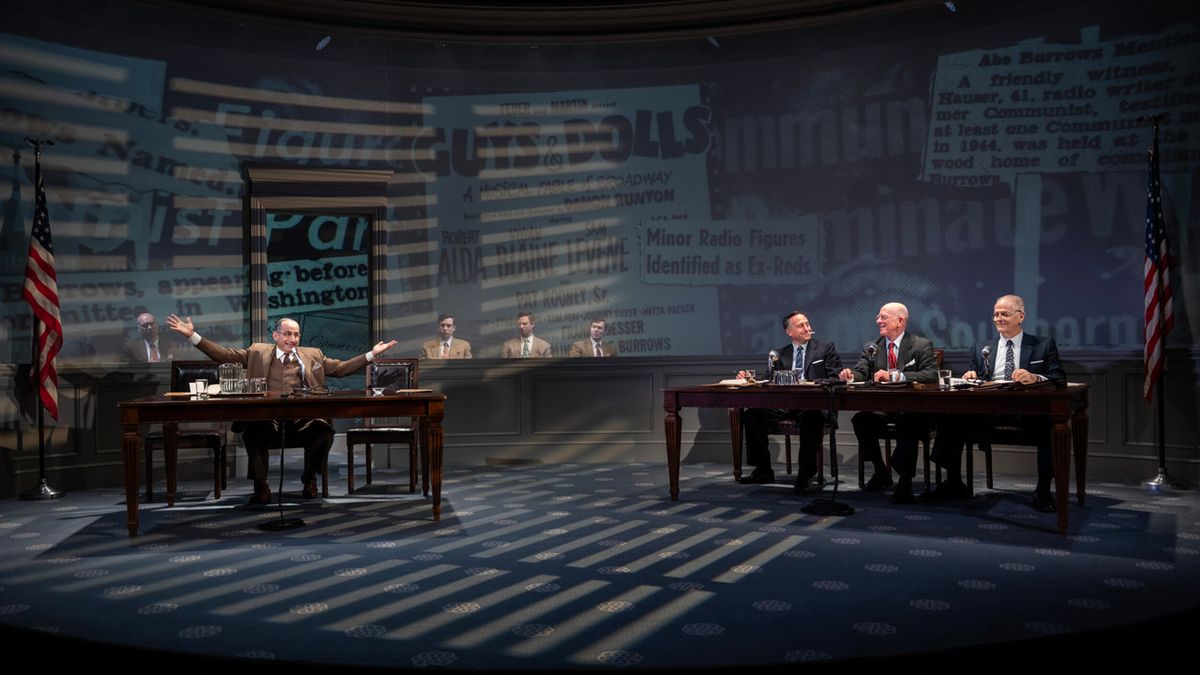
A description of "Are You Now..." is somewhat challenging, as the play consists nearly entirely of dialogue exchanges, and occasional fourth wall-breaking soliloquies delivered by the cast. The Spartan set, reminiscent of "Our Town," consists of two tables, one at which the Congressional investigators sit and one at which the subpoenaed witnesses sit. Contemporaneous newspaper headlines about the hearings are projected onto screens at the rear of the theater. The Congressional persecutors are named in the script as the Chairman (John Leslie Wolfe), Committeeman 1 (Philip Earl Johnson) and Committeeman 2 (Jason Babinsky), amalgams of various officials and staffers who served on the Committee at different points during its inglorious tenure. Together, the three form a chillingly bureaucratic ensemble, relentlessly pressing the witnesses in the hopes of getting them to incriminate themselves or name the names of fellow current or past party members. Man 1 ( Edward L. Simon) Man 2 (Greg Stuhr) and Man 3 (Stephen Cefalu Jr.) all play various figures who were summoned to testify. Simon plays both film and theatre director Elia Kazan and his sometime collaborator, playwright Arthur Miller. Kazan appeared as a "friendly witness" before the Committee, and named eight members of the Group Theater who had been associated with the Communist Party, including Miller. As Miller, Simon replies, "My conscience will not permit me to use the name of another person" when asked about his colleagues' associations. Miller famously wrote "The Crucible," about the Salem Witch Trials of the 1690s, first performed in 1953, in part as an allegory for the anti-communist crusade. In response to that, Kazan directed the following year's Best Picture winner, On the Waterfront, in which Marlon Brando's longshoreman character heroically informs on his corrupt union bosses. In response to that, Miller wrote "A View From the Bridge," in which an Italian-American longshoreman, jealous of and perhaps harboring a secret desire for his niece's illegal immigrant boyfriend, denounces the latter to the immigration authorities. Kazan's actions haunted him for the remainder of his long life; there was great controversy over the Motion Picture Academy's decision to bestow an honorary Oscar on him in 1999.
Other figures brought to life by the trio include Stuhr as Edward Dmytryk and Cefalu as Ring Lardner Jr. Dmytryk and Lardner were both members of the Hollywood Ten, early victims of the blacklist who all refused, on First Amendment grounds, to testify and spent time in federal prison. The script notes that Dmytryk later encountered his persecutor, onetime HUAC chair J. Parnell Thomas, in the Danbury Federal Correctional Institute after the latter was indicted for corruption.
Other actors portray witnesses who are given the opportunity to speak at greater length. As actor Larry Parks, Aaron Bliden attempts to cooperate with the Committee while begging not to be compelled to name names. Jeff Still earned much applause for his portrayal of Lionel Stander, an actor who combined humor with serious denunciations of the Committee's overreach and hypocrisy. A memorable excerpt of his testimony: "I know of a group of fanatics who are desperately trying to undermine the Constitution of the United States by depriving artists and others of life, liberty, and the pursuit of happiness without due process of law... I can tell names and cite instances and I am one of the first victims of it. And if you are interested in that and also a group of ex-fascists and America-Firsters and anti-Semites, people who hate everybody including Negroes, minority groups and most likely themselves... and these people are engaged in a conspiracy outside all the legal processes to undermine the very fundamental American concepts upon which our entire system of democracy exists."
Rivka Borek, the only female cast member, portrays playwright Lillian Hellman, also among those denounced by Kazan. Borek reads from Hellman's letter to the Committee, refusing to name names. Similar to Miller, she states, "I cannot cut my conscience to fit this year's fashion."
The most stirring exchange is the last of the play. In 1956, the famous African American singer and labor activist Paul Robeson (Kevin Mambo) spars with the Chariman-in this case representing then-Chairman Francis E. Walter. Reflecting the sentiments of many Blacks galled at the hypocrisy of the US claiming to defend the "free world" against communism, Robeson defiantly states that it is unthinkable that African Americans would "take up arms in the name of an Eastland, to go against anybody," referring to the virulently segregationist Mississippi Democratic Senator James Eastland. Robeson further says that the government "should go down to Mississippi and protect my people." Mambo delivers the lines with rousing conviction.
"Are You Now" will appeal to history buffs, and anyone interested in this important episode of the American experience. Shapiro draws fine performances from the ensemble. Though moving at a fast pace, it does run about two hours without an intermission, so be mindful of how many drinks you have at the Margot Kelly Concessions Bar before the show.
As it happens, as I stepped out of the Waterfront Metro Station and made my way towards the theater, demonstrators from the group Free DC, which advocates for greater self-determination for the city, set up on the street corner and, at the stroke of 7:00, began rhythmically banging tin pans. One of them pressed a refrigerator magnet with an attached Mystery Flavor Dum-Dum lollipop into my hand. A timely reminder that the American tradition of dissent is alive and well.
Breaking Broadway alerts by text
Get the biggest stories sent straight to your phone.

Weekly top stories - unsubscribe anytime.

|
Are You Now or Have You Ever Been? Arena Stage at the Mead Center for American Theater (10/17-12/06) |

|
Frida...A Self Portrait Shakespeare Theatre Company (10/08-11/08) |
|
The Score Shakespeare Theatre Company (9/11-10/25) |

|
XXII FUEGO FLAMENCO FESTIVAL GALA Hispanic Theatre (11/05-11/22) |

|
Monsters of the Villa Diodati Creative Cauldron (10/08-11/01) |

|
Some Like It Hot Bernard Family Theatre, Olney Theatre Center (9/18-11/08) |

|
Stonewall's Bust The Writers Center (10/09-10/25) |
|
Dupont Investigations: Flight of the Fallen Nocturne Hall (9/01-11/11) |

|
Moxie Events presents "The Fleetwood Mac Experience" F. Scott Fitzgerald Theatre (10/23-10/23) |
|
Les Misérables Olney Theatre Center (11/05-1/31) |
Reader Reviews
To post a comment, you must register and login.