
Interview: Courtney Costello of BABETTE'S FEAST at MIGHTY ACORN PRODUCTIONS
We discover the magic of adapting a short story from scratch!
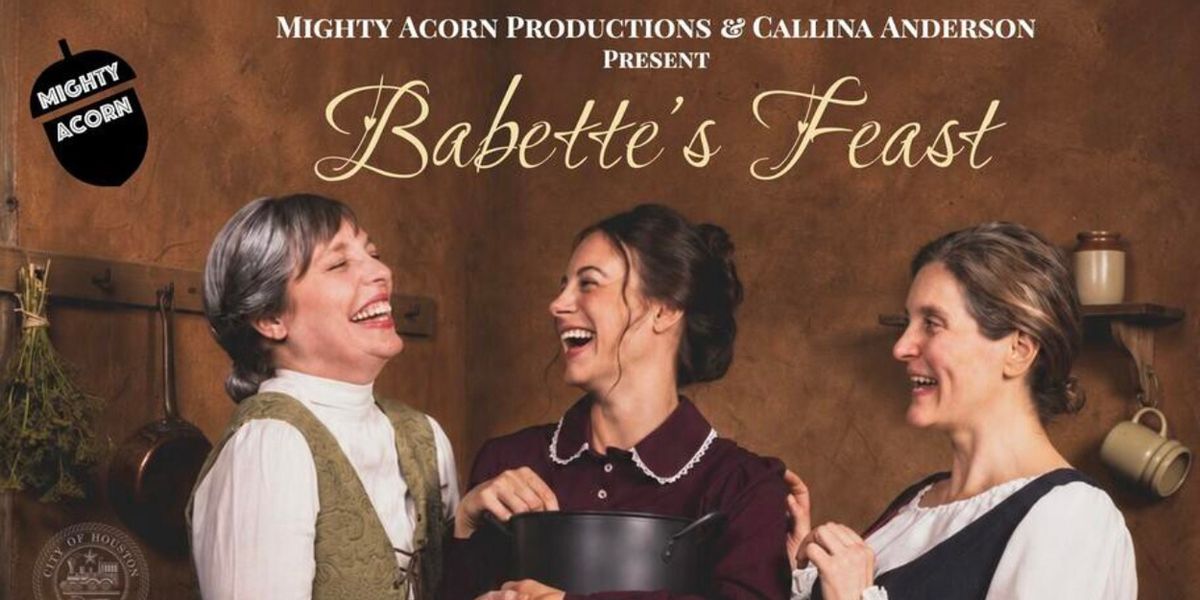
Courtney Costello is an actress and playwright from New York City who received her training at Vassar College, RADA, and the Eugene O’Neill Center’s National Theatre Institute. She was an original member of Project 400 Theater Group. She’s done it all. Movies, plays, soap operas! Courtney is the founder of the theater production company Wiltsie Bridge Productions. Her adaptation of BABETTE’S FEAST will be performed by Mighty Acorn Productions starting September 17th and running through October 4th at the MATCH. The plot of BABETTE’S FEAST is pretty straightforward. In a remote village where tradition and sacrifice shape everyday life, the arrival of a mysterious outsider quietly transforms an entire community. Based on Isak Dinesen's short story, made famous by the 1987 Academy Award-winning film. Courtney Costello’s stage adaptation of Babette’s Feast will be performed by Mighty Acorn Productions at The MATCH beginning September 17. BROADWAY WORLD WRITER Brett Cullum got a chance to sit down and talk to Courtney Costello about adapting this work and her journey to adding playwright to her resume.
Brett Cullum: So right off the bat, what made you want to adapt Babette’s Feast for the stage?
Courtney Costello: Well, I was actually offered this opportunity by my collaborator, Abigail Killeen, who is a wonderful theater maker, now a professor, at Bowdoin College, and she had a vision to put this story on stage. She felt it was inherently theatrical, and she wanted someone who could adapt it into a stage play. And so she approached me, and I felt like I had just been given this enormous and surprising opportunity, really. She had procured the rights from the Dinesen estate, which was quite a feat. She did that largely through her own power of persuasion, you know? I mean, she really just called them and said, "I have this vision, and I have a love of this story," and they allowed her to do it, which is really incredible.
So it was really an opportunity that came to me, and of course, I leapt at it, because it was an incredible piece of literature, and I also felt like I was suited to it as a writer, that I could at least make a good attempt at it. So that's why I said yes.
Brett Cullum: It's an interesting story, and it's an interesting idea for a play. So, tell me a little bit about the themes and things like that that run through Babette's Feast that really attracted you to the work.
Courtney Costello: Luckily, I was very aligned with Abby and, eventually, with our director, Karin Coonrod. We were very aligned in the sense that the thing that most stood out to us about the story was the sense of the stranger arriving in a strange land and being embraced, feared, bearing gifts, bearing mysterious gifts. It was a story—the reason we were all compelled by that aspect of the story is that at the moment that we all started working on it, it was the moment when immigration became a flashpoint in American culture. And we thought this story was ripe for bringing that into our consciousness in a way that isn't political or didactic. It's just fully, fully human. The way this story shows us a stranger arriving in a strange land, being feared, and eventually actually being transformative to them. So we thought there was great value in that at that moment in American culture.
Brett Cullum: You had this whole career as an actor, and doing all of these different things. What got you into the arts originally?
Courtney Costello: Oh gosh, that's very personal, actually, because I was so shy as a child that I could hardly talk to people. I really could hardly hold a conversation. And so, when I was like six years old, my parents—I grew up in New York City, right?—and my parents enrolled me in this children's acting company where we performed these plays, but we also had grown-up professional actors performing along with us. And honestly, as soon as I arrived at my first rehearsal, and I think I stood on stage, I think I might have burst into tears. I was so overcome with this sense of relief that I had found my place in the world. Like, I thought, this is a place where I can just be myself, and these people are going to—I don't know, I felt very aligned and very at home. And honestly, I'm very lucky, because from that moment, I knew exactly what I wanted to do with my life. And I think that's a rare gift, right? I mean, to know. Super rare. To know. But I've always known, and I'm so lucky now that, having gone through all these different— I've worked in so many aspects of theater, but I feel like it's a language I speak very fluently, and I'm honored to speak it. You know, and just try to continue to work at it.
Brett Cullum: Well, apparently so. I mean, you've done so many different forms and variations on it. I noticed that we saw soap operas in your bio, which is so wild. It's an art form that I think is kind of going away, unfortunately.
Courtney Costello: Very similar to theater.
Brett Cullum: Yeah, I can imagine. It's interesting how you've just kind of weaved in and out of this art. But what is it about playwriting that gives you a little bit more—what is it that draws you to the writing part? Because it's so different than taking a script and bringing it to life. I mean, you are actually creating this.
Courtney Costello: That's true, that's true. Again, it's like, it seems like this is a bit of a theme in my life, that this also sort of came to me. When I was studying at the O'Neill Center, during my junior year in college, we had to take a play—it was an actor training program, but we had to take a playwriting class, and my teacher, I wrote a one-act that my teacher, then submitted, unbeknownst to me, to a company in New York called Circle Rep Lab. And they—I was home on vacation, this is before cell phones, right? So my family's landline rang, and I answered it, and it was a guy who was the artistic director of Circle Rep, and he said, "We'd like to produce your play." And I was like, you know, 19 years old, and I didn't even know he had my play. But I was incredibly delighted for them to produce it. So I ended up having this great experience of working with a director, and working with actors, and seeing my play brought to life, and I had a sense that, you know, I'm a writer as well.
So I was actually able to weave, as you—the word "weave" is really good, you know—I kind of wove in and out of these modalities. And then I had a child at a certain point, and I focused, I refocused on writing at that point, because I wanted to not be traveling, and kind of be a little bit more in command of my own schedule. So I refocused on writing. It's been very rewarding. It's hard. It's not easy. And I actually recently went back to school to train as a director, and I think that's my favorite chapter in the theater. Yeah. I think it's the thing I'm actually most suited to. The sense of—there's this cumulative sense for me that everything else has been sort of leading to this. So it's an exciting moment.
Brett Cullum: Well, Courtney, you're making me feel better, because I transitioned from actor to maybe more of a writer, so that was one of the things that always—and it's so hard to say what you like about one or the other. But let's go back to Babette's Feast. It was originally produced in what year? Your play version?
Courtney Costello: I believe it was 2015? I could be wrong, though, honestly. It was also a long process, because it premiered at Portland Stage in Maine, and then it had an Off-Broadway run. It transferred to New York and had an Off-Broadway run in New York. And there were — even before Portland, there was a workshop production that is close to my heart, because it was so lovely. We had such limited resources, but sometimes, you know, when you don't have much in terms of resources, you find great creativity. So we did an initial workshop production in New York that was very, very cool. So it was a—my point is, it was a years-long development process, you know?
Brett Cullum: Well, and how do you decide? You've got a short story, and you've got a film. How did you bring those together to your own?
Courtney Costello: I did not watch the film. I had seen it years before, but the thing is, we did not have the rights to the film. We only had the rights to the story and to the theatrical version. So I really was very careful not to watch the film, because I didn't want to inadvertently use something from the film in the play. That would not have been cool. So I didn't watch the film.
I mean, we were very much about, you know, this is about putting this on stage, you know, and taking what is in it already, that it's already theatrical, and making a play out of it. So, yeah, it was fully a theater project from the very beginning.
Brett Cullum: Well, that's so interesting, because you look at Isak Dinesen as an author, and now she's been translated twice, obviously—movie and stage. And it obviously did very well. How did you end up getting connected by Mighty Acorn? Did they talk to you about putting on this play?
Courtney Costello: What happened was, after the play was produced Off-Broadway, I published it. I got it published by Dramatic Publishing, and they license it, and it's, you know, it actually gets licensed frequently to theaters around the country, and all kinds of theaters, you know, like professional theaters, community theaters, schools, churches. So it gets done periodically at different times, and I honestly don't have much involvement with that, but I do love it when I get to have contact with the theaters. You know, because it makes it feel—I mean, the theater world is very close-knit, even if we're not geographically close, you know? We are each other's people. So I'm always delighted when someone contacts me, or if I can see a production. It's thrilling, you know?
Brett Cullum: Well, it's so interesting because when you have a movie, you know, it gets distributed around the country, and everybody sees the same movie, right? I mean, because it gets just—it's in cinemas.
But when you have a play, it goes to these different companies, and it's their interpretation, so they bring it to life. So it's very interesting to see all of this kind of come around. And I'm very curious to see it, because I am familiar with the work more through the 1987 film, because I was obsessed with the Academy Awards at that time.
Courtney Costello: I mean, you're not alone in that. Most people did know, and we were—it was an interesting thing, because the theater audience that came to see it, most of them had seen the film. And I think in many cases, you know, we were so delighted in this kind of sly way to be able to take them by surprise. You know, because I think they thought they were going to see something very similar to the film. And what we showed them was not at all similar to the film, except that the DNA of the story was the same. But I love—I love surprising people in my work, you know, and I felt like as long as we did right by the story, it was going to be really fun to surprise people.
Brett Cullum: Oh, great. Well, I'm going to be surprised. On September 17th! So, there you are.
It is going to be playing September 17th through October 4th at The MATCH, Mighty Acorn Productions. Courtney Costello, how amazing to have adapted this short story in a totally different way, and present it to the world. And it sounds like it's really going to resonate with what the world is today.
Courtney Costello: Oh gosh, I don't see how it couldn't, and honestly, that is Isak Dinesen's legacy to us. Stories that resonate on so many levels. She understood people and relationships and was not afraid to dramatize things that are uncomfortable, and perhaps the most tender parts of us, you know, the parts that people aren't as eager to look at. She did it, and now we get the fruits of that.
Brett Cullum: Yeah. Well, that's the best heart to have, is anything that looks that deeply in there. So thank you for translating her voice out there.
Courtney Costello: Thank you so much for talking with me about it, and I mean, I hope you enjoy it more than anything. I hope you're entertained, and I hope you come away feeling transformed in some way.
Weekly top stories - unsubscribe anytime.
|
The Carpenters Songbook: A Live Celebration Lutcher Theater (11/07-11/07) |
|
Waitress Lutcher Theater (10/24-10/24) |
|
The Rainbow Fish Company OnStage (1/30-2/20) |

|
anthropology Theatre Southwest (10/30-11/21) |
|
Sweat Theatre Southwest (2/19-3/13) |
|
Kinky Boots Theatre Under The Stars (3/30-4/11) |
|
The Who's Tommy Theatre Under The Stars (2/02-2/14) |
|
Disney's The Little Mermaid Theatre Under The Stars (12/08-12/24) |
|
Oh, Mary! Theatre Under The Stars (4/27-5/09) |
|
Ed Sheeran at AT&T Stadium AT&T Stadium (10/24-10/24) |