The Next Act: Idris Goodwin on Getting Theater Back to the People
Goodwin is Associate Professor of Dramatic Writing at Arizona State University.
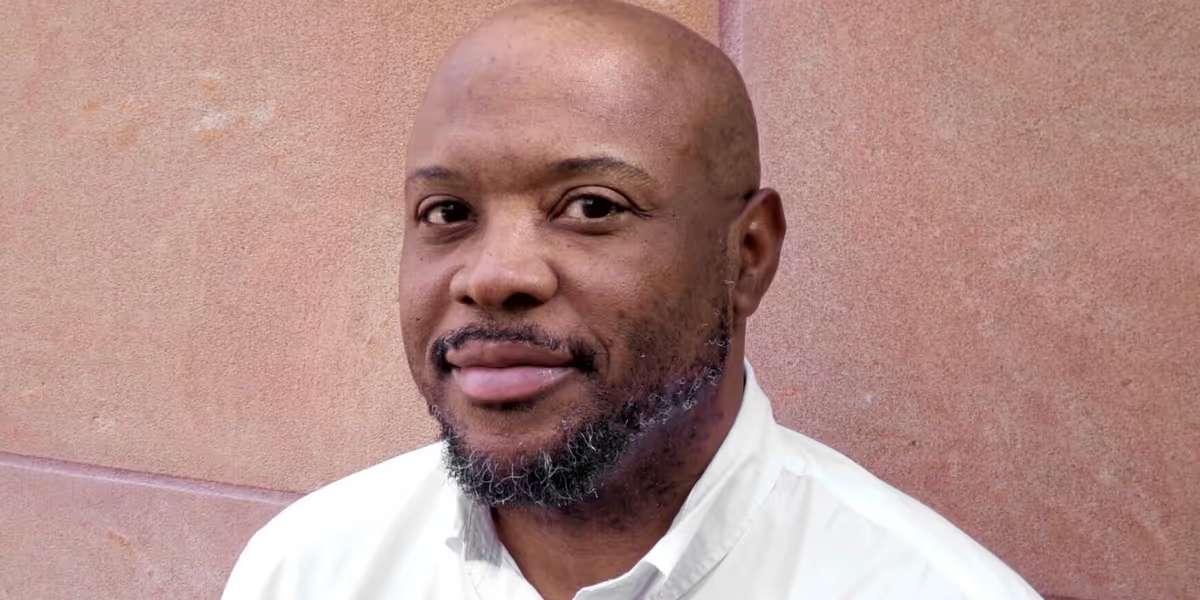
In the inaugural installment of The Next Act, a new BroadwayWorld series spotlighting the artists and creative leaders shaping the future of theater, I sat down with Idris Goodwin to talk storytelling, audiences, artistic leadership, Hip-Hop, young Black boys, and what American theater may need to remember before it can move forward.
Idris Goodwin is thinking about his next act.
Not because the playwright, poet, novelist, director, educator and arts leader is slowing down. Quite the opposite. As he approaches 50 and begins a new chapter as an Associate Professor of Dramatic Writing at Arizona State University, Goodwin is thinking deeply about where he wants to put his time, his knowledge and his stories.
“It is living an even more story-centered life,” he told me. “365, 24/7, story, telling story, community, story building, story architecture.”
For an artist whose career has never been interested in staying in one lane, this next chapter is not necessarily about choosing one. It is about recognizing the thing that has connected them all.
Story.
“I want to spend this next significant chapter of my life really assuming the role of master educator, master mentor,” Goodwin said, “but also devoting my skills, my intellect and my energy to carrying on this ancient and essential tradition of storytelling.”
Teaching, writing, mentoring, directing, leading. For Goodwin, they are not separate careers as much as different ways of doing the same work.
And somewhere in our conversation about Goodwin’s own next act, another question began to emerge.
What does the next act of American theater look like?
Goodwin has a particularly interesting vantage point because he has seen the industry from multiple sides.
Before he ever carried the title of artistic director or executive director, he understood something about artists that isn't always acknowledged.
“Every maker, every creative person, is their own CEO in a way,” he said. “You have to invest in the time, the space, the belief, and it is an investment.”
Moving into institutional leadership gave him a different view of what he calls “the business of story.”
Much of Goodwin’s leadership tenure unfolded during COVID. A time of national racial reckoning, social unrest, growing political hostility toward people of color, and an industry publicly questioning who held power and whether its institutions were actually willing to chal 0lnge.
Goodwin got a chance to look behind the curtain.
What he saw helped clarify where he did and did not want to spend his creative energy.
“I move quick. I’m very collaborative. I’m very open. I move swift and decisively,” he said. “I found that the wheels of the traditional nonprofit theater, even a TYA theater, just moved too glacially for me.”
His greatest impact, he realized, might not happen behind an institutional desk.
It might happen back where the thing itself was being made.
“I knew my place was basically in the rehearsal room, in the workshop, where we can move quick. We can move nimble. We can be in true dialogue as creative people and as makers.”
From there, Goodwin believes artists can find what he calls “the right soils” for their work to take root and grow.
What he saw behind the curtain also shaped how he thinks about the people sitting on the other side of it.
So I asked him: Does American theater have an audience problem?
I barely got the question out.
“Yes.”
Goodwin isn’t simply talking about ticket sales or getting audiences “back” after the pandemic. He is questioning how theater thinks about audiences in the first place.
“Theater does have an audience problem because we do a lot of, it’s very inside baseball,” he said.
And he’s right.
Theater people know theater language. We understand tech week. We understand why everyone disappears as opening night approaches. We understand the conversations we have convinced ourselves are urgent.
But everybody else has a life.
The show opens. People come. They see it. Maybe they like it. Maybe they don’t. And then, as Goodwin put it, “they move on with their lives.”
“A lot of times we’re doing theater for other theater people,” he said.
The industry has spent decades talking about audience development. That conversation eventually became intertwined with diversity and representation. Diversify the staff. Diversify the playwrights. Diversify the stories. Then, somehow, entirely new audiences will appear.
Goodwin pushes back on that assumption. The idea that programming a play by a Black playwright means the Black community will automatically show up ignores something fairly obvious: no community is a monolith. People have different tastes, different interests and, quite simply, different things competing for their time.
And while theaters are planning seasons, audiences are choosing from an entire world of entertainment.
Maybe, as Goodwin pointed out, Christopher Nolan just released a movie.
People know what that is.
They may not know the play that was a hit in another city last year.
So what do we do?
“We got to get in the streets.”
Goodwin comes from street promotion in Chicago, and having lived and studied in Chicago myself, I could hear that Chi-Town history in the way he talks about audiences.
“We’re unwilling sometimes to just listen, to really get into communities because we use this word community and audience, but what does that mean?”
For Goodwin, reaching audiences requires more than getting people through the doors. It requires understanding who those people actually are, listening to them, and remaining relevant to them.
“You have to find that middle ground and you have to constantly stay relevant,” he said. “I think it’s a humility problem. I think it’s a risk aversion problem.”
That distinction matters.
If the problem is simply marketing, theaters can buy more ads. If the problem is mentality, the solution requires something deeper.
Goodwin learned that lesson long before he was sitting behind an artistic director’s desk.
 He learned it from Hip-Hop.
During our conversation, Goodwin brought up KRS-One and a philosophy about what it means to be an MC.
“The people empower you to be an MC,” Goodwin said. “He said if you go on stage and the first thing you do is say, ‘Everybody throw your hands in the air,’ and they don’t, that’s on you.”
For Goodwin, you have to earn the audience first.
“You go out there and you give them your best rhyme. You give them your best stuff. And then once they’re feeling you, once you’ve established that relationship, then you can say, ‘Throw your hands in the air.’”
That philosophy became foundational to how Goodwin approaches his own work.
“I have to make sure that I’ve done my work and I can really engage people authentically, not just with what I write, but with my whole spirit, with what I am, with what I’m about, with my philosophies.”
The clothes, the production, the spectacle, all of it can add to the experience. But none of it can replace the relationship.
“I can have the flyest outfit on. I can have pyrotechnics, all of that, but that is secondary to, do I have an authentic relationship with this audience? Are they feeling me?”
Are they feeling me? That question stayed with me.
Theater spends a lot of time asking how to get audiences back. Maybe the more uncomfortable question is, have given them enough reason to return?
When I asked Goodwin what American theater needs to let go of in order to move forward, he didn’t offer another initiative, strategic plan or new industry model. Instead, he returned to the fundamentals.
“We need to return to Aristotle’s Poetics and what he talks about in terms of just the fundamentals,” he said. “What is it that human beings gathering in space need? We need catharsis. We need pathos. We need to get back to the people.”
Getting back to the people also means being clear about what business theater is actually in.
“Are you in the real estate business? Are you in the storytelling business? That is the central question,” Goodwin said. “Is theater the thing we do? Is it a verb? Are we doing theater or are we in a theater? Are we in the business of running a theater?”
Goodwin wasn’t just thinking theoretically about what a return to those fundamentals could look like. He pointed to artists already doing the work and creating models for what could come next.
One of those examples is MEXODUS, created and performed by Brian Quijada and Nygel D. Robinson.
“What they’re doing right now is electrifying,” he said.
Goodwin’s relationship with Quijada goes back to How We Got On, which appeared at the Humana Festival in 2012 and was one of Quijada’s early major professional productions.
More than a decade later, Goodwin sees what Quijada and Robinson have created together, two artists live-looping, scoring, acting and building an entire theatrical world, as a possible model for where the field can go.
“The show is clear, and they had theaters that supported them from the beginning that believed in what they were doing,” he said. “That play, to me, is what we should all be looking at as a model for the future.”
For Goodwin, MEXODUS isn’t about every future production needing two actors and live looping. It is about what can happen when artists are given the space to build, experiment and discover their own language together, with the infrastructure coming in to support the art rather than define it.
Goodwin’s vision for the future isn’t limited to institutions or the artists already in the room. Our conversation kept coming back to the young people still finding their way there.
And when you look across his work, there is one group of young people he keeps making space for: Black boys.
Goodwin’s vision for what comes next isn’t limited to audience engagement and how institutions support artists. You can’t speak about a next act without acknowledging the next generation and who gets to see themselves in the stories we tell.
For Goodwin, that has often meant making space for Black boys.
From How We Got On to his adaptation of Jason Reynolds’ Ghost to his own young adult novel King of the Neuro Verse, Goodwin repeatedly centers young Black boys whose gifts are not always immediately legible to the adults or systems surrounding them.
I asked what keeps bringing him back to young people.
“I’m trying to write the things that I needed and wanted and thinking about all the other Black boys out there,” he said.
For Goodwin, that responsibility became even more personal when he became a father.
“I was a relatively new dad, and I wanted my kids to come to work and see what I do, and I also wanted to have a real impact on the next generation, future generations.”
Goodwin grew up loving Marty McFly, Luke Skywalker, Han Solo. He remembers not seeing many Black boys reflected back at him. So in his own work, he has been intentional about expanding what Black boys get to imagine for themselves.
“I’m trying to go beyond just tragic tales,” he said. “I want to see us in science fiction. I want to see us in celebratory concert plays about Hip-Hop and coming of age. I want to see us in weird, supernatural pieces.”
Goodwin wants Black boys to have access to the same breadth of imagination he searched for as a kid, to see themselves not only surviving, but exploring, creating, tinkering and existing in worlds where their possibilities are expansive.
There can be tremendous pressure in this industry to become legible as one thing.
Playwright.
Director.
Producer.
Educator.
Pick the title. Build the brand. Make it easy for everybody else to understand what box to put you in.
Goodwin’s career has resisted that.
For multidisciplinary artists trying to figure out the scope of their own next act, Goodwin shared a simple piece of advice:
“Whatever you got to do, just don’t quit.”
He doesn’t romanticize what it takes to build an artistic life.
“It’s hard work,” he said. “It’s not easy, and it comes from a place and it has a cost and all of that.”
Still, he encourages artists to keep exploring.
“Stay curious, stay humble. Love it, love the craft of it, and just also see where there’s opportunities,” he said. “What stories aren’t being told? What are the things that you want to see that you think other people might also enjoy?”
Because an artistic career isn’t something you figure out once. It moves. It changes. There are seasons.
“It’s a process. It’s a journey, and you have ups and you have downs and seasons and chapters, and you just can’t, you got to just keep moving forward.”
And through all of those seasons, Goodwin returns to one thing.
“You gotta be in love with the process. You gotta just love the process.”
It feels fitting coming from Goodwin at this particular moment in his own life. He is approaching 50, returning to the classroom and stepping more intentionally into the role of educator and mentor. He is still writing, still creating and still exploring what else story can do.
His next act isn’t about abandoning all the things he has been or finally choosing one.
It is about going deeper into the thing that has always connected them.
Story.
Before we ended our conversation, I asked Goodwin the question I plan to ask every artist who sits with me for The Next Act.
Finish this sentence:
The next act of American theater will be...
“A committed return to the fundamentals of theatrical storytelling.”
By then, his answer felt like the place our entire conversation had been leading us.
Back to the people.
Back to artists having room to create and young people having room to imagine. Back to remembering that an audience doesn’t owe us its attention. We have to earn it.
Maybe getting to theater’s next act doesn’t require us to reinvent the whole thing.
Maybe we remember who we are telling stories for.
We get in the streets.
We listen.
We make something worth gathering for.
And then, if we’re lucky, like KRS-One said, maybe they’ll throw their hands in the air.
Photo Credit: Idris Goodwin
.jpg?format=auto&width=300)