


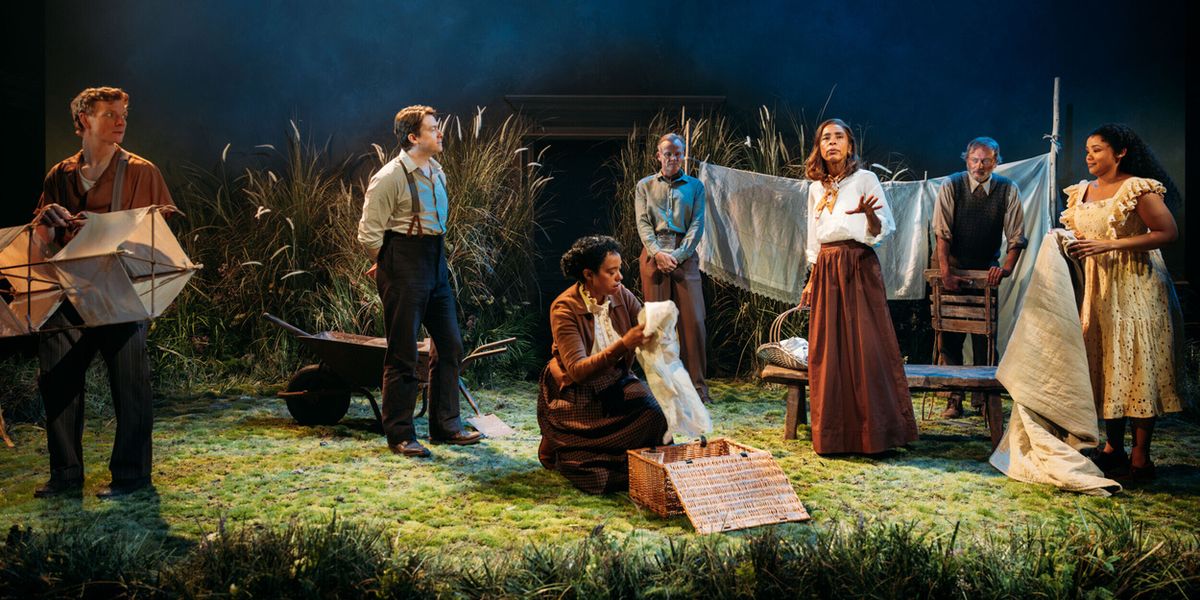

Natalya Petrovna has it all: a devoted husband, a gentle life, and enough wealth not to care about any of it. In spite of her long list of admirers and the silver tongue that goes with it, she’s bored. Everything changes when she hires Aleksey as her son’s tutor. Ennui, the potential of a young lover, and plenty of jealousy make Brian Friel’s take on Ivan Turgenev’s play the perfect end-of-summer treat. Friel succeeds in maintaining the classic idle nature of Russian drama, and Lyndsey Turner turns it into a delicious slow burn.
Sophie Okonedo leads a stunning cast, introducing an imperious Natalya. Her fiery disposition borders on disdain as she accepts her feelings with inflexible impassibility. Self-aware and hypercritical, she stirs the pot out of sheer boredom. Okonedo, much like her character, has a penchant for manipulating the scene in her favour, delivering a thoroughly remarkable performance. Once revealed, her emotional anguish takes over her whole being until order is restored and she goes back to being snooty and entitled.
%20Photo%20by%20Helen%20Murray.jpg?format=auto&width=800)
The men who orbit her aura embody a gradient of blind loyalty. Alistair Petrie’s melancholic Michel self-identifies as Natalya’s lapdog; her husband Arkady (an openhearted and emotive Thomas Arnold) breaks down in tears and flees at the thought of her infidelity. Her young suitor Aleksey (Patrick Gibson), on the other hand, receives a more complicated treatment. Gibson’s naivety is shifty; his Aleksey isn’t overtly into Natalya until she makes the first move, which sets off a bona fide entrancement for the “open, eager, energetic” 24-year-old.
The intensity of the romantic plots is efficiently balanced by the comic relief: Mark Hadfield’s semantic fumbles as Herr Schaaf are a funny twist, and Susan Brown rebukes them as a wise Anna. Daniel Rigby adds a whole other level as the doctor. He starts off as the jester of the family, dispensing bad jokes and lightening the mood steadily. Then, a sudden turn reveals a bitter man who despises the wealthy, but remains pragmatic about his position in the social ecosystem.
%20Photo%20by%20Helen%20Murray.jpg?format=auto&width=800)
The younger women in the cast begin as mere afterthoughts, but grow to become electric. Rachelle Diedericks is a girlish Vera, constantly fighting the childish role that Natalya assigns her and trying hard to break free from her shackling influence. Amanda Wilkin has somewhat of a similar journey, with her Lizaveta blending into her surroundings before she blooms into a firecracker lit by Rigby’s insincerity.
The mildness of the Russian summer translates into vibrant foliage (Leslie Travers) and warm lighting (Tim Lutkin). A glass box filled with greenery traps the characters in a terrarium, while vignettes animate the scene changes. Max Pappenheim’s soundscape comes in to support the tonal shifts, tightening the tension and emphasising emotionally relevant moments.
%20Photo%20by%20Helen%20Murray.jpg?format=auto&width=800)
It might not be a challenging play on the surface, but there’s a lot to unpack if one so wishes. There are easygoing reflections on romance, faithfulness, age, patriarchy, and family, all wrapped up by the sophisticated fabric of the class discourse.
The individual dynamics between Okonedo and the other actors prop up the narrative. While nothing extravagant happens, the appeal of the production is deeply rooted in the correlation between the writing and the performances. The rhythm is deliberately unhurried. Turner establishes a placid pace that’s surprisingly firm in the resolution of its trajectory. The result is a quiet, witty, and gently entertaining piece of theatre that leisurely examines the volatile passions of the upperclass.
A Month in the Country runs at The Donmar Warehouse until 3 October
Photo Credits: Helen Murray

Sign up for all the news on the Fall season, discounts & more...
|
Powered by

|







Reader Reviews
To post a comment, you must register and login.