


Previews: ASSASSINS at Out Of The Box At Center Stage
Out of the Box Presents This Overlooked Gem of a Sondheim Treasure
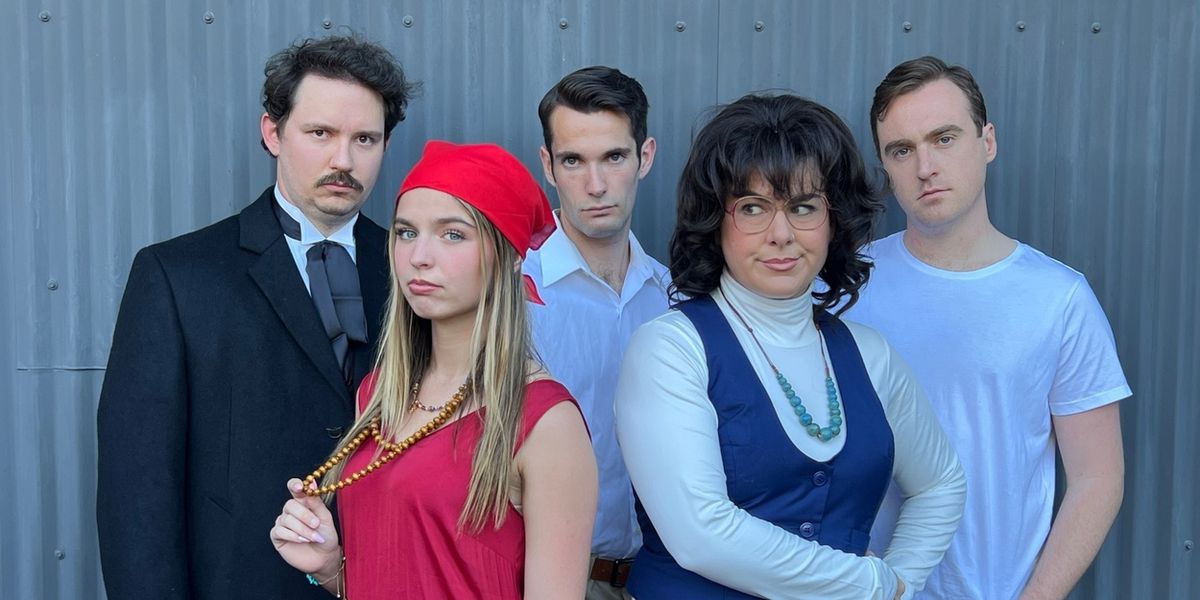
Out of the Box Theatre Company’s upcoming production of Stephen Sondheim’s “Assassins” opens at Center Stage this Friday night. Expect a rogue’s gallery of America’s presidential assassins (and try-hard assassins) who feel no remorse whatsoever for their crimes. And, in a way that only Stephen Sondheim’s musicals can finesse, it’s a comedy. It also shows the continuity and change of political violence in America.
The assassinations touched on by the story span a little more than one hundred years: from John Wilkes Booth's assassination of President Lincoln in 1865 to John Hinkley’s attempted murder of President Reagan in 1981. Cast members Leesa Beck, who plays Emma Goldman, and Brian Hoyson, as John Wilkes Booth, spoke with me about how Out of the Box is handling this tricky production, which has often been misunderstood as celebrating political violence.
Leesa Beck plays Russian-born anarchist Emma Goldman, who never actually pulled a trigger. She did, however, articulate an ideological framework around the righteousness of political extremism in the face of the brutality of industrial capitalism. In the unfolding of the action of the play, Goldman inspires Leon Czolgosz, President McKinley’s assassin, to take that extra step that all killers take from outrage to violence. Leesa Beck described the challenge of portraying a real person on stage: “There’s always a burden that goes along with playing an actual human being… You want to be true to that, but also true to the character as they’re written in the show.” Beck synthesized her reading of the play's Goldman with witness accounts of Goldman's speech and her presence to realize the role.
As President Lincoln's infamous assassin John Wilkes Booth, Brian Hoyson felt the pressure to fulfill the implicit contract he has with the audience to embody a Booth that they would recognize–the Booth that leapt from the stage of the Ford Theater, exclaiming, “Sic semper tyrannus!” Booth's theatricality personifies the yearning for fame and recognition that motivates assassins.
“I’ve never played a character who is real,” remarked Hoyson, “and who was an actor.” Hoyson worked with dialect coach Meredith McMinn to create a period‑ and class‑specific Southern accent to match Booth’s background and actor-training. All the while, he was trying to master Sondheim’s intricate score: “There are already so many technical things that we’re all doing just being on stage in a musical… making sure my diction is where it needs to be, and then adopting the southern accent… It’s definitely been a challenge.”
Realizing Booth’s disturbing inner life brought Hoyson other challenges. Booth believed in slavery, in white supremacy, and to our country's eternal loss, in the romance of the “lost cause” of the South. Hoyson stressed that “I hope no one who’s seeing the show agrees with Booth’s ideology,” while acknowledging that, stripped of context, some of Booth’s raw grievances can be identified in current mainstream political discourse.
Extremism has its appeal to a certain kind of desperate person. And each assassin portrayed in "Assassins" carries an inner wound or a grievance that has “caused them to feel the way that they feel, and to believe that this is the best way to deal with what they see as being wrong with the world and wrong with the United States,” as Leesa Beck said.
"Assassins" explores the lure of violence that constantly threatens to destroy the state, to undermine the will of the people by robbing it of its popularly elected leader. Assassinations represent the ultimate denial of a democratic state because they assert one person’s will over the population’s. As Hoyson describes: “All of the characters in the show are deeply wounded. The fork in the road… is that they end up choosing violence to solve their issues. And one that never works. But two, what a choice to make.”
What chilled Hoyson was that the show, written in 1990, seemed to predict an escalation in American violence: “This show debuted in 1990, which was almost a decade before Columbine… Back then, the assassinations in the show were political in nature. Now, so many shootings… have almost nothing to do with an ideology at all and solely are based on a grievance about someone being… disrespected or feeling like they’re entitled to something or someone. I think that’s really scary.”
Beck sees "Assassins" as an inquiry into that tipping point in history where we began seeing violence as a legitimate response: “We all have that in us somewhere… but there’s something that tips you at some point from being like a normal person going about your day who suffered some things, and somebody who chooses to go in this direction. And the musical is sort of investigating that line.”
Hoyson locates the show's appeal in its fantastic musical score combined with complex ideas: “I’ve never been part of a show that’s felt as timely and has also felt as challenging… If you are expecting to go into the show feeling uplifted by the end, I don’t know if that’s necessarily gonna happen, but I think great art is art that challenges you and really makes you think. And I think the show does an incredible job of doing that.”
For all its darkness, Beck underscored that "Assassins" is a comedy: “It’s a very dark comedy, but I think it tackles a difficult issue in an interesting and well‑rounded way… It’s a much more fun show than you would think from the title.” For theatergoers who don’t think of themselves as “musical people,” Beck offers an invitation: “My family’s not a musical theater family… [The show] looks a little scarier than it really is. I think people are really going to enjoy it.”
Love Theater in Santa Barbara? Join The Community!
Whether you've got past experience writing about theater or just starting, the BroadwayWorld Community offers a unique opportunity to become a champion for your local arts community, helping raise awareness of local offerings and adding another local voice to the conversation at a time arts coverage is shrinking in the press across the continent. Join us and become a pivotal part of the movement that celebrates and promotes the arts in the digital age.
Learn MoreWeekly top stories - unsubscribe anytime.
|
The Lehman Trilogy Rubicon Theatre Company (3/24-4/11) |
|
SIX (Boleyn Tour) Christopher Cohan Center (5/18-5/19) |
|
Gutenberg! The Musical! San Luis Obispo Repertory Theatre (10/09-11/08) |

|
Number the Stars San Luis Obispo Repertory Theatre (1/15-1/24) |

|
HUMOR & HARMONY: THE CANELLAKIS-BROWN DUO Hahn Hall (11/10-11/10) |
|
Ubu's Other Shoe Staged Reading: Incognito San Luis Obispo Repertory Theatre (3/19-3/20) |

|
Ubu's Other Shoe Staged Reading: Nickel & Dimed San Luis Obispo Repertory Theatre (4/23-4/24) |
|
Three Tall Women San Luis Obispo Repertory Theatre (5/07-5/23) |
|
Seminar San Luis Obispo Repertory Theatre (4/02-4/18) |

|
John & Jen Rubicon Theatre Company (2/10-2/28) |
