


Interview: David D'Lancy Wilson of DISNEY'S THE LION KING at Salle Wilfred Pelletier, Place Des Arts
THE LION KING takes the stage at Salle Wilfred-Pelletier, Places des Arts, 175 Rue Sainte-Catherine O, Montréal, QC H2X 1Y9 from August 19 - September 6, 2026.
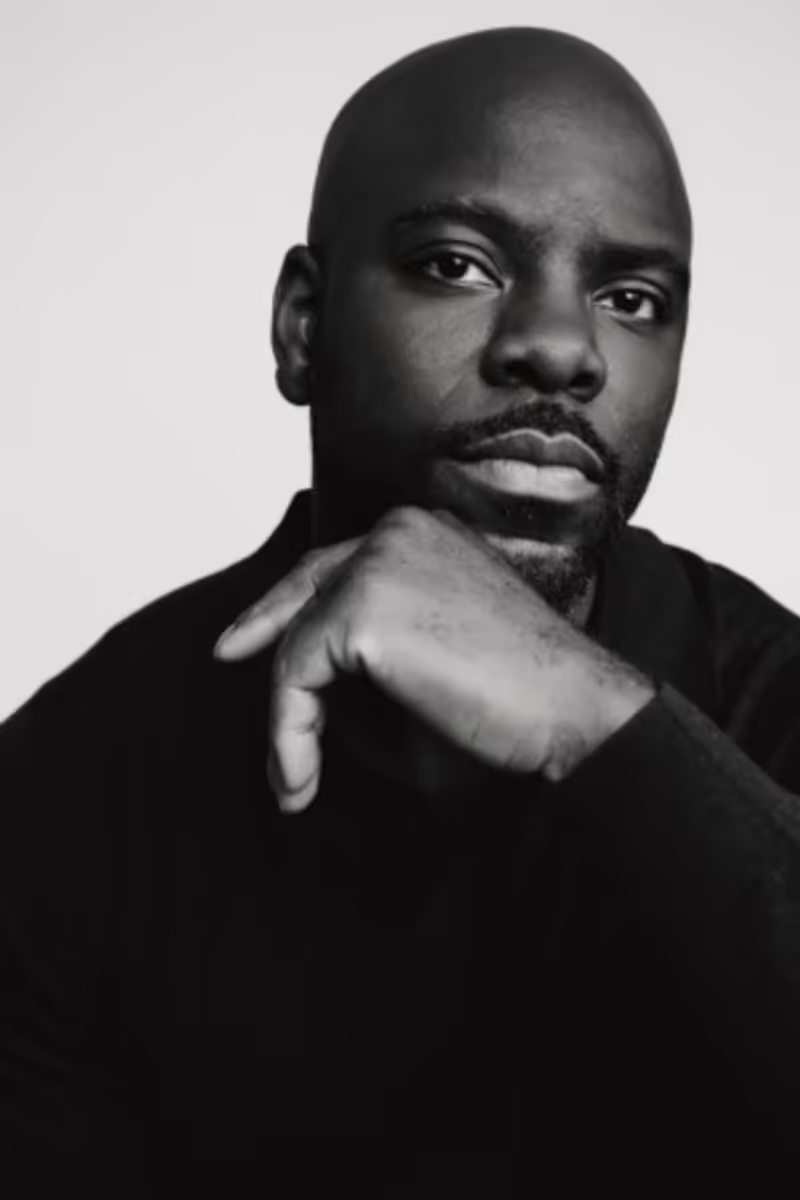
Canadian-born David D’Lancy Wilson is nearly one year into his run as Mufasa in THE LION KING. Next week, Pride Rock comes roaring into Montreal and Wilson is coming home to Canada. I had the opportunity to chat with Wilson about his life, career, and the experience of wearing the mask of one of musical theatre’s most iconic fathers. For Wilson, however, Mufasa is more than a king, warrior, husband and protector. At his core, he says, “he is just a parent trying to do right and best for their child.” As a father of two young boys himself, that perspective carries particular weight. THE LION KING takes the stage at Salle Wilfred-Pelletier, Places des Arts, 175 Rue Sainte-Catherine O, Montréal, QC H2X 1Y9 from August 19 - September 6, 2026.
Tell me a little bit about your journey into the arts.
I started as a child performer, overcome with crazy amount of stage fright. I was explaining to another child performer that I would often attach my wings to my identity, and my ability to sort of step out and do what I want to do. Unfortunately, that's the most unhealthy way to do it where there's no enjoyment and it just becomes about the audition and the nerves in the audition. So, I walked away from the arts or the industry and tried to focus on different things. I was also a pretty good athlete. So I sort of put all of my focus and my drive and desire into my school and my athletics and lo and behold, while I was in my first year at university, my... she's now my wife, but at that point, she was my friend...knew that I was sort of looking around and poking around in the arts. She encouraged me to audition for a play in which she was in. That was when I was 19 and years later, we're married and I am, you know, Mufasa in THE LION KING.
Turning to Mufasa a little bit, can you share some details about what your audition process was like for that?
We had received news that that THE LION KING was coming to Toronto and that they were looking to fill up slots. So I sent my agents a request and I was like, "Hey, you know, this is what I want to do. Do you think you could set it up?" And he was like, "David, can you sing?" I said, "yeah, man, like, it's all my resume," blah, blah, blah. But I guess, you know, I guess everybody sort of puts on their resume that they can sing! So thankfully, I had a demo of some of the some of the things that I had done in terms of singing...some songs and stuff on YouTube. I sent it over and he was like, "Oh, my goodness, I had no idea you were sitting on this talent!" Being raised in the church, singing is very second nature to me. From a praise and worship perspective, and sort of leading and singing background for different artists that would come into the city, it was sort of like a no brainer for me to be a part of this production. The audition process, I would like to say was smooth, but it certainly was not. My first couple of auditions going in, was was great. It was sort of like flying, you know, or sailing with the wind on my back, until it became real for me. It is a rigorous audition process. I think overall I did between five and six auditions, just to land the role. I think it was audition three when I
realized that I could actually get it. And at that point, I just started panicking. I was forgetting lines. It wasn't like I was unprepared, I was very prepared for it. I had messaged somebody who had played Nala on Broadway, as a Canadian actor. So I had the inside scoop as to what I needed to focus on. Then I had my acting coach, Marianna Phung, who was also with me every step of the way in preparation. So I was definitely prepared for it. But just, you know, as in, and I'm sure you know this too, as an artist, you you sort of just do things and you throw it away like, okay, yeah, we've done it. We've done everything that we can. We've controlled all of the tangibles that we could. We just sort of let it go and release it. And so
by the third audition, that's when I realized, as I said that, oh there's a chance that I could actually get this. Panic came in because it was like am I good enough for this? You know, a lot of the the self sabotaging thoughts creep up on you. Maya Angelou said that, "our greatest fear is not that we are inadequate, but we are more powerful than beyond measure." I've always felt a certain a certain calling to this role. Not just becaise I'm a performer or a singer, but also because I'm a father of two young boys. At that point in time, my wife was pregnant with my second. We were just sort of going through it, and really trying to figure it out. So like all of the things were like, okay, how am I going to do this as a newborn father, being a principal role? So all of those doubts started
creeping in during the audition. Needless to say, Anthony Lyn, who is our associate director, saw the panic and was like, "Okay, you know what, let's let's take five. David, take a second. Cover the notes, refresh yourself. We're gonna go do something else. When we come back, we want to see this audition." So, I took some time, I called my wife immediately. I was like, "Hey, man, I am messing up," Sometimes, all you need is just a few words of affirmation from your most staunch supporter to really just sort of get your mind right. One of the casting directors was gracious enough to run lines with me and also give me a little bit of a pep talk where he was like, "hey, you know, we've seen you do it twice before. You've got this." I walk back in and totally killed it. You know, Bob's your uncle, Becky's your aunt. Here we are. Two years later, not on the Toronto productio, because now that the Toronto production is closed. I sort of put my hand up and I was like "hey if there's an opportunity for me to play somewhere else I would love to because I don't think my time with Mufasa is finished." That's when I was given the opportunity to play Mufasa here on the Broadway tour.
I think it's really important that when we see things that we know we're right for, we do everything we possibly can to be seen for it. What pros and cons can are there to wearing a mask on stage,while singing and moving in a musical theater production?
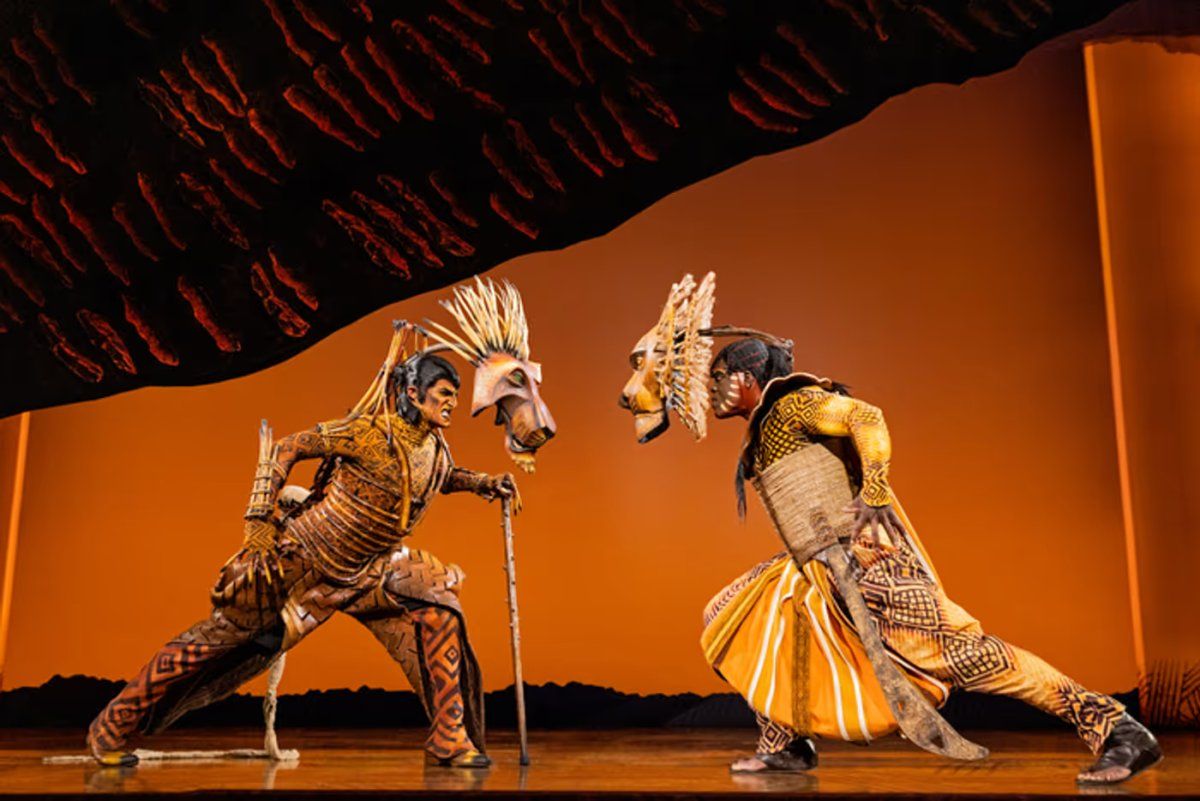
You know, I do like it. In terms of its design and its intricacy and how it was all conceived, is really amazing to me. There's a moment in the play where my mask comes down in front of me and immediately everybody understands oh that's like warrior mode versus when the mask is up on my head, where it acts as a crown. There's there's a tender moment where I'm really trying to connect with my son and I take the mask off completely. The mask acts as a extension of storytelling. We are able to have audience members connect and understand on a deeper level. When I put my crown down on the floor, as I said, to connect with my son about bravery and what it means to be connected and how he will never be alone. It's sort of like a truth that cannot be taken or taken away from, with all of the extra stuff. Mufasa is lion. Mufasa is king. Mufasa is father, he's husband, he's warrior, he's protector, he's X, Y, Z, X, Y, Z. But at the core of who he is, Mufasa is just a parent trying to do right and what's best for their child. I hope that parents watching it get to see that aspect through the mask, and what the mask can be and the messaging that it sends. Sorry, I'm just trying to think, wait, did I answer your question? You asked, what does it feel like wearing a mask? It's like an extra arm. It's almost like it becomes a part of you. Our mask is like super light. It's less than two pounds. I don't even really notice it except, when I walk through doorways. For the most part, it's relatively easy working and using the mask.
Being on such a long tour, how does it feel to come home to Canada?
It feels great. I'm so excited. I have family in Montreal. Those are folks that never got to see me in Toronto when I was there. On top of that, I mean, I am so loudly Canadian in my American company that like, know, it's one of those things where everybody's like, you know, “we're so excited to go to Montreal. Can you take us to different places?” I'm not that familiar with Montreal, but I'm making it my duty to ensure that we have some honorary Canadians in the cast, just because of the experience that I know that Montreal will give them.
Looking ahead, what are three dream roles?
Well, you know, I'm also a film and television actor. I would love to have an action film. Something where there's a lot of running! In theatre, I love HAMILTON and what they've done for theatre in terms of revitalizing it amongst non-theater. young non-theater audience members. I would love to be a part of that world. I would love to do an original Broadway production and be a part of that process, bringing it from the ground up. I had my eye on Miss Saigon at one point, or even Phantom. I think the main thing would be an original Broadway production. Something fresh that no one's seen before.
Is there anything else that you would like to add?
I'm really excited and I'm honored to come back to Canada, playing Mufasa. Just being in this role, I don't take that for granted. It's a huge honor to play a father, while being a father. It's a huge honor to my family. It's an ode to my journey through parenthood. But it's also an honor to my friends and my family in Montreal, to get to see me embody this larger than life character. I'm really excited and really looking forward to the Montreal audience and really, what Montreal brings.
Follow David D'Lancy Wilson on Instagram
DISNEY'S THE LION KING
When: August 19 - September 6, 2026
Where: Salle Wilfred-Pelletier, Places des Arts, 175 Rue Sainte-Catherine O, Montréal
Tickets are on sale at the Place des Arts box office
By phone 1.866.842.2112
Get yours online: placedesarts.com evenko.ca
PERFORMANCE SCHEDULE
August 19-22, 25-29, September 2-5 at 7:30 PM.
August 20-23, 29-30, September 4-6 at 1:00 PM
August 23 and 30 at 6:30 PM
THE LION KING has been touring North America for more than 24 years and, during that time, has playyed more than 10,000 performances in over 90 cities to more than 28 million theatergoers, making it North America’s longest-running and most-attended Broadway tour.
Approaching 30 landmark years on Broadway, THE LION KING continues ascendant as one of the most popular stage musicals of all time. Since its premiere on November 13, 1997, 32 global productions have been seen by over 130 million people. Produced by Disney Theatrical Group, under the direction of Andrew Flatt and Anne Quart, THE LION KING has made theatrical history with two productions worldwide running 20 or more years and three others running 25 or more years.
Performed over its lifetime in nine different languages (English, Japanese, German, Korean, French, Dutch, Spanish, Mandarin and Portuguese), there are currently nine productions of THE LION KING around the world: Broadway, London, Paris, Hamburg, Madrid, Tokyo, Mexico City and on tour across North America and Australia. THE LION KING has played over 100 cities in 24 countries on every continent except Antarctica. Its worldwide gross exceeds that of any film, Broadway show or other entertainment title in box office history.
THE LION KING won six 1998 Tony Awards®: Best Musical, Best Scenic Design (Richard Hudson), Best Costume Design (Julie Taymor), Best Lighting Design (Donald Holder), Best Choreography (Garth Fagan) and Best Direction of a Musical (Julie Taymor). THE LION KING has also earned more than 70 major arts awards including the 1998 NY Drama Critics Circle Award for Best Musical, the 1999 Grammy® for Best Musical Show Album, the 1999 Evening Standard Award for Theatrical Event of the Year and the 1999 Laurence Olivier Awards for Best Choreography and Best Costume Design.
Julie Taymor, who conceived and directed the production and is its Costume Designer and mask co-designer, was the first woman to win a Tony Award for Best Direction of a Musical. She remains actively involved in the show, launching new productions and maintaining the flagship Broadway production.
The Broadway score features Elton John and Tim Rice’s songs from THE LION KING animated film along with three new songs by John and Rice; additional music and lyrics by South African Lebo M, Mark Mancina, Jay Rifkin, Julie Taymor and Hans Zimmer; and music from “Rhythm of the Pride Lands,” an album inspired by the original music in the film, written by Lebo M, Mark Mancina and Hans Zimmer. The resulting sound of THE LION KING is a fusion of Western popular music and the distinctive sounds and rhythms of Africa, ranging from the Academy Award®-winning song “Can You Feel the Love Tonight” to Lebo M’s rich choral numbers.
Elton John, Lebo M and Hans Zimmer all collaborated on the 2019 version of the film, executive produced by Julie Taymor and Thomas Schumacher, which has gone onto extraordinary worldwide success.
The book has been adapted by Roger Allers, who co-directed the animated THE LION KING feature, and Irene Mecchi, who co-wrote the film’s screenplay. The stage production was originally produced by Peter Schneider and Thomas Schumacher. Other members of the creative team include: Michael Curry, who designed the masks and puppets with Taymor, Steve Canyon Kennedy (sound design), Michael Ward (hair and makeup design), David Kreppel and Sean Mayes (music supervisors), Anthony Lyn (associate director), Marey Griffith (associate choreographer), Lisa Dawn Cave (production supervisor), Michael Bolgar (general manager), Robert Elhai (associate music producer), Michael Keller (music coordinator), Robert Elhai and David Metzger (orchestrators), Rick Sordelet (fight director) and ARC/Mark Brandon, CSA (casting).
The North American touring production (launched in April 2002) uses 17 trucks to transport puppets, set pieces and other materials from city to city. 16 of the trucks are 53’ long semi-trailers.
The tour requires four days of on-site technical preparation and installation to set-up the physical production in each new city.
DISNEY’S THE LION KING NORTH AMERICAN TOUR FUN FACTS
Winner of more than 70 global theatrical awards including:
- 1998 Tony® - Best Musical
- 1998 Tony® - Best Direction of a Musical - Julie Taymor (making Taymor the first woman in theatrical history bestowed with the honor).
- 1998 Tony® - Best Scenic Design - Richard Hudson
- 1998 Tony® - Best Costume Design - Julie Taymor
- 1998 Tony® - Best Lighting Design - Donald Holder
- 1998 Tony® - Best Choreography - Garth Fagan
- 1998 NY Drama Critics Circle Award - Best Musical
- 1999 Grammy® - Best Musical Show Album
- 1999 Evening Standard Award - Theatrical Event of the Year
- 1999 Laurence Olivier Awards - Best Choreography and Best Costume Design
Masks & Puppets
- Tony® Award-winning director and designer Julie Taymor, along with designer Michael Curry, hand sculpted and painted every prototype mask that now appears in the iconic “Circle of Life” opening of the show. Their department of skilled mask makers, sculptors, puppeteers and artisans spent 17,000 hours to build the anthropomorphic animal characters for the original Broadway production.
- With the masks, Taymor created what she calls "the double event," which enables the audience to see the characters as animal and human at the same time.
- Mufasa’s mask weighs 11 ounces, Scar’s mask weighs seven ounces and Sarabi’s mask is just four ounces. The masks, along with many others used in the show, are extremely lightweight (just under one pound) and are comprised of silicone rubber (to form the mask imprint) with carbon fiber overlay - the same durable material used to build airplanes. Over 750 pounds of silicone rubber were used to make the masks.
- Scar and Mufasa each wear two different masks: one moves and one is a stationary headdress.
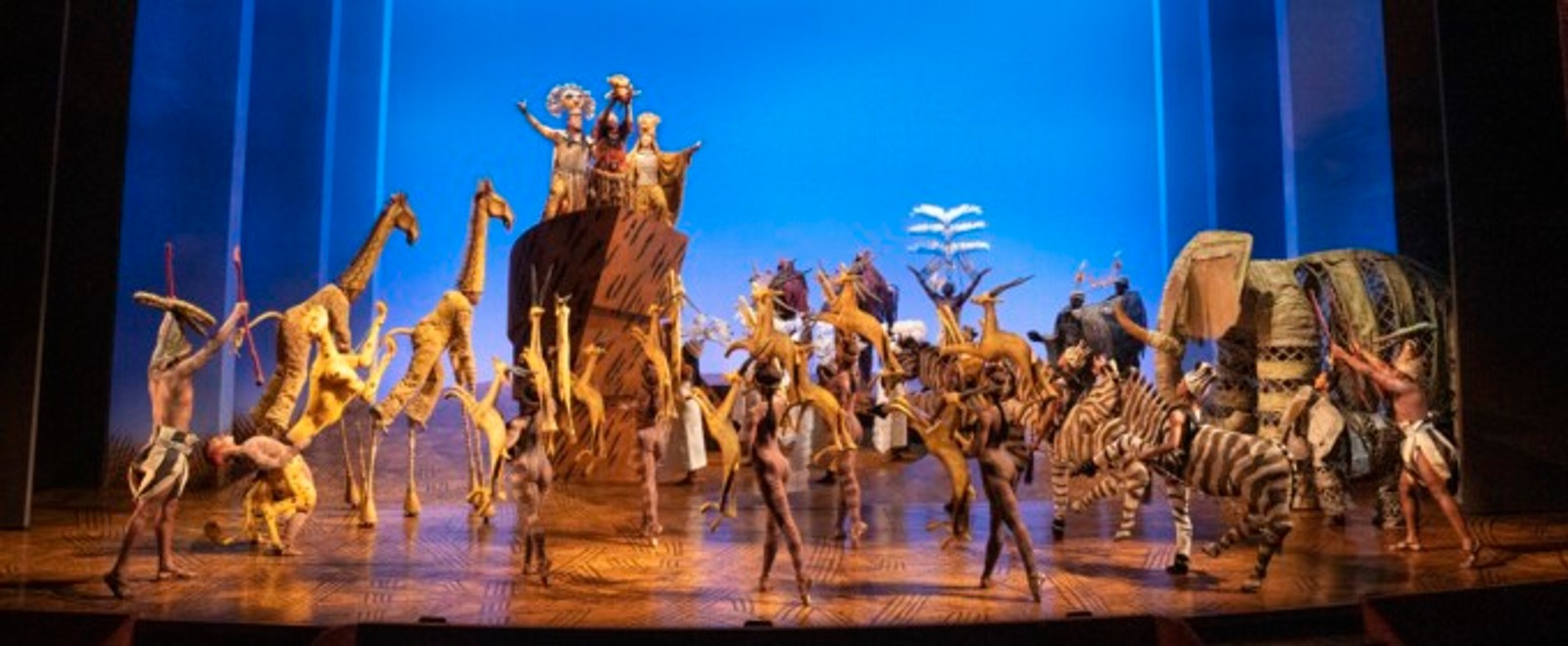
- The tallest animals in the show are the four, 18-foot exotic giraffes from “I Just Can’t Wait to Be King.” The two giraffes in “Circle of Life” are 14 feet high. Two actors trained in stilt-walking, climb 6-foot ladders to fit inside the puppets, mount stilts and enter stage left to cross the stage.
- The largest and longest animal in the show is the Elephant (nicknamed “Bertha” by the back stage crew when the show premiered in 1997). At 13 feet long, 12 feet high and 9 feet wide, the puppet requires four actors to carefully walk her down the orchestra aisle. When not occupied by the actors, the puppet can collapse down flat for convenient backstage storage.
- The smallest animal is the trick mouse at the end of Scar’s cane at just five inches.
- Zazu is the last animal to make his entrance on stage in the “Circle of Life” opening number.
- The Timon meerkat puppet weighs 15 pounds.
Costumes
- Worn like a backpack, the Pumbaa puppet is the heaviest costume, weighing in at 45 pounds.
- The yearly upkeep and maintenance of the 20 Grasslands headdresses requires over 3,000 stalks of grass (roughly 60 pounds).
- Every ensemble member plays a hyena.
- The Bird Lady and Bird Man costumes represent a flock of birds.
- There are just over 300 costume changes in the show.
MUSIC
- The tour travels with 12 musicians who play over 80 different musical instruments from all over the world. Among them are 55 different drums and percussion instruments as well as 13 flutes.
Pride Rock, Sets & Lighting
- The most complicated set piece is Pride Rock, which appears five times during each performance. On tour, Pride Rock is a wireless controlled, battery-powered set piece which expands out like an accordion to 18’ wide at its fullest position onstage and compresses to 8’ when it stores offstage in the wings.
- Lighting Designer Donald Holder used over 500 lighting instruments to create the show’s lighting plot.
- There are 573 lighting cues run during the show.
By the Numbers
- Puppets including rod puppets, shadow puppets and full-sized puppets: 200
- Number of cast members needed to bring those animals to life: 49
- Ants on the Ant-Hill Lady costume: 40
- Wigs: 45
- Wildebeests: 22
- Hyenas: 39
- Types of animals, birds, fish and insects represented in the show: 25
- Gazelles: 15, five actors each wear a gazelle puppet on both arms and one affixed to their head.
- Gazelles on the gazelle wheel prop: 6
- Lionesses: 14 (Nala, Young Nala and 12 ensemble in the ‘Lioness hunt’).
- Bird Kites: 12, featured in “One By One,” the opening number of Act II.
- Bird Ladies: 5
- Bird Man: 1, he appears in “Circle of Life” opening number and in the “Circle of Life” reprise in the final scene.
- Simba representations: 6 (Baby Simba puppet, Young Simba-actor, Young Simba puppet, Simba Shadow puppet, Rafiki’s Simba painting-Act I & II, Adult Simba-actor).
- Zebras: 3
- Crocodiles: 3
- Elephants: 2 (they are “Bertha” and the Baby Elephant who is operated by the child actresses alternating the role of Young Nala).
- Antelope: 2
(In the opening number, the low and high antelope are the first animals Rafiki calls out to in Swahili – the ‘NGONYAMA’ call & response choral chant. The antelope are portrayed by two South African male ensemble singers.)
- Rhinoceros: 1
- Cheetah: 1
- Other animals represented include guinea fowl, buzzards, fireflies, mice, ants and unspecified birds and fish.
Language
There are five indigenous African languages spoken in THE LION KING:
- Zulu
- Xhosa
- Sesotho
- Setswana
- Swahili
Worldwide Success
- THE LION KING stage musical worldwide gross is the highest of any in box office history (this is the musical’s ticket sales only, and does not include receipts from THE LION KING films, home entertainment sales, merchandise, record sales, or other ancillary streams). It exceeds:
- the gross of the top three movies of all time combined
- All 10 films of the J.K. Rowling's Wizarding World franchise combined; all 6 films of the Jurassic Park franchise combined; and all 10 films of The Fast and the Furious franchise combined.
Production Staff
- Worldwide, nearly 1100 people are directly employed by THE LION KING, including 20 whose sole mission is artistic upkeep of the show.
- Since THE LION KING'S Broadway premiere, nearly 250 South Africans have been employed in one or more of the global productions as lead actors, ensemble dancers/singers, musicians or members of the crew.
- THE LION KING'S Garth Fagan and Lebo M are Broadway's Longest-Running Black Choreographer and Composer.
On tour, there are 134 people directly involved with the daily production of the show:
- 49 cast members –six of whom are South African
- 19 wardrobe staff
- 15 carpenters
- 12 musicians
- 8 electricians
- 5 hair/make-up artists
- 4 props people
- 4 stage managers
- 4 sound people
- 3 puppet craftspeople
- 2 creative associates
- 2 company managers
- 2 merchandise associates
- 2 child guardians
- 1 physical therapist
For more information worldwide, visit LionKing.com, www.facebook.com/thelionkingusa and www.instagram.com/thelionking
Prefer BroadwayWorld in Google Search?
Add us as a preferred source so our stories show up more often in Top Stories and Google’s AI answers — for you.
Sign up for all the news on the Fall season, discounts & more...
|
The Secret Chord: A Leonard Cohen Experience Segal Centre for Performing Arts (10/05-10/25) |
|
Come From Away Segal Centre for Performing Arts (11/22-12/13) |

|
Lama: D''aventures en aventures Cabaret du Casino de Montreal (10/17-10/17) |
|
Doja Cat Centre Bell (11/27-11/27) |
|
La Florida Théâtre Manuvie (2/24-2/24) |
|
It's a Good Life If You Don't Weaken Segal Centre for Performing Arts (5/09-5/30) |
|
Jonathan Van Ness L'Olympia (10/24-10/24) |
|
Cathy Gauthier - Humaine L'Olympia (2/24-2/24) |
|
Mamma Mia! Place des Arts [Salle Wilfrid-Pelletier] (10/13-10/18) |
|
Ménopause, la parodie musicale Cabaret du Casino de Montreal (10/31-10/31) |
