


REVIEW: The Festival d'Avignon Presents UN PROCÈS By Christiane Jatahy and Wagner Moura
If only the real world were so accommodating.
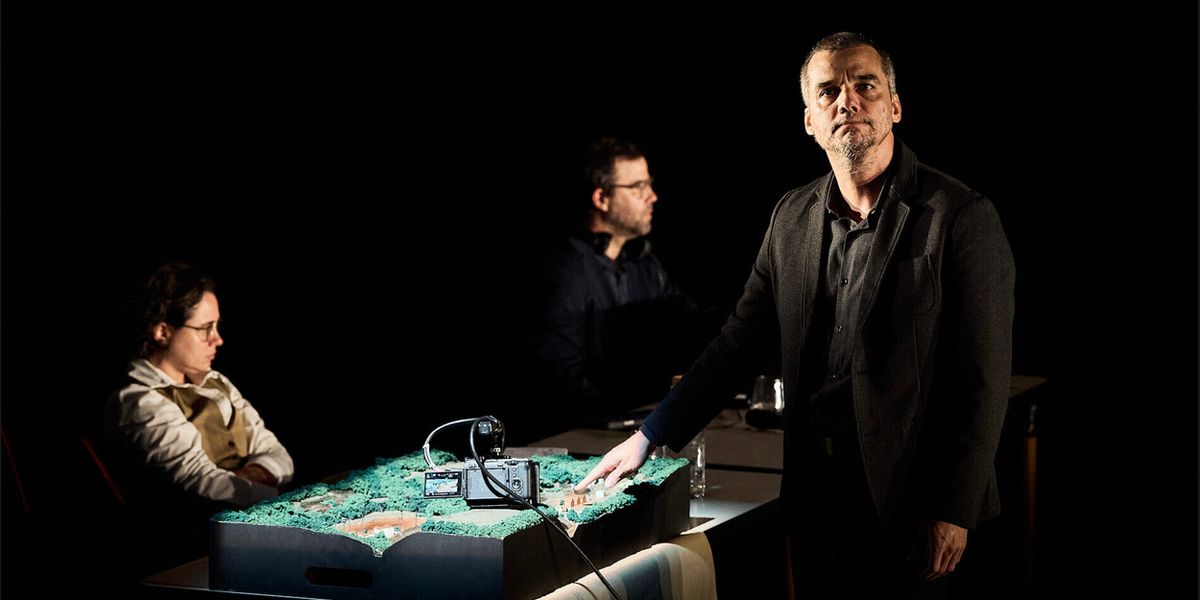
In Christiane Jatahy and Wagner Moura's Un Procès Après l'Ennemi du Peuple, now performing at the Festival d'Avignon's Gymnase du Lycée Aubanel, Thomas Stockmann finally gets his day in court. Reimagining the events of Ibsen's An Enemy of the People in contemporary Brazil, the production transforms the drama into a modern courtroom trial. The question before the court is simple: Is Thomas Stockmann an enemy of the people? On stage right sit Thomas and his daughter Petra. On stage left is his older brother Robert, arguing for the prosecution. Upstage, eleven audience members, selected at random at the start of the performance, serve as the jury that will determine Thomas's fate. The result is a gripping piece of meta-theatre that harnesses the rhythms of a courtroom drama to reconsider Ibsen's enduring questions about the cost of speaking inconvenient truths.
In Ibsen's original play, Dr. Thomas Stockmann discovers that the town's lucrative spa is contaminated with toxic chemicals. When he reveals his findings, the town turns against him, fearing the economic consequences. His brother Robert, who oversees the spa, leads the campaign to discredit both Thomas and his research. Branded "an enemy of the people," Thomas is ostracized alongside his family. Jatahy and Moura's production begins where Ibsen leaves off. Thomas has been driven from town, his wife is dead (possibly by suicide), and his children now live with their grandfather. His life destroyed by his commitment to the truth, Thomas and Petra bring his case before the court.
The production closely follows the mechanics of a criminal trial. Jurors question the witnesses, with the actors improvising their responses in real time. Evidence is introduced, witnesses testify both in person and over Zoom, opposing counsel present their arguments, and, ultimately, the jury delivers its verdict. This procedural framework is interwoven with carefully staged dramatic scenes. The brothers erupt into a violent fistfight. Petra breaks down while watching footage of her mother pushed to the brink of despair. Thomas delivers impassioned speeches defending the necessity of truth in the face of overwhelming opposition. Yet it is the improvised exchanges that free the production from the conventions of courtroom melodrama. Aware of their own role within the performance, audience members respond vocally, cheering Thomas's pleas and booing Robert with the enthusiasm reserved for a pantomime villain.
As Petra, Julia Bernat serves both as translator (rendering Thomas's improvised English into French) and as the emotional heart of the production. She embodies the moral conviction inherited from her father while revealing its profound personal cost. As Robert, Danilo Grangheia offers a measured and dignified counterweight to Thomas's idealism. Though the audience quickly casts him as the antagonist, Grangheia quietly grounds the character in practical concerns rather than simple villainy. Other members of the ensemble operate the sound, lighting, and surtitles from either side of the stage while occasionally stepping into the action through improvised exchanges, further blurring the line between theatrical production and courtroom reality. It is Wagner Moura's commanding performance as Thomas, however, that gives the evening its emotional force. Through his eyes, we experience each piece of evidence and every testimony that may determine both his legal fate and his moral legacy. In one particularly devastating sequence, Robert presents a secretly recorded video, filmed by Thomas's estranged son, depicting an argument between Thomas and his late wife. The uncomfortable act of voyeurism culminates in Thomas embracing his devastated daughter.
Ultimately, there is little suspense surrounding the verdict itself. The votes are counted: two guilty, nine not guilty. While the audience cannot help wondering about the two dissenting jurors, neither Ibsen's play nor this sequel truly invites us to question Thomas's moral position. His story is presented not as an ethical dilemma but as a social one. Thomas is undoubtedly flawed, but the production argues that his commitment to truth remains worthy of admiration. As a coda to Ibsen's classic, Un Procès Après l'Ennemi du Peuple offers a satisfying sense of closure. Thomas Stockmann is finally declared not an enemy of the people. A historical injustice has, at least theatrically, been corrected. If only the real world were so accommodating.
Photo Credit: Christophe Raynaud de Lage
Prefer BroadwayWorld in Google Search?
Add us as a preferred source so our stories show up more often in Top Stories and Google’s AI answers — for you.
Recevez l'actualité de Broadway sur WhatsApp
Recevez les dernières mises à jour, les nouvelles de dernière minute et une couverture exclusive directement dans l’application.

Sign up for all the news on the Fall season, discounts & more...
|
OH LES BEAUX JOURS THEATRE DES BOUFFES PARISIENS (9/23-11/01) |
|
|
RENVERSANTE THEATRE DES MATHURINS (9/15-12/15) |
|
LES PEINTRES AU CHARBON RADIANT - BELLEVUE (11/21-11/21) |
|
|
DU CHAOS NAISSENT LES REVES APOLLO THEATRE (12/09-12/09) |
|
|
LE PROCES D''UNE VIE RADIANT - BELLEVUE (3/16-3/16) |
|
|
HISTOIRES DE CREVETTES TH DU ROND POINT-SALLE RENAUD BARRAULT (9/18-9/27) |
|
|
LE GUIDE DU PARFAIT GENTLEMAN ASSASSIN THEATRE DU PALAIS ROYAL (8/22-10/17) |

|
LE JOURNAL D''EDOUARD BAER RADIANT - BELLEVUE (1/27-1/27) |
|
|
SAMUEL CERTENAIS THEATRE DES MATHURINS (9/18-11/27) |
|
|
RADIO LIVE : LE JOUR D''APRES TH DU ROND POINT-SALLE RENAUD BARRAULT (5/27-5/29) |
