


Review: FDR'S VERY HAPPY HOUR at High Hard Heat At The Studio Loft At Ellie Caulkins Opera House
A warm invitation to connect with strangers offers welcome respite from a world whose problems demand more than kindness.
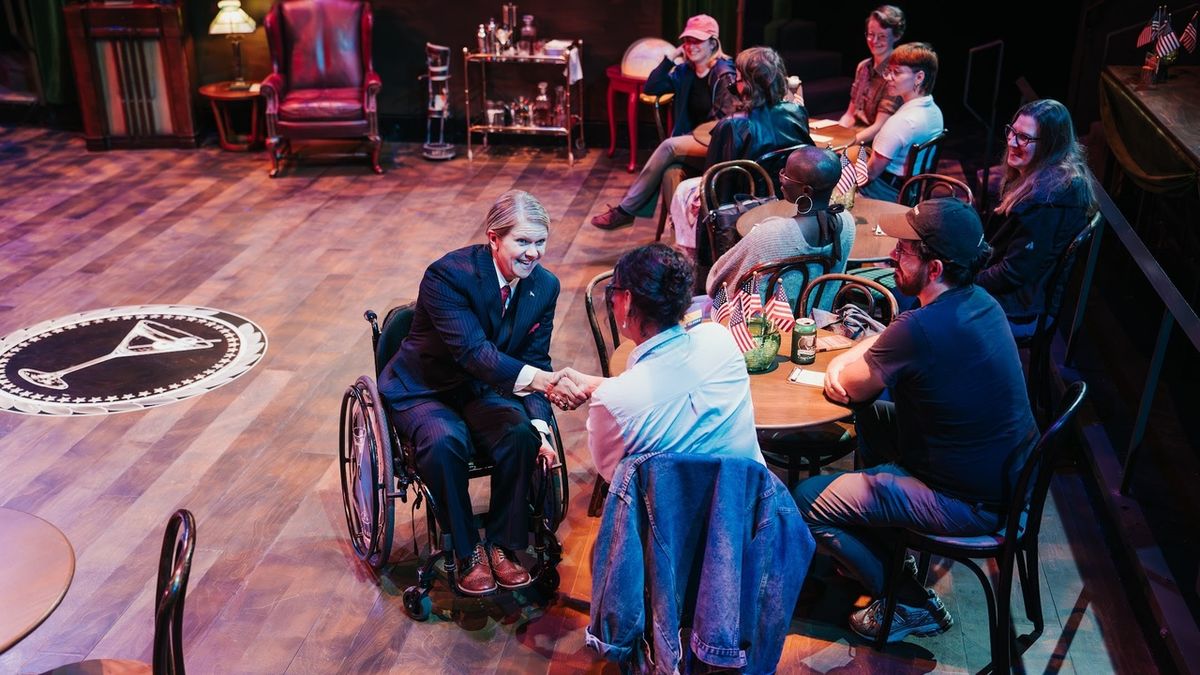
FDR's Very Happy Hour is an opportunity for a very talented actor, Regan Linton, to pry the phones from our clammy hands and eyes from their blue-light screens and encourage us to engage with one another for a brief moment. It's an invitation to celebrate people who make a difference in their communities and imagine ourselves as potential changemakers. Most of all, it's an attempt at hope in a time when we're divided and the world seems to be crumbling around us.
Written by Linton and directed by M. Graham Smith, the production brings Franklin Delano Roosevelt back from the great beyond to host a happy hour inspired by the gatherings he held at the White House. There are drinks, historical anecdotes, games and opportunities to interact with fellow audience members. Alexandria Wailes joins Linton in a variety of supporting roles, including Eleanor Roosevelt, James Madison and Smokey Bear.
The evening is at its strongest when it turns to the history of disability, particularly Roosevelt's own experience. Linton, herself a wheelchair user, describes the horrifyingly uncomfortable leg braces FDR wore and the adaptations he made to navigate spaces that weren't designed for him. His ingenious use of ramps, essentially redesigning the entrances to venues so that he could move through them, is fascinating. A discussion of his canes was among my favorite moments of the evening, and I'll leave its particulars for audiences to discover.
That attention to the practical realities of disability extends to the production itself. FDR's Very Happy Hour is unusually attentive to the needs of disabled performers and audiences. ASL interpreters are present at every performance, the seating is comfortable and accessible, and audience members are repeatedly encouraged to move, fidget, step out or otherwise take care of themselves without apology. Linton and Wailes, a Deaf performer, occupy a theatrical space that has been designed with their participation in mind rather than retrofitted to accommodate them.
It's a welcome example of what happens when accessibility is treated as a foundational artistic principle rather than an afterthought.
The discussion of Japanese American incarceration is less convincing. The production uses Roosevelt's role in this injustice to explore the contradictions of even our most celebrated historical figures. We shouldn't simply "cancel" FDR, it argues, but recognize that people are capable of both great accomplishments and terrible mistakes. Fair enough. But the sequence is accompanied by ominous music, as though the horror of mass incarceration requires a soundtrack. The production makes a theatrical display of the tragedy, but its real interest lies in what the event reveals about FDR rather than what it meant for the people who were incarcerated. There's nothing necessarily wrong with that approach in a show about Roosevelt, but the solemnity feels a little unearned.
The evening also celebrates people who are already making a difference in their communities. At each performance, FDR interviews a local "Changemaker" about their work. At mine, it was Karen Kellen, a board member of Metro West Housing Solutions. Linton is an affable, adaptable interviewer, giving her guest an opportunity to discuss their work, engage in a little hopeful free association and even pose questions to the former president. There's something genuinely heartening about giving ordinary people doing good work this kind of attention. It's a reminder that, for all the reasons to despair, there are people out there making things better.
But FDR's Very Happy Hour isn't content to simply celebrate the community that already exists. It also wants to create community among the strangers gathered in the theatre, using a series of games and activities to bring them together.
Some of these invitations are perfectly pleasant. A toast, a wave of a flag, a few enthusiastic cheers: simple moments of collective activity that give the room a welcome sense of occasion. But other exercises, including an invitation to write down personal accomplishments and share them with strangers, feel uncomfortably like a leadership seminar.
Linton is skilled at speaking directly to an audience, putting people at ease and drawing them into conversation. But there's a difference between encouraging participation and asking people to make themselves vulnerable. Some of the evening's activities ask participants to perform openness and optimism before they've had much opportunity to feel either. We're told to take a deep breath and exclaim, "The only thing to fear is fear itself." The result, however, is more false smiles than genuine connection. Building community among strangers in 100 minutes is probably impossible, barring the occasional case of love at first sight. And the evening's "grin and bare it" soul-sharing may leave audiences more socially exhausted than refreshed.
That disconnect between good intentions and meaningful action becomes particularly apparent in a sequence featuring Smokey Bear.
FDR proudly recounts having planted two billion trees and invites Smokey to celebrate the accomplishment. But Smokey isn't in a celebratory mood. Climate change has left the bear despondent, a condition illustrated by a projection of the entire globe consumed in flames.
Not to worry. FDR has a solution.
It's the small acts that make a difference! Someone waters a flower. Someone gives Smokey a hug. We all sing "This Land Is Your Land." Together, we can change the world!
Against the reality of climate change, which is no longer some distant threat but part of our common lived experience, watering a flower and hugging a bear seem like rather modest contributions to preventing planetary collapse. Clearly, these gestures are meant to be symbolic. But symbols ought to stand for something. Watering a flower won't stop climate change. What individual action might? I was reminded of the old "Duck and Cover" films, in which children were instructed to crouch beneath their desks in the event of a nuclear attack. Perhaps doing something small will make us feel better about ourselves as the world vaporizes around us.
Perhaps that's the fundamental difficulty with FDR's Very Happy Hour. The production is built on the optimistic belief that connecting with one another can help heal a fractured country. It creates a welcoming little playground in which strangers can practice that connection, with Linton serving as an exceptionally capable host.
But I wonder how Roosevelt himself would fare in today's political climate. This was a president who asked the press nicely not to photograph him in his wheelchair. How would that request fare against today’s bloodthirsty internet?
There's something lovely about the show's faith in human decency, and certainly no harm in spending an evening being kind to strangers. But the problems facing our country aren't simply the result of people failing to be nice to one another. They're bigger, more complicated and more entrenched than that. Even genuine connection, valuable as it may be, isn't necessarily enough.
The optimism of the 1940s is a lovely place to visit. Like a dip in one of FDR's therapeutic hot springs, FDR's Very Happy Hour offers a welcome respite from the harshness of the world outside. But eventually we have to climb out of the water. And the world is still on fire.
Sign up for all the news on the Fall season, discounts & more...
|
Stranger Sings The Storyteller Theater (10/31-11/14) |

|
Colorado Jazz Repertory Orchestra Presents Jazz de Paris Dazzle (10/25-10/25) |
|
CMF & CMA Concert Series: Violinist Bade Dastan & Pianist Mark Livshits Center for Musical Arts (11/13-11/13) |

|
The Secret Comedy of Women Garner Galleria Theatre (4/21-5/16) PHOTOS |
|
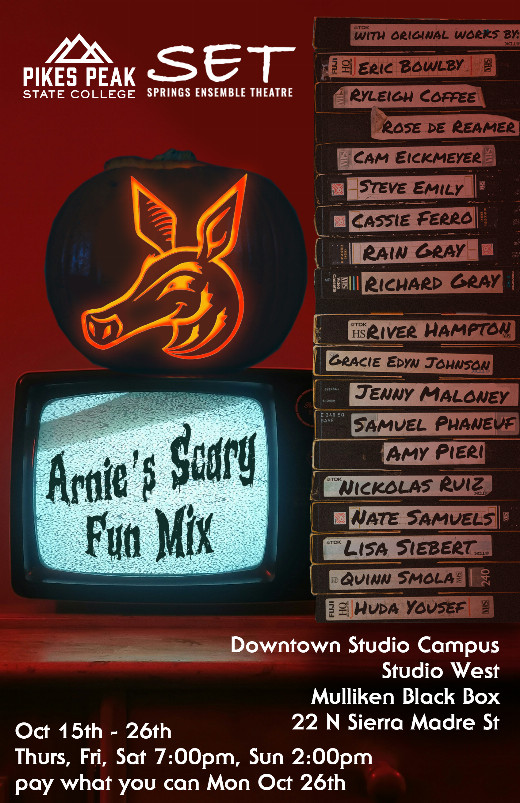
Arnie's Scary Fun Mix Pikes Peak State College Downtown Campus - Studio West (10/15-10/26) |
|
Riverdance 30 – The New Generation Buell Theatre (3/23-3/27) PHOTOS |
|
The Lakewood Cultural Center Presents Quarteto Nuevo Lakewood Cultural Center (10/24-10/24) |
|
BOOP! The Betty Boop Musical Buell Theatre (3/09-3/21) PHOTOS |
|
Feeding Beatrice Aurora Fox Arts Center (10/02-11/01) |
|
Maybe Happy Ending Buell Theatre (8/18-8/29) PHOTOS |

Reader Reviews
To post a comment, you must register and login.