


Review: ENGLISH at Denver Center For The Performing Arts
Theatricality creates space for understanding bicultural experiences
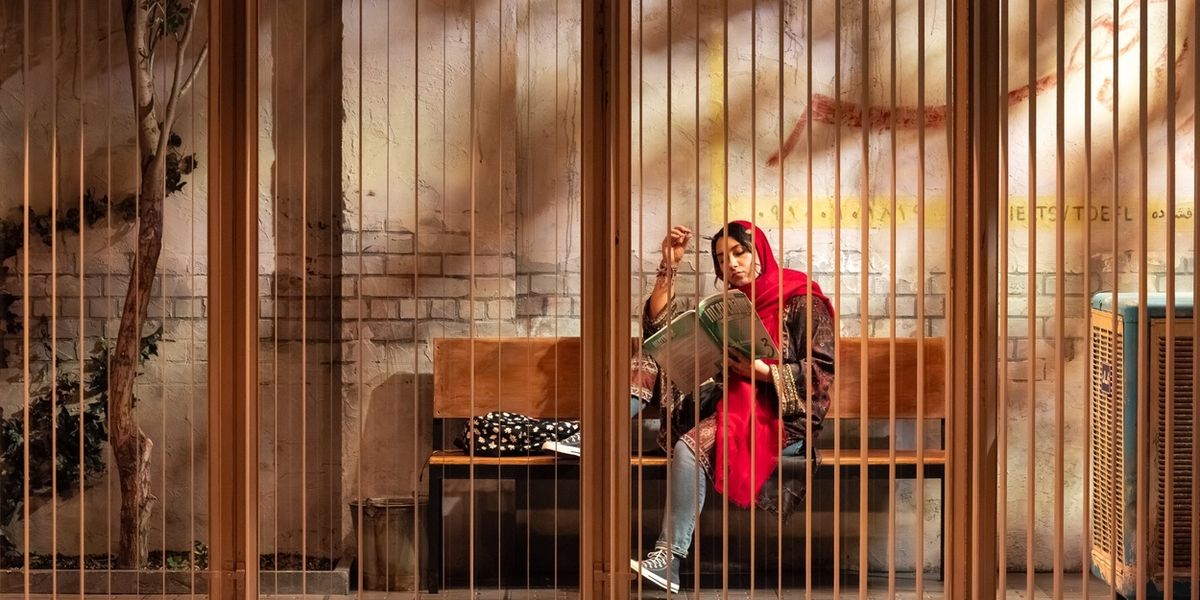
Elham, playwright Sanaz Toossi’s brilliant character played by an equally brilliant Vanah Assadourian, frustratedly exclaims in a tongue unfamiliar to her mouth, “I want everyone to know I am not an idiot and also I am nice.” English, produced by the Denver Center for the Performing Arts, captures the day-to-day drama of living your identity in an unfamiliar language. Set in an adult language learning classroom in Iran, Toossi’s clever theatrical device of using Persian-accented and non-accented English allows audiences to understand characters in both their native Farsi and English. This lets an audience not only literally understand characters across language and culture, but to understand how culture and personality shift in a new linguistic landscape. Executed with precision by the Denver Center’s team, the device opens a window onto an experience that may feel opaque to monolingual audiences, revealing just how difficult the process of learning a language is while offering bilingual and bicultural viewers the rare experience of recognition.
The success of the production’s central device rests on the precision of its dialect work (a remarkable achievement from voice and dialect coach Vaneh Assadourian), and here the directors and performers excel. Rather than treating accent as a broad marker, the production places its characters along a clear spectrum of fluency and control. On one end, Elham and Roya (the latter played with devastating appeal by Lanna Joffrey) speak with thick accents that are openly ridiculed by their classmates, their effort audible in every line. On the other, Omid (played with easy charisma by Nima Rakhshanifar) speaks with an ease that renders his accent nearly imperceptible (so subtle, in fact, that it occasionally complicates the production’s linguistic shifts), defining his position as top student in the class. Between them sits Marjan (a dynamic Roxanna Hope Radja), striving toward that same fluency, her accent fading in and out depending on her ability to maintain control. The actors’ ability to move across this spectrum with such speed and clarity is a technical feat in itself; that these shifts so clearly delineate character and status elevates the work further. Here, dialect is not a broad gesture, but a surgical instrument.
Another precise, elegant element of the production is Omid Akbari’s magnificent set. For the first forty minutes of the play, the set was dominated by the “English Only” classroom lorded over by the dry-erase marker–wielding, power-tripping Marjan. When, in the back half of the play, blinds and windows were opened revealing a brightly lit exterior courtyard, complete with a tree and Farsi scrawl, the audience feels the relief of the world opening up. Before the blinds opened, the audience didn’t see how much of the world was being left out of Marjan’s classroom, but revealing the courtyard allows a breath of fresh air. The set was also composed partially of fully transparent, and partially of frosted glass windows – this allowed the director (Hamid Dehghani – a master of bold and effective choices) to paint his scenes like classic artworks, with beautifully dressed characters (Afsaneh Aayani’s excellently calibrated costumes) centered through the transparent openings and others half obscured by panes of semi-opaque glass. The effect was strikingly beautiful.
English’s five characters are brought to life through both the depth of Toossi’s writing and the nuanced performances of the cast, each revealing a distinct relationship to language and identity. Lanna Joffrey will bring you to tears as Roya, her portrayal warm, steadfast, and quietly revolutionary. I’d fight anyone who tried to malign the youthful Goli, brought into sweetness and sharp observational wit by the lovely Shadee Vossoughi, whose optimism feels hard-won rather than naïve. Nima Rakhshanifar’s Omid could easily veer into villainy in the back half of the play, but his performance complicates that reading, rendering his cruelty toward his classmates sympathetic, grounded in a drive for belonging. Elham, played by Vaneh Assadourian, is a girl after my own heart—competitive, cynical, sarcastic, and deeply driven. Assadourian’s performance shows Elham’s rudeness (at one point Roya points out, “In English, you won’t have any redeeming qualities”) while always backing up her rude remarks with a relentless intelligent spirit and deep sensitivity.
Roxanna Hope Radja’s leading lady, Marjan, embodies a troubling relationship to language. Her devotion to English and Western culture borders on the romantic, and her attempts at fluency often read as a quiet disavowal of her own culture. She also appears as the voice of experience to her students. Her description of her immigration experience shows the risk that each of her students are about to undergo, “You go years without making anyone laugh. No one has any idea that you were top of your class. Or that you’re adventurous or optimistic or that you’re kind. Really kind. How long can you live in isolation from yourself?” To survive in an English-speaking world, Marjan had to create a Western version of herself she now much grieves the loss of in Iran. Hope Radja’s doesn’t back away from the dissonances within Marjan even when it risks making the character unlikable. This is a form of bravery, to show Marjan as often unsympathetic, but always deeply human.
In the program’s dramaturgical note, director Hamid Dehghani frames the act of staging English as a political one: an insistence on the humanity of Iranian people at a moment when that humanity is flattened, ignored, and threatened. That impulse resonates deeply here, not because the production makes an overt argument, but because it refuses simplification at every turn. Through its precise use of language, performance, and design, English invites its audience, whether encountering this experience for the first time or recognizing themselves within it, to sit with the complexity of identity across cultures. It does not resolve that complexity. Instead, it makes space for it, opening outward into something fuller, more human, and more difficult to dismiss.
Sign up for all the news on the Fall season, discounts & more...
|
Plot/Twist: A Show About Narrative Rise Comedy (2/06-2/05) |
|
Hadestown Buell Theatre (6/08-6/13) |
|
Cirque Kalabanté: WOW (World of Words) PACE Center (2/21-2/21) |

|
MAMMA MIA! Buell Theatre (5/11-5/16) PHOTOS |
|
Venus in Fur The Other Road Theater Project (12/04-12/12) |
|
Once Wolf Theatre (4/02-5/02) PHOTOS |

|
Five 5ths: Beetlejuice Band of Toughs: A Theatre Collaboratory (10/28-10/28) |
|
The Outsiders at Temple Hoyne Buell Theatre Temple Hoyne Buell Theatre (9/08-9/27) |
|
Violinist Bade Dastan & Pianist Mark Livshits at Center for Musical Arts Center for Musical Arts (11/13-11/13) |

|
Hank Williams: Lost Highway Aurora Fox Arts Center (12/04-1/03) |

Reader Reviews
To post a comment, you must register and login.